


























Views
Downloads

Printable Materials We Use Worksheet | Grade 1 Science
Paste this activity's link or code into your existing LMS (Google Classroom, Canvas, Teams, Schoology, Moodle, etc.).
Students can open and work on the activity right away, with no student login required.
You'll still be able to track student progress and results from your teacher account.
This Grade 1 science worksheet helps students identify and categorize common materials found in their everyday environment. By distinguishing between metal, wood, and plastic, children build essential observation skills required for physical science mastery. The activity combines handwriting practice with critical thinking to ensure students can accurately name and recognize the properties of various objects.
At a Glance
- Grade: Grade 1 · Subject: Science
- Standard:
2-PS1-1— Classify different kinds of materials by their observable properties like color and sound- Skill Focus: Material Classification (Metal, Wood, Plastic)
- Format: 1 page · 11 problems · Answer key included · PDF
- Best For: Introductory material properties lesson and science classification practice
- Time: 10–15 minutes
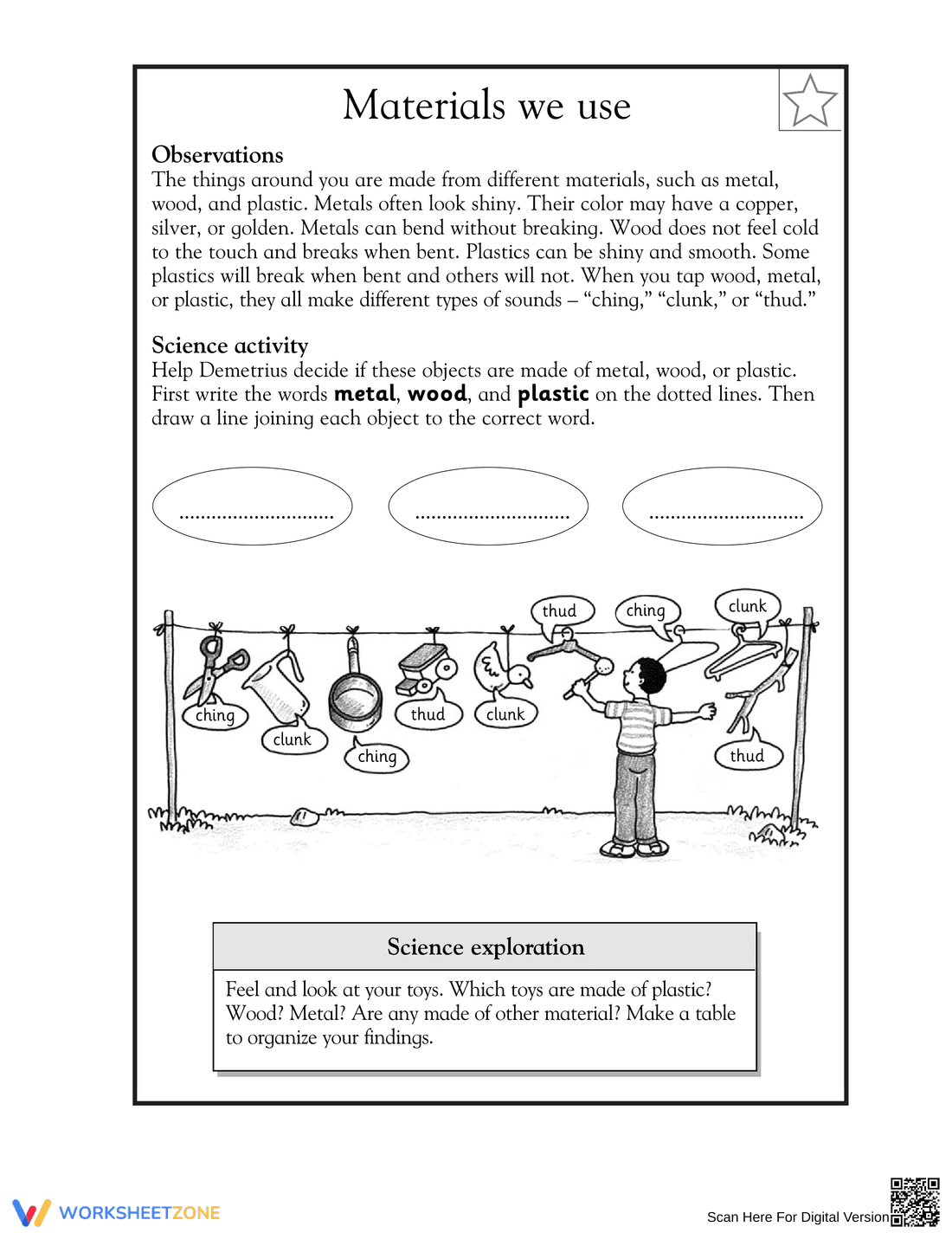
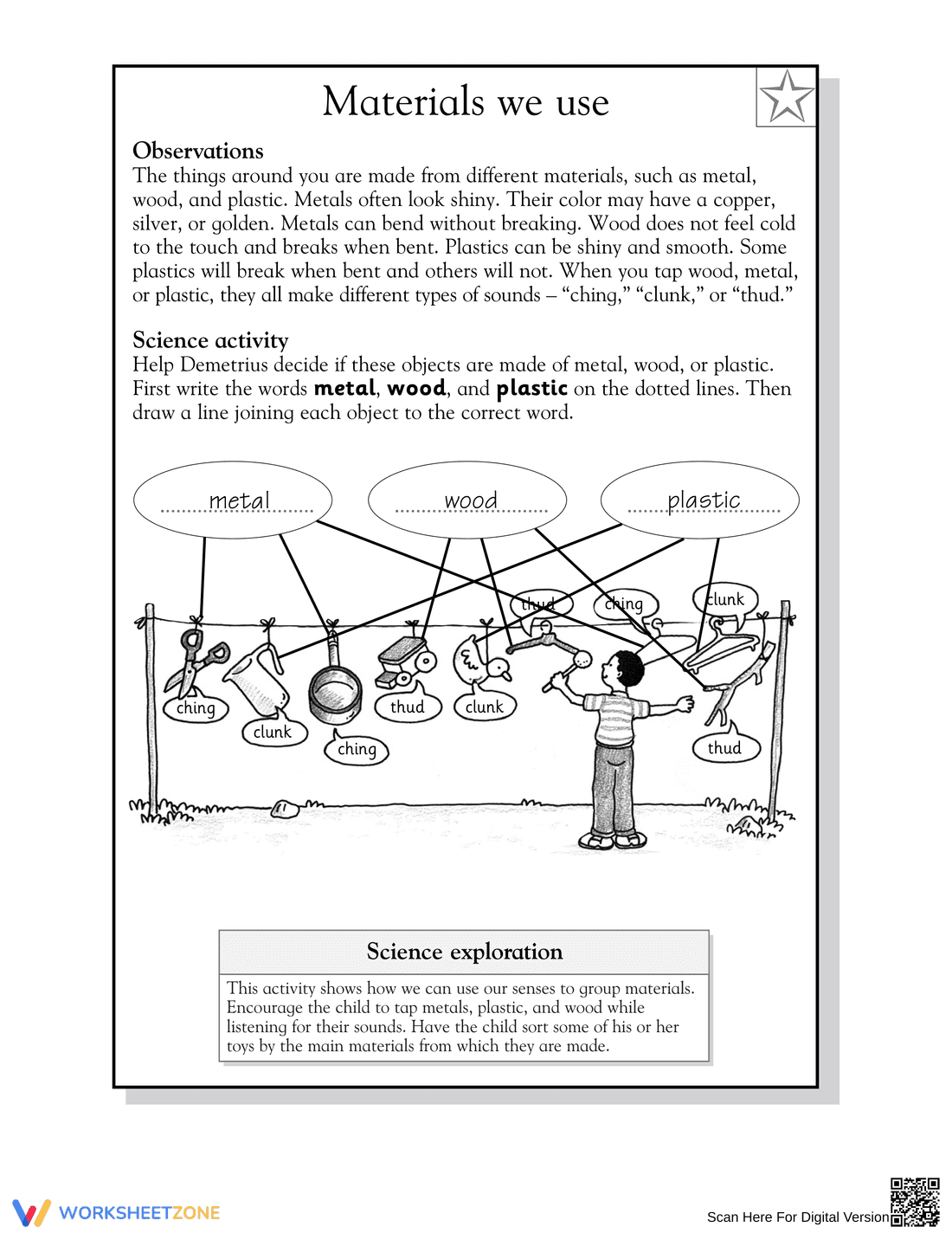
This printable resource features a structured one-page layout designed for maximum student engagement. It includes an "Observations" section that provides sensory clues about material properties, followed by a matching activity with eight distinct object illustrations. Students practice writing key scientific vocabulary on dotted lines before connecting items like scissors, toy ducks, and hangers to their corresponding material types. A bonus "Science exploration" extension is included for independent investigation.
The zero-prep design allows teachers to implement this lesson in under two minutes. Step one involves printing the single-page PDF, which takes less than 30 seconds. Step two is distribution, requiring another 30 seconds of transition time. Step three focuses on a five-minute guided review of the observation clues (such as "ching" for metal and "thud" for wood) before students begin work. This streamlined workflow is ideal for substitute plans or morning work.
Aligned to NGSS 2-PS1-1: "Plan and conduct an investigation to describe and classify different kinds of materials by their observable properties." While classification is often introduced in Grade 1, this activity directly supports the foundational skills needed for elementary physical science. This standard code can be copied directly into lesson plans, IEP goals, or district curriculum mapping tools to ensure instructional consistency across the grade level.
Implement this worksheet during the "Explain" phase of your physical science unit on properties. It serves as an excellent formative assessment after a hands-on material station or classroom scavenger hunt. Teachers should observe whether students utilize the sound bubbles to help differentiate between wood and metal objects. Most first graders will complete the matching and writing tasks within 12 minutes, making it a perfect quick-check resource.
This resource is tailored for Grade 1 students beginning their journey into physical science observation. The clear illustrations and word banks support English Language Learners (ELL) and students requiring literacy scaffolds. It pairs naturally with a classroom display of real material samples for students to touch and compare. Use this worksheet to bridge the gap between concrete objects and abstract scientific classification schemas.
Primary students thrive with classification tasks linking concrete observation to abstract categorization. This worksheet, aligned with Fisher & Frey (2014) research, scaffolds scientific vocabulary alongside visual representations. Identifying common materials like plastic, metal, and wood helps learners develop foundational schemas for advanced physical science. Sensory descriptions, such as the "ching" of metal versus the "thud" of wood, offer multisensory reinforcement for diverse learners. This Grade 1 resource targets NGSS 2-PS1-1 competencies by requiring students to analyze and classify objects based on observable physical characteristics. Its layout facilitates independent practice, enabling educators to efficiently monitor student progress during station rotations or desk work. Early classification exercises ensure students build linguistic and conceptual tools for more complex material investigations in later grades, informing future science instruction.


