


























Views
Downloads

Matching Synonyms Worksheet | Printable Kindergarten ELA
Paste this activity's link or code into your existing LMS (Google Classroom, Canvas, Teams, Schoology, Moodle, etc.).
Students can open and work on the activity right away, with no student login required.
You'll still be able to track student progress and results from your teacher account.
This Kindergarten English Language Arts worksheet focuses on identifying and using synonyms to expand early vocabulary. Students learn to recognize that different words can share the same meaning, which is a foundational skill for reading comprehension and descriptive writing. By mastering these word relationships, young learners build the confidence needed for effective communication.
At a Glance
- Grade: Kindergarten · Subject: English Language Arts (ELA)
- Standard:
CCSS.ELA-LITERACY.L.K.5— Explore word relationships and nuances in word meanings with adult guidance- Skill Focus: Synonym Identification and Application
- Format: 4 pages · 16 problems · Answer key included · PDF
- Best For: Vocabulary expansion and descriptive writing practice
- Time: 15–20 minutes
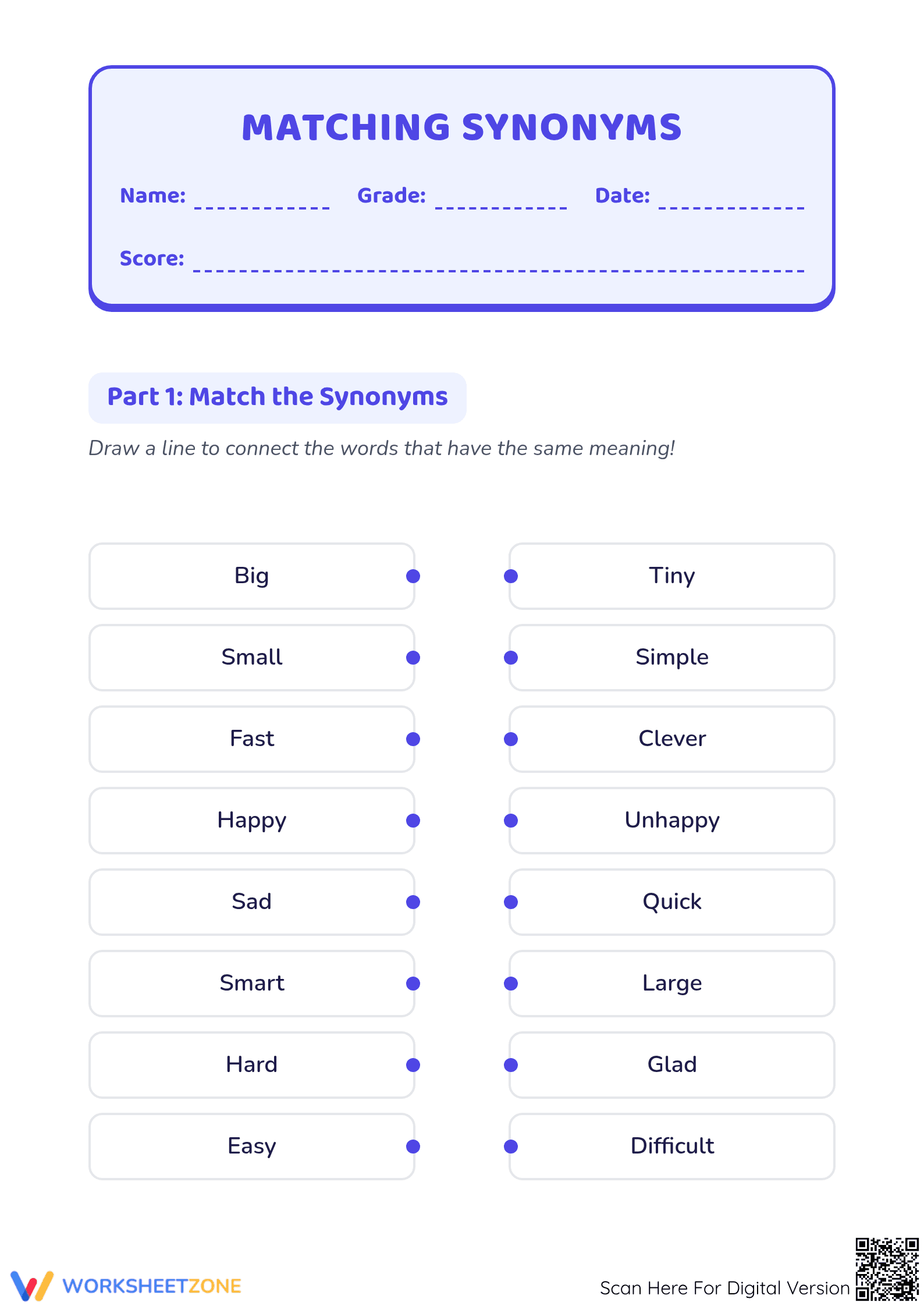
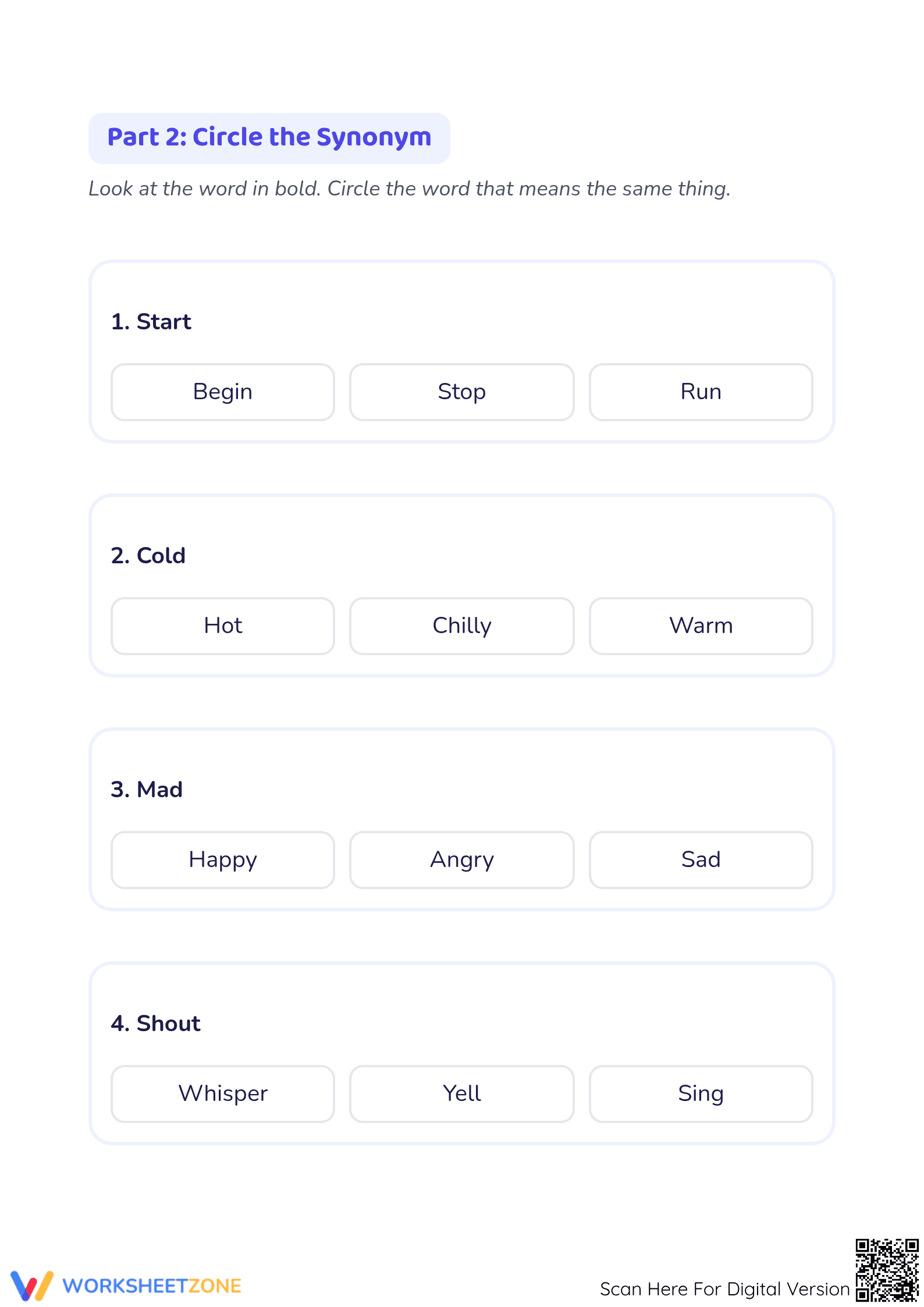
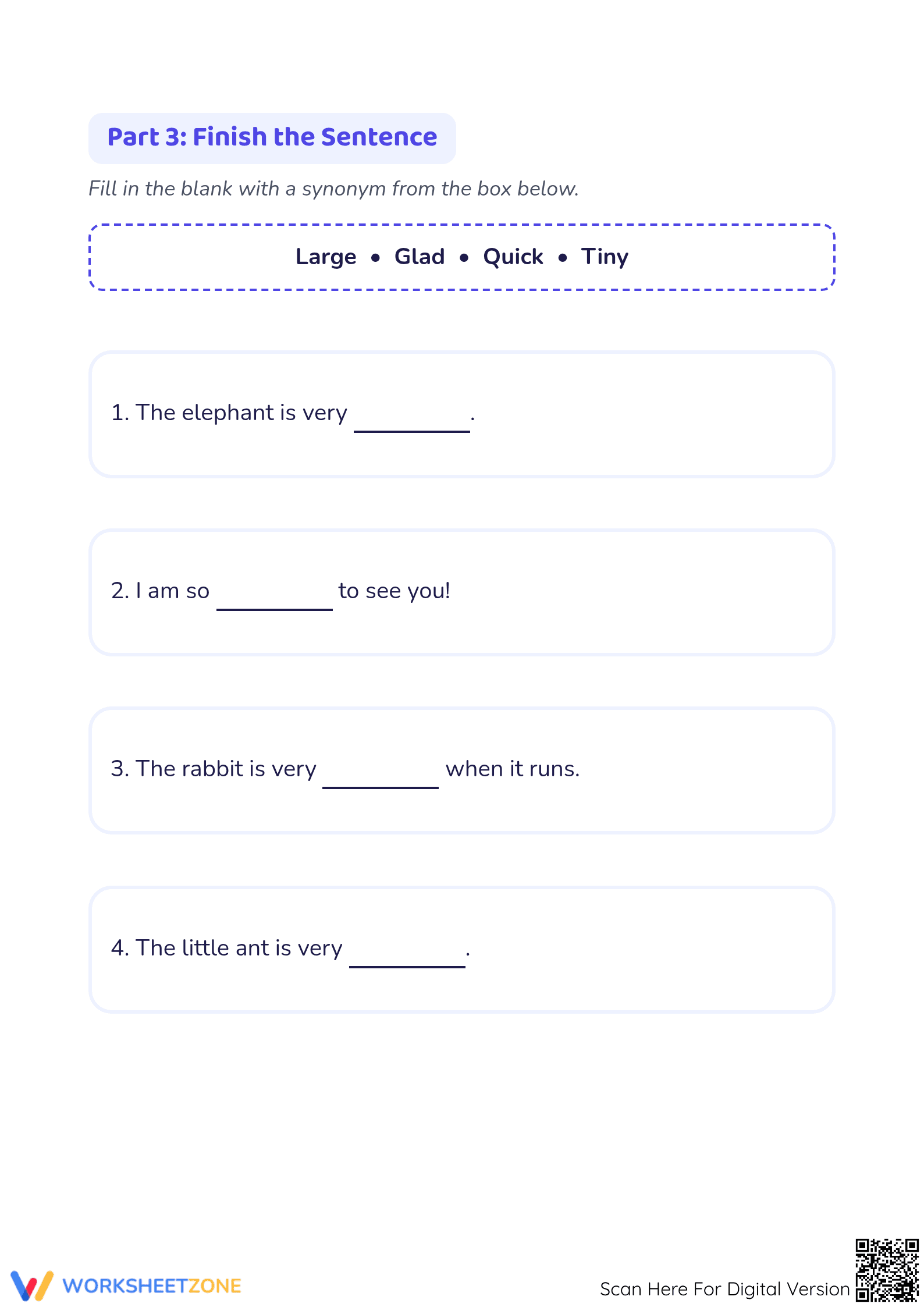
The worksheet is organized into three distinct parts across four printable pages. Part one features eight matching pairs of common adjectives like Big and Large. Part two provides four multiple-choice questions where students circle the correct synonym for a bolded word. Part three includes a word bank and four fill-in-the-blank sentences. A complete answer key is provided for quick grading.
Skill Progression
- Guided Practice: Students begin by drawing lines to connect basic synonym pairs, using visual cues and common word recognition to match eight pairs.
- Supported Practice: The second phase requires students to select one correct synonym from three options, reinforcing the concept through forced-choice identification for four target words.
- Independent Practice: Finally, students apply their knowledge by selecting appropriate synonyms from a word bank to complete four context-heavy sentences. This follows a gradual-release model.
Standards Alignment
This resource aligns with CCSS.ELA-LITERACY.L.K.5, which requires students to explore word relationships and nuances in word meanings. It specifically supports the acquisition of frequently occurring adjectives and verbs by demonstrating how they relate to one another. This standard code can be copied directly into lesson plans, IEP goals, or district curriculum mapping tools.
How to Use It
Use this worksheet during a small-group literacy rotation after a direct instruction lesson on words that mean the same thing. Teachers should observe if students can read the word bank independently or if they require decoding support. The activity takes approximately 15 to 20 minutes and serves as an excellent formative assessment for vocabulary development.
Who It's For
This resource is designed for Kindergarten students, but it also serves as a valuable intervention tool for first-grade students who need additional vocabulary support. It pairs naturally with a classroom anchor chart displaying common synonym pairs or a picture book that emphasizes descriptive language and varied word choices.
Vocabulary acquisition in the early years is a significant predictor of later reading success, as noted in the RAND AIRS 2024 report on literacy foundations. This worksheet directly addresses CCSS.ELA-LITERACY.L.K.5 by providing structured practice in identifying and using synonyms. According to Fisher & Frey (2014), the gradual release of responsibility—moving from simple matching to contextual sentence completion—allows students to internalize new lexical connections effectively. By engaging with 16 targeted tasks, students move beyond simple word recognition to understanding the functional use of synonyms in written language. Research from ScienceDirect TpT Analysis suggests that high-quality, zero-prep vocabulary resources significantly reduce teacher burnout while maintaining rigorous alignment with state standards. This document provides the necessary scaffolding to help Kindergarten students transition from oral language to written descriptive fluency.


