


























Views
Downloads

Printable Synonyms Worksheet | Kindergarten ELA Essential
Paste this activity's link or code into your existing LMS (Google Classroom, Canvas, Teams, Schoology, Moodle, etc.).
Students can open and work on the activity right away, with no student login required.
You'll still be able to track student progress and results from your teacher account.
This Kindergarten synonyms worksheet provides a clear, visual way for young learners to expand their lexical depth by identifying words with similar meanings. By matching common adjectives and verbs to their synonyms, students strengthen their early literacy foundations and improve their ability to express ideas precisely.
At a Glance
- Grade: Kindergarten · Subject: English Language Arts
- Standard:
CCSS.ELA-LITERACY.L.K.5— Relate frequently occurring words to their opposites and similar words to build vocabulary.- Skill Focus: Synonym Identification and Vocabulary Expansion
- Format: 2 pages · 8 problems · Answer key included · PDF
- Best For: Literacy centers and independent vocabulary practice
- Time: 10–15 minutes
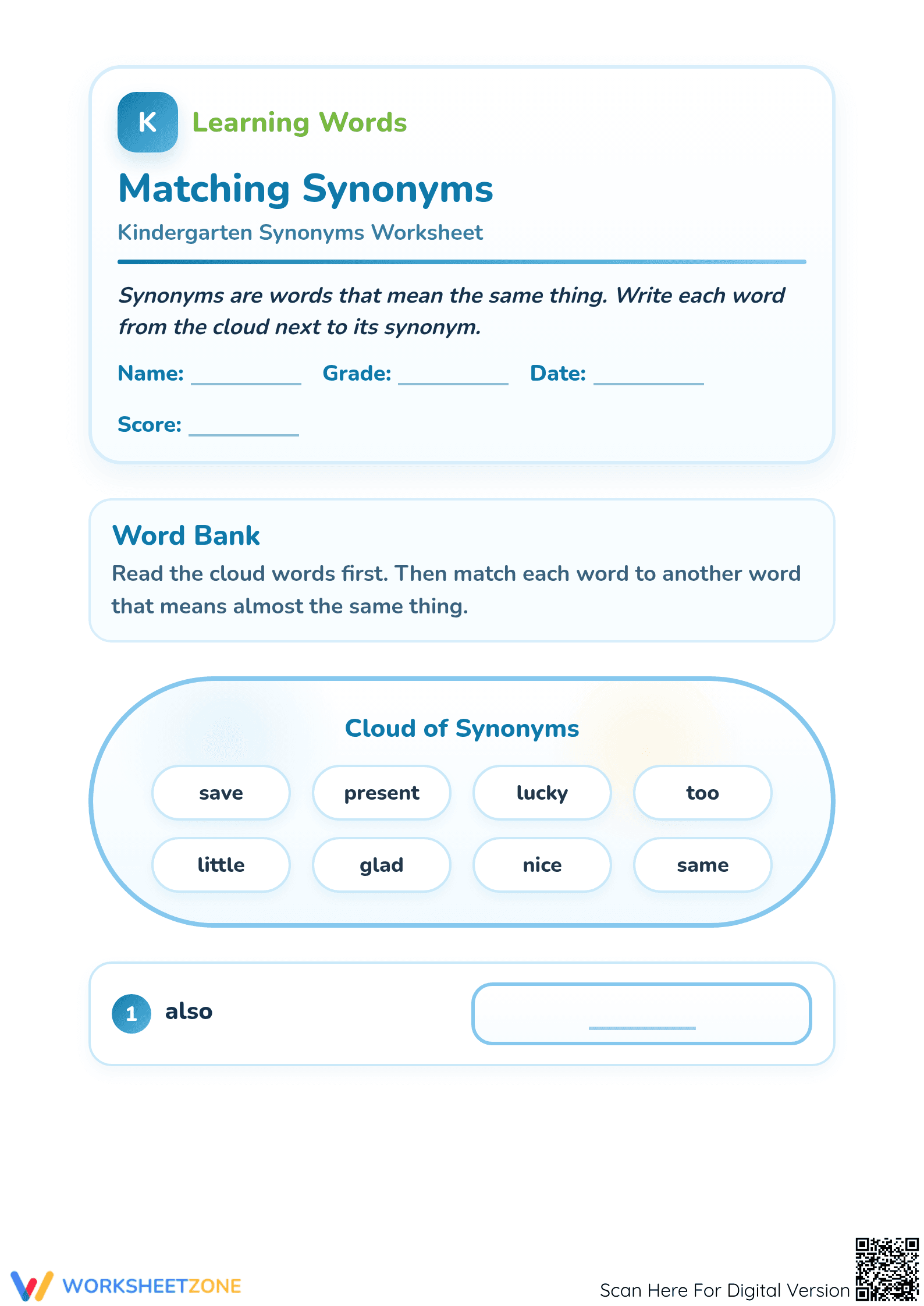
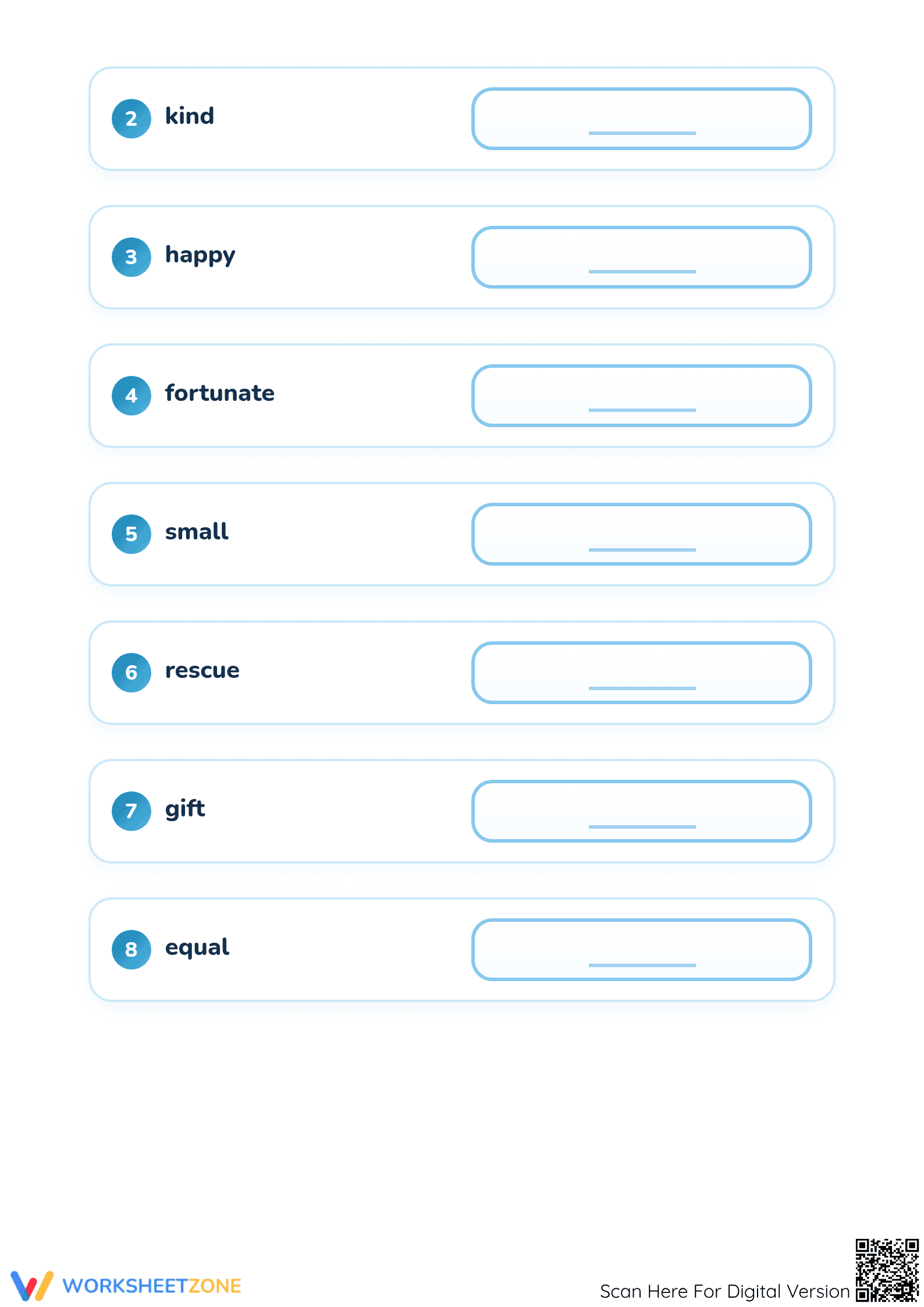
The resource consists of a two-page PDF featuring eight distinct vocabulary matching tasks. A central "Cloud of Synonyms" acts as a word bank, containing familiar terms such as "save," "present," "lucky," and "small." Each item requires students to read a prompt word—like "also" or "fortunate"—and select the corresponding synonym from the cloud to write in the provided answer box.
Skill Progression
- Guided Practice: The introductory section provides a clear "Word Bank" and "Cloud of Synonyms" to reduce cognitive load while students familiarize themselves with the matching mechanic.
- Supported Practice: The first page features an initial problem with ample visual space, allowing teachers to model the process of scanning the cloud for the correct lexical match.
- Independent Practice: The second page contains seven additional matching tasks that challenge students to apply their understanding of word relationships across various common adjectives and verbs without direct assistance.
Standards Alignment
CCSS.ELA-LITERACY.L.K.5 requires students to demonstrate understanding of word relationships and nuances in word meanings. This worksheet specifically addresses the sub-standard of relating frequently occurring verbs and adjectives to similar words. Both standard codes can be copied directly into lesson plans, IEP goals, or district curriculum mapping tools.
How to Use It
Use this worksheet as a literacy center activity during your vocabulary block. After introducing the concept of synonyms through a mentor text, have students work in pairs to find "word twins" from the cloud. For a quick formative assessment, observe students as they complete the second page. Note which students struggle with abstract pairings like "fortunate/lucky" versus concrete ones like "small/little" to identify needs for further small-group instruction.
Who It's For
This resource is designed for Kindergarten students but serves as an excellent intervention tool for first graders needing vocabulary reinforcement. It pairs naturally with anchor charts showing common synonym pairs or a read-aloud focused on descriptive language.
Aligning instructional materials with the Common Core State Standard CCSS.ELA-LITERACY.L.K.5 is essential for developing the linguistic flexibility required for later reading comprehension. Research from Fisher & Frey (2014) emphasizes the importance of direct vocabulary instruction and the use of word relationships to bridge the gap between simple decoding and deep textual understanding. This worksheet provides 8 high-frequency synonym pairs that help Kindergarteners move beyond basic word recognition into semantic categorization. By providing a structured "Cloud of Synonyms," the resource scaffolds the learning process, allowing students to focus on the logical connection between words like "rescue" and "save." This evidence-based approach to vocabulary acquisition ensures that young learners build a robust mental lexicon, which is a primary predictor of future literacy success. The inclusion of an answer key allows for immediate feedback, further reinforcing the correct lexical associations during the practice phase.


