


























Views
Downloads

Printable Matching Synonyms Worksheet | Grade K ELA
Paste this activity's link or code into your existing LMS (Google Classroom, Canvas, Teams, Schoology, Moodle, etc.).
Students can open and work on the activity right away, with no student login required.
You'll still be able to track student progress and results from your teacher account.
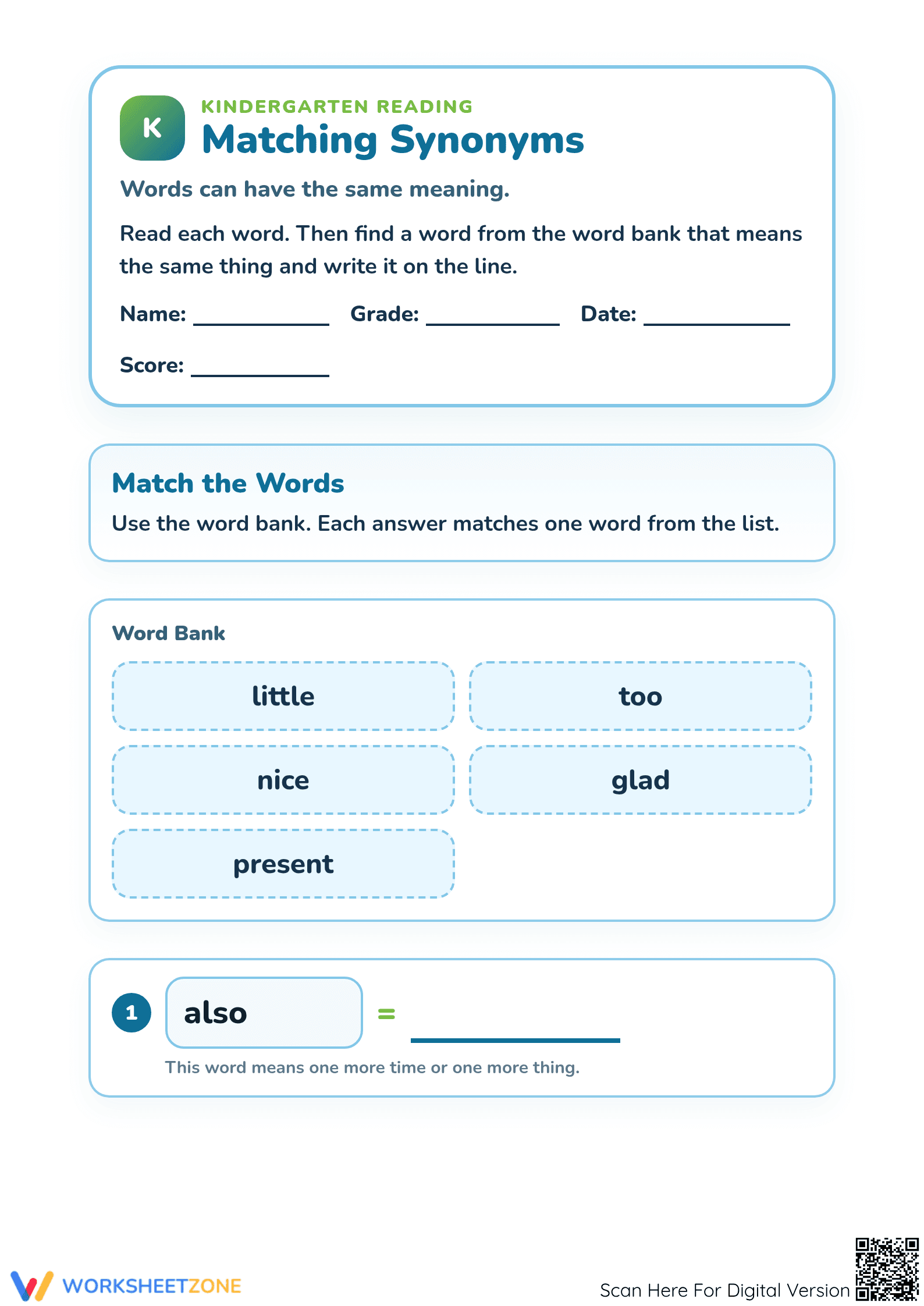
This printable Grade K matching synonyms worksheet provides students with targeted vocabulary practice by connecting familiar words to their lexical matches. By identifying words with similar meanings, young learners build the foundation for descriptive writing and reading comprehension. This resource ensures students can confidently expand their word choices through structured, supported practice.
At a Glance
- Grade: Kindergarten · Subject: ELA
- Standard:
CCSS.ELA-LITERACY.L.K.4— Determine word meanings using kindergarten-level context and identifying words with similar meanings- Skill Focus: Synonym recognition and matching
- Format: 2 pages · 5 problems · Answer key included · PDF
- Best For: Early finishers or vocabulary centers
- Time: 10–15 minutes
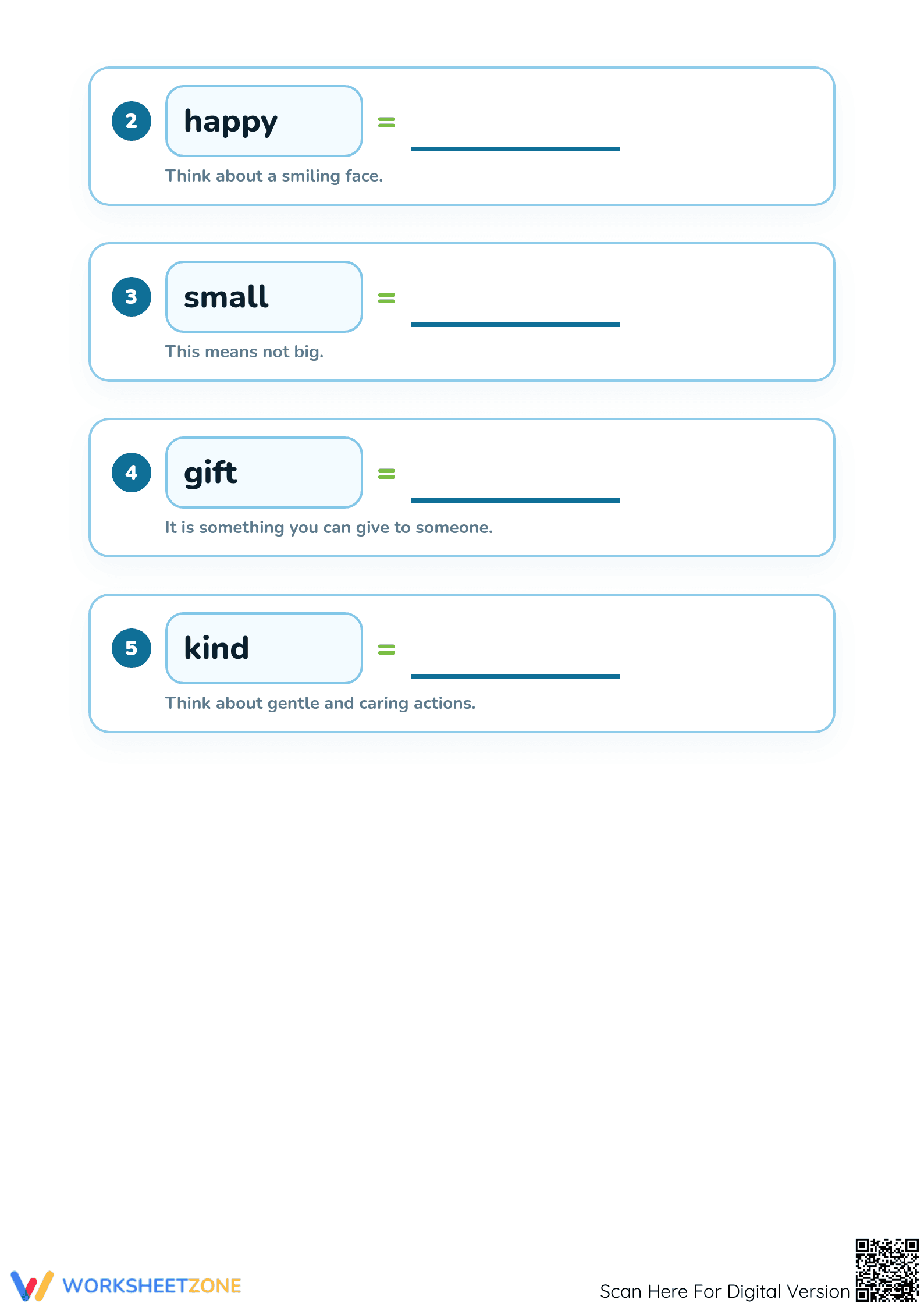
Inside this resource, teachers will find a two-page layout designed for maximum clarity and student success. The first page introduces the concept of synonyms and provides a clear word bank containing five high-frequency adjectives and adverbs. Each problem features a target word paired with a simple definition or clue, followed by a writing line for the student to record the matching synonym from the list.
The zero-prep workflow is designed for immediate classroom integration. First, print the two-page document for each student or as a reusable master for a dry-erase center in under 1 minute. Next, distribute the sheets and briefly model the first example to show how the word bank works in under 1 minute. Finally, review the answers as a group or use the provided answer key for quick individual assessment in 1 minute.
This worksheet is aligned to CCSS.ELA-LITERACY.L.K.4, which requires students to determine or clarify the meaning of unknown and multiple-meaning words and phrases. By focusing on synonyms, it also supports L.K.5 by exploring word relationships and nuances in word meanings. Both standard codes can be copied directly into lesson plans, IEP goals, or district curriculum mapping tools.
Use this worksheet as a quiet morning work activity after a read-aloud session that highlights descriptive language. During the activity, circulate and observe if students can verbalize why two words mean the same thing to assess their depth of understanding. This task typically takes 10 to 15 minutes to complete, making it an ideal bridge between whole-group instruction and independent stations.
This resource is for Kindergarten students who are beginning to recognize word relationships and expanding their oral and written vocabularies. It offers differentiation for emerging writers through the use of a provided word bank and supportive definitions. Naturally pair this worksheet with a vocabulary anchor chart or a Word of the Day routine to reinforce the lexical connections made during the exercise.
The development of a robust early vocabulary is a primary indicator of future reading success. According to the RAND AIRS 2024 report, early exposure to lexical relationships, such as synonyms, significantly improves the trajectory of reading comprehension scores in primary grades. This worksheet specifically addresses the kindergarten standard for determining word meanings by providing a visual and structural framework for synonym acquisition. By isolating high-frequency words like happy, glad, small, and little, students engage in the cognitive process of categorization and semantic mapping. This structured approach follows research-based practices for vocabulary development, ensuring that learners move beyond rote memorization toward a conceptual understanding of word clusters. Teachers can use this tool to gather formative data on student lexical range and identify those needing further intervention in word usage.


