


























Views
Downloads

Printable Synonyms Matching Worksheet | Grade K Essential
Paste this activity's link or code into your existing LMS (Google Classroom, Canvas, Teams, Schoology, Moodle, etc.).
Students can open and work on the activity right away, with no student login required.
You'll still be able to track student progress and results from your teacher account.
This printable Kindergarten ELA worksheet provides a focused introduction to lexical word classes by teaching students how to identify and match synonyms. By connecting words with similar meanings, young learners expand their vocabulary and improve reading comprehension. This essential resource ensures students understand that different words can express the same concept effectively.
At a Glance
- Grade: Kindergarten · Subject: ELA
- Standard:
CCSS.ELA-LITERACY.L.K.5— Explore word relationships and nuances in word meanings- Skill Focus: Synonym Matching
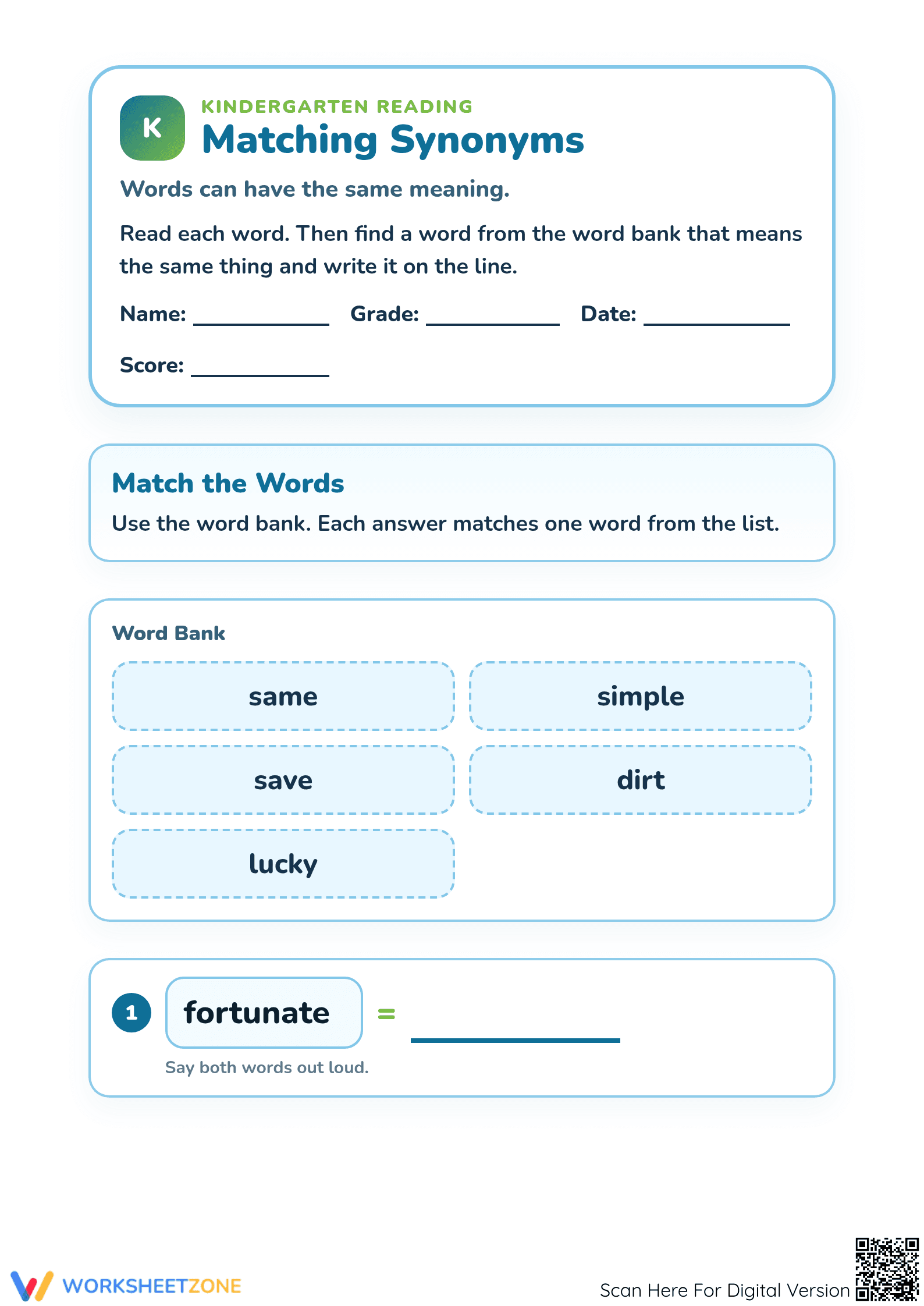
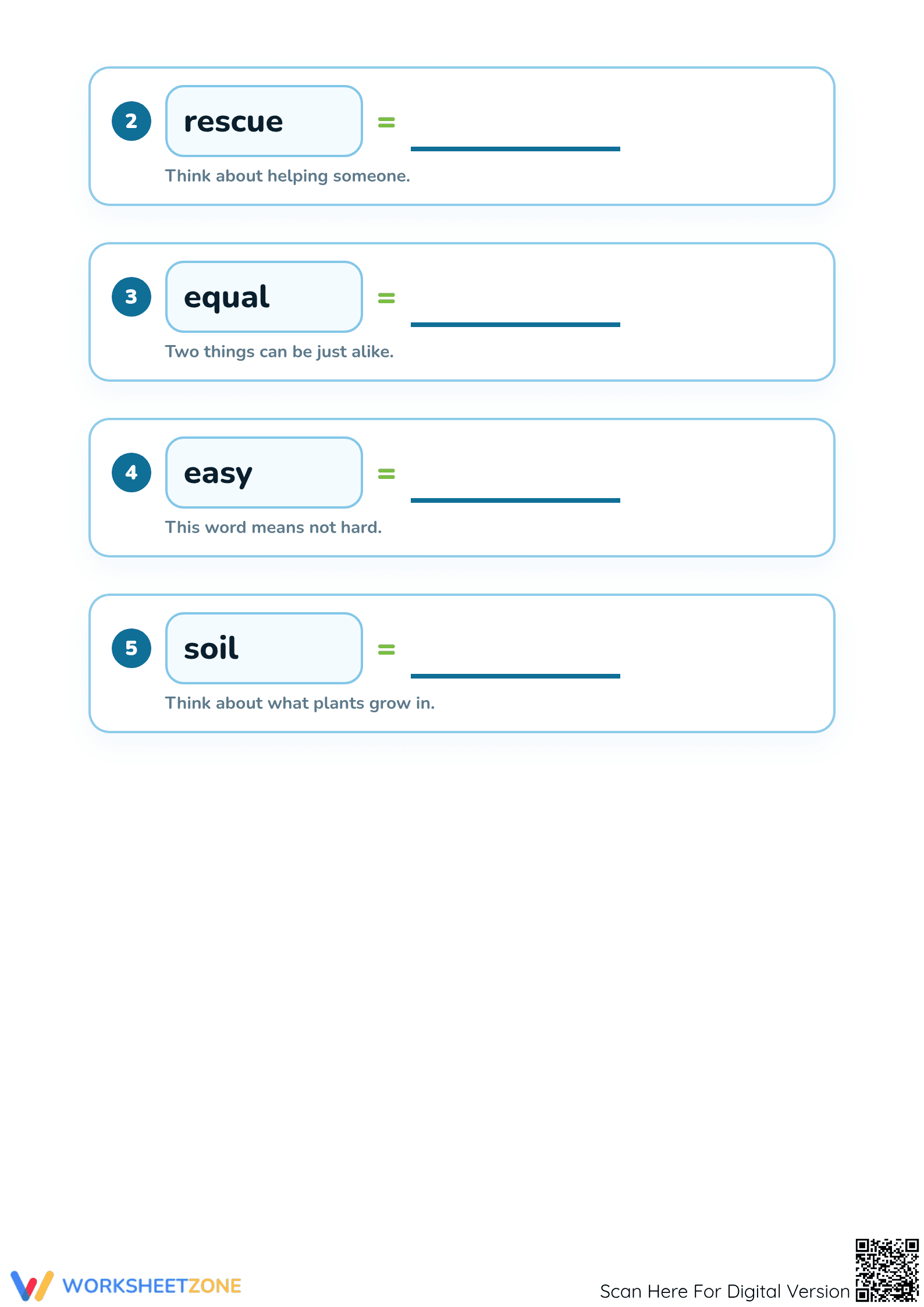
- Format: 2 pages · 5 problems · Answer key included · PDF
- Best For: Independent vocabulary practice and centers
- Time: 10–15 minutes
This two-page PDF document features five distinct vocabulary matching tasks. Each problem presents a target word, such as "fortunate" or "rescue," and requires students to select the corresponding synonym from a provided word bank. The worksheet includes helpful contextual clues and prompts students to say words aloud to reinforce auditory recognition of lexical connections. A full answer key is provided for quick grading.
This resource is designed for immediate classroom implementation with a total teacher preparation time of less than two minutes. Educators simply need to print the two-page document and distribute it to students. Because the word bank and instructions are self-contained, no additional teacher-led introduction is required. The intuitive matching layout makes it an ideal choice for emergency sub plans or quiet seatwork during small-group instruction.
The primary alignment for this activity is CCSS.ELA-LITERACY.L.K.5, which focuses on helping students explore word relationships and nuances. Specifically, it supports the developmental milestone of understanding that different words can share similar meanings. This standard code can be copied directly into lesson plans, IEP goals, or district curriculum mapping tools to ensure instructional compliance and tracking.
Use this worksheet during a vocabulary center rotation or as a follow-up activity after a direct instruction lesson on "same-meaning" words. Teachers should observe students as they say the words aloud, noting whether they can phonetically decode the synonyms before matching them. This formative assessment provides immediate insight into student progress. Completion typically takes 10 to 15 minutes depending on student reading levels.
This worksheet is primarily designed for Kindergarten students but serves as an excellent remedial tool for first graders needing extra vocabulary support. It is particularly effective for English Language Learners (ELLs) who are building their core lexical database. The worksheet pairs naturally with illustrated anchor charts or picture books that highlight descriptive language and synonyms in context.
Research from Fisher & Frey (2014) emphasizes that early exposure to word relationships, such as synonyms, is critical for developing the cognitive flexibility required for advanced reading comprehension. This Kindergarten worksheet aligns with CCSS.ELA-LITERACY.L.K.5 by providing structured practice in identifying lexical similarities. By matching five key vocabulary terms with their counterparts from a word bank, students move from simple word recognition to understanding the nuances of language. This process of active retrieval and matching strengthens the neural pathways associated with vocabulary acquisition. According to recent ScienceDirect TpT Analysis, high-quality, printable resources that focus on a single lexical skill significantly reduce teacher burnout while maintaining high instructional standards. The inclusion of an answer key and self-guided prompts ensures that the learning objective remains the focus, allowing for both independent and teacher-supported instructional moments in the early childhood classroom.


