


























Views
Downloads

Printable Synonym Matching Worksheet | Grade K ELA
Paste this activity's link or code into your existing LMS (Google Classroom, Canvas, Teams, Schoology, Moodle, etc.).
Students can open and work on the activity right away, with no student login required.
You'll still be able to track student progress and results from your teacher account.
Essential Synonym Practice for Early Learners
Building a robust vocabulary in Kindergarten starts with understanding how different words can share the same meaning. This focused ELA worksheet provides a clear, structured framework for students to identify and pair synonyms, strengthening their lexical word classes and improving both reading comprehension and expressive language skills through direct matching practice.
At a Glance
- Grade: Kindergarten · Subject: English Language Arts
- Standard:
CCSS.ELA-LITERACY.L.K.5.E— Identify and match words with similar meanings to expand early vocabulary- Skill Focus: Synonym identification and matching
- Format: 2 pages · 5 problems · Answer key included · PDF
- Best For: Daily vocabulary warm-up or small groups
- Time: 10–15 minutes
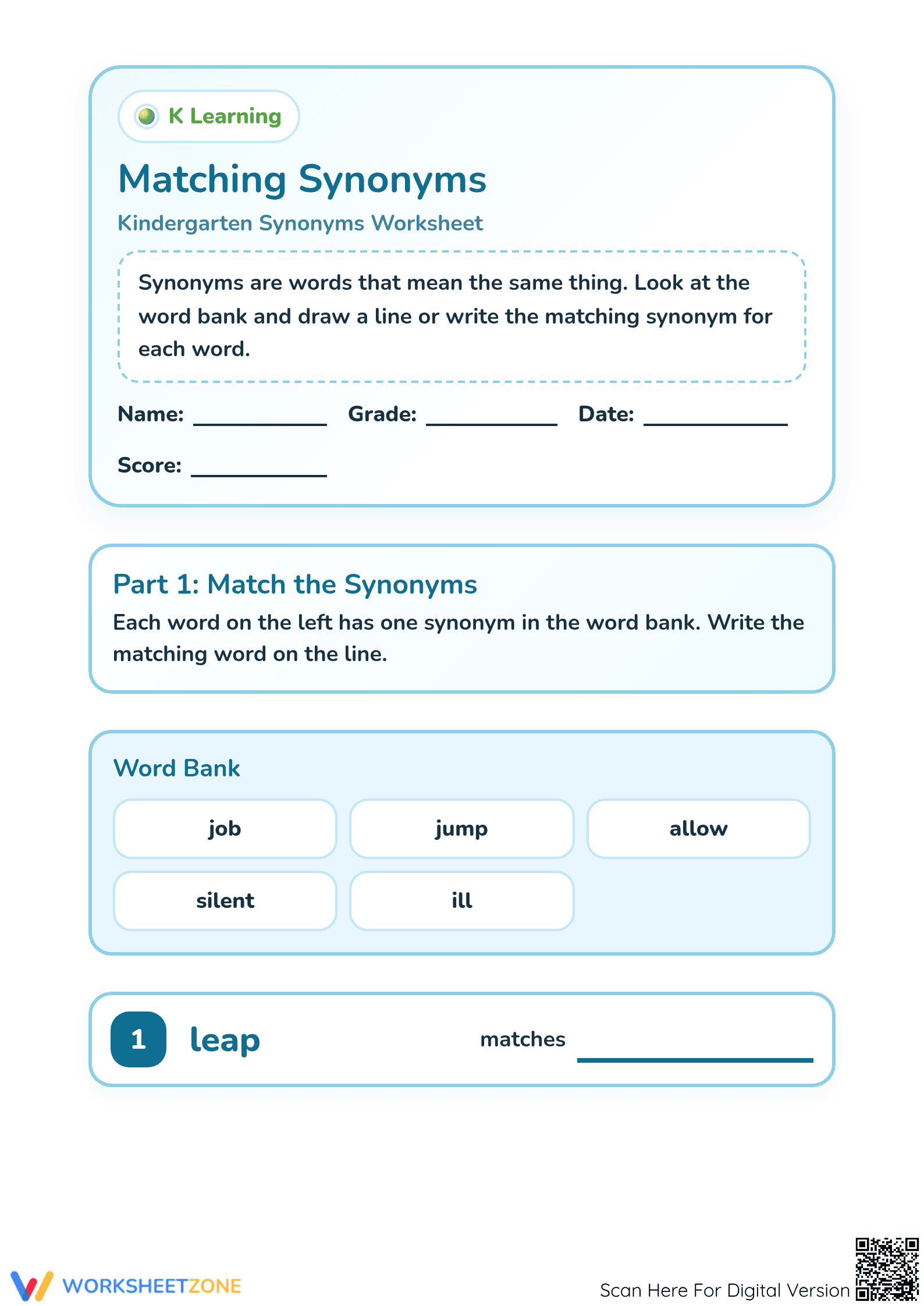
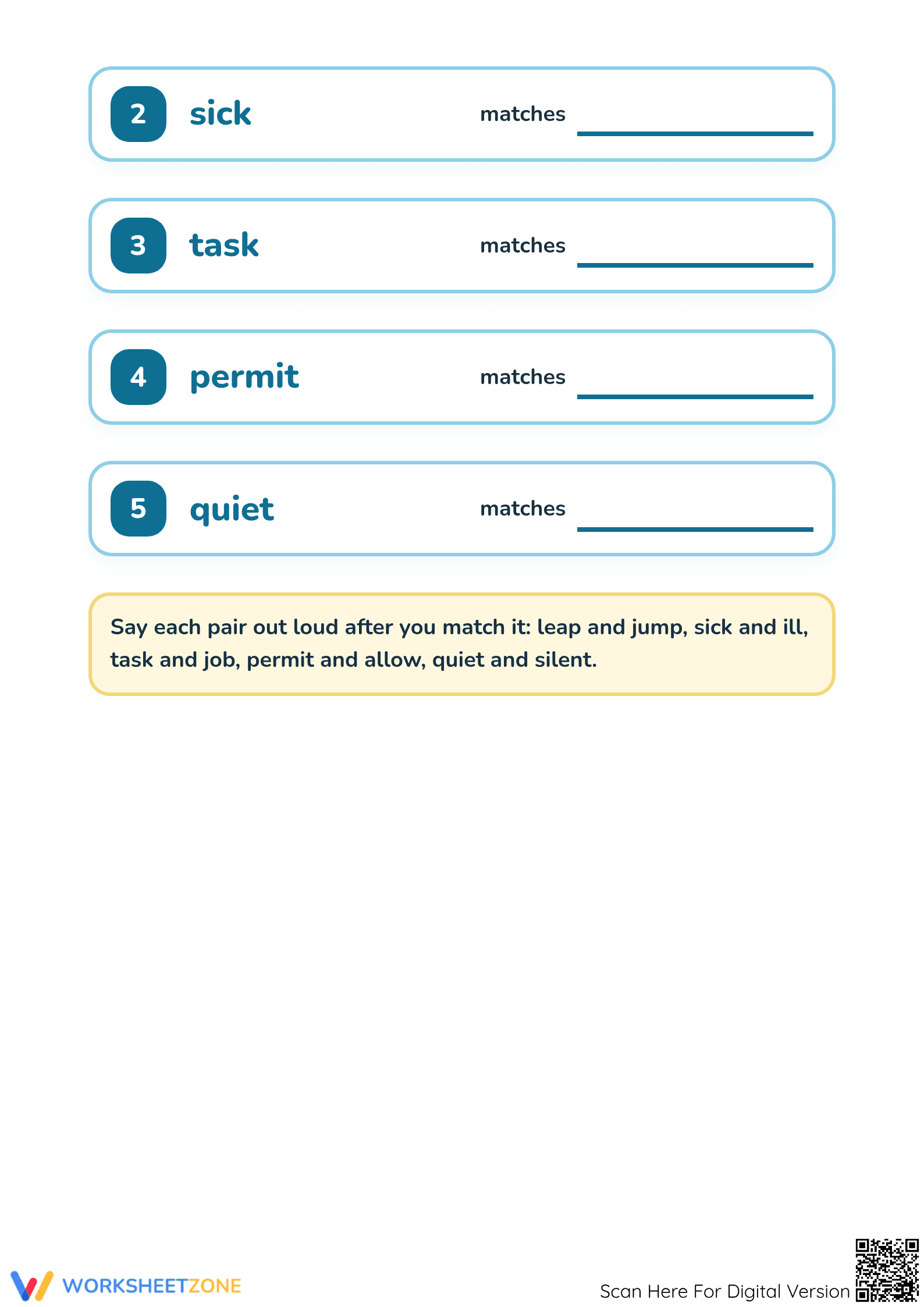
This two-page resource is designed specifically for early childhood learners. It features a clear word bank and five individual matching tasks that use high-frequency Kindergarten vocabulary. The layout includes large, readable fonts and a "matches" sentence structure that helps students conceptualize the relationship between words. A final extension activity encourages students to say the pairs aloud to reinforce phonetic and semantic connections.
Skill Progression and Scaffolding
- Guided Identification: Students begin by reviewing the word bank, which contains five simple synonyms: job, jump, allow, silent, and ill. This provides a closed set of options to reduce cognitive load.
- Supported Matching: The worksheet presents five target words like "leap" and "sick" with dedicated writing lines for the matches. This step bridges the gap between recognition and production.
- Independent Verbalization: The final section asks students to say the pairs out loud, moving the skill from paper to speech. This follows a gradual release model, ensuring students master the concept before independent use.
Standards Alignment
The content is aligned with CCSS.ELA-LITERACY.L.K.5.E, requiring students to explore word relationships and nuances in word meanings with adult support. By identifying connections between synonyms like "sick" and "ill" or "quiet" and "silent," students meet Kindergarten language acquisition goals. This standard code can be copied directly into lesson plans or IEP goals.
How to Use This Resource
This worksheet is best utilized after a direct instruction lesson on synonyms. Teachers can model the first match ("leap" and "jump") on an anchor chart before allowing students to complete the remaining four tasks independently. During the activity, circulate and observe if students are using the word bank effectively. The expected completion time for most Kindergarteners is approximately 12 minutes, making it an ideal formative assessment tool.
Who It's For
While designed for Kindergarten, this resource is an excellent intervention tool for first-grade students who need additional vocabulary support or English Language Learners (ELLs) building their lexical base. It pairs naturally with a short read-aloud passage where teachers can pause to ask for synonyms of common verbs found in the text.
Research indicates that direct instruction in word relationships is a critical predictor of later reading success. According to Fisher & Frey (2014), the purposeful matching of synonyms allows students to build mental schemas that facilitate faster word retrieval during reading and writing. By focusing on five core pairs like leap/jump and quiet/silent, this worksheet provides the high-repetition practice necessary for Kindergarteners to internalize the concept of same-meaning words. The inclusion of the CCSS.ELA-LITERACY.L.K.5.E standard ensures that this activity supports district-mandated learning objectives while providing a measurable task count for progress monitoring. This approach to lexical word classes transforms abstract linguistic concepts into concrete, manageable tasks that help young learners navigate early literacy demands with confidence and accuracy.


