


























Views
Downloads

Printable Matching Synonyms Worksheet | Grade K ELA
Paste this activity's link or code into your existing LMS (Google Classroom, Canvas, Teams, Schoology, Moodle, etc.).
Students can open and work on the activity right away, with no student login required.
You'll still be able to track student progress and results from your teacher account.
This kindergarten matching synonyms worksheet helps young learners discover words with identical or similar meanings to expand their foundational vocabulary. By identifying synonym pairs through interactive matching and circling activities, students build the semantic connections necessary for stronger reading comprehension and more descriptive writing. It provides a clear, guided introduction to lexical variety.
At a Glance
- Grade: K · Subject: English Language Arts
- Standard:
CCSS.ELA-LITERACY.L.K.5— Explore word relationships and nuances in word meanings through guided practice- Skill Focus: Synonym Recognition
- Format: 3 pages · 11 problems · Answer key included · PDF
- Best For: Vocabulary building and independent center work
- Time: 15–20 minutes
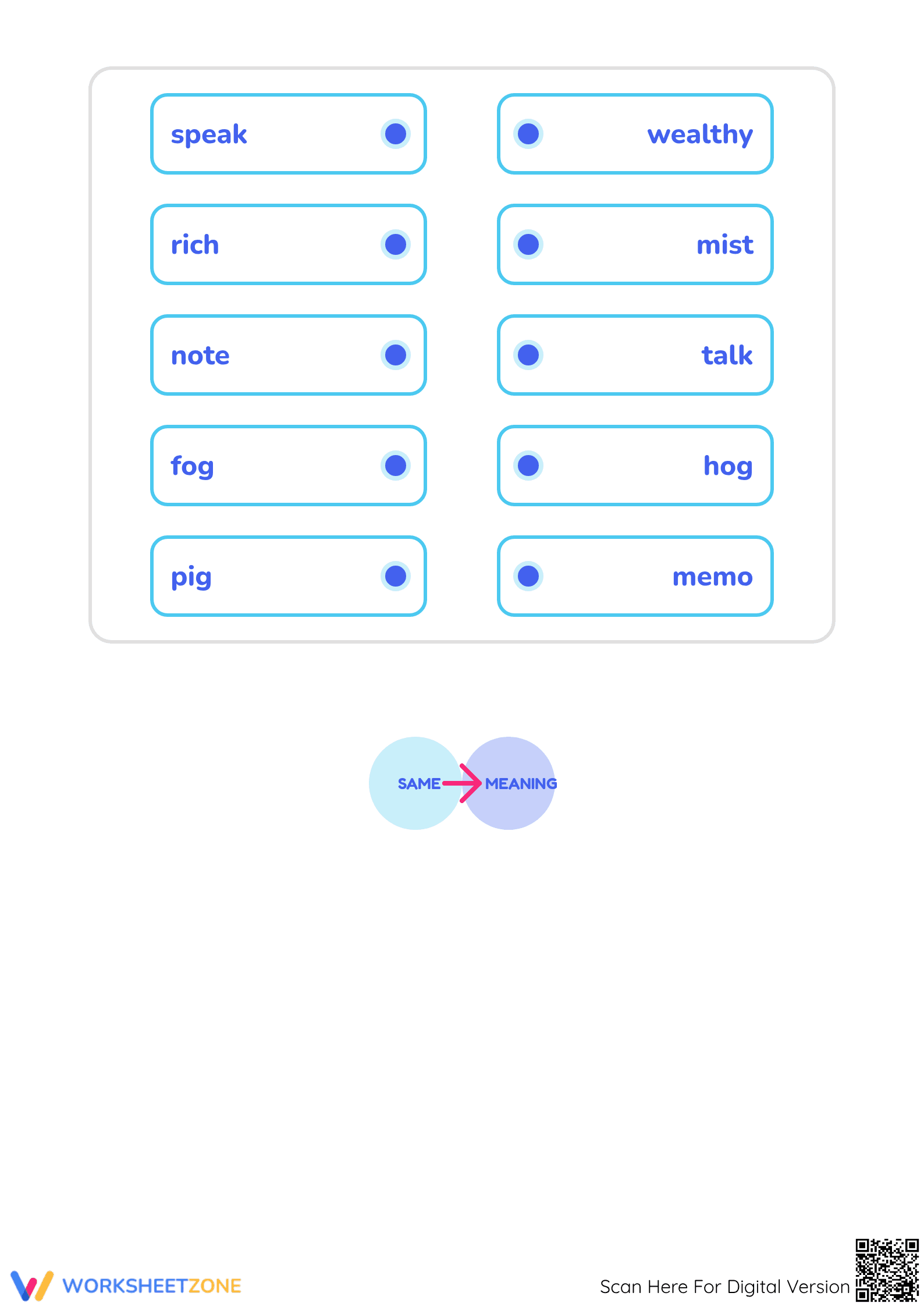
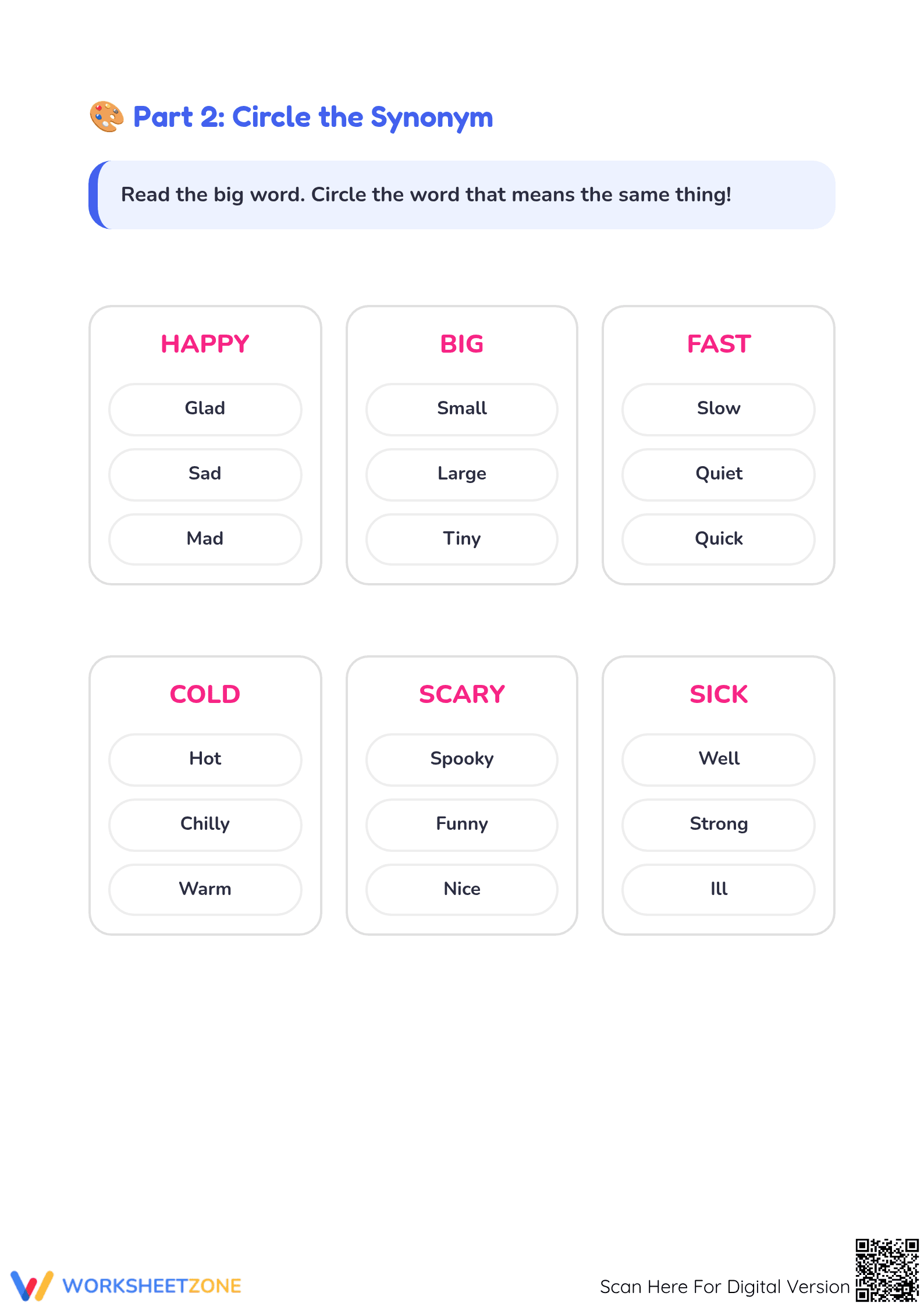
This comprehensive three-page PDF features two distinct parts designed to reinforce word meaning. Part one involves a line-matching activity where students connect five pairs of common words, such as "speak" and "talk." Part two presents six multiple-choice blocks where students must circle the correct synonym for high-frequency adjectives like "happy" and "big." A full answer key is provided for quick grading.
Skill Progression
- Guided Practice: The first page provides a clear definition of synonyms and a dedicated space for notes, allowing teachers to model the concept through 1-2 introductory examples before students begin the matching task.
- Supported Practice: The five-item matching section uses familiar, decodable words and visual connectors to help students build confidence in identifying words with identical meanings.
- Independent Practice: The final page challenges students to independently evaluate three options for six different target words, requiring them to distinguish true synonyms from distractors.
This resource follows a gradual-release model of "I Do, We Do, You Do," ensuring students master the lexical concept before moving to independent application.
Standards Alignment
This worksheet is directly aligned with `CCSS.ELA-LITERACY.L.K.5`, which requires students to explore word relationships and nuances in meanings with guidance and support. It specifically addresses the need for students to understand how different words can represent the same concept. This standard code can be copied directly into lesson plans, IEP goals, or district curriculum mapping tools.
How to Use It
Use this during direct instruction on vocabulary. After explaining "same-meaning words," distribute page one for a whole-group matching session. Alternatively, use page three as a formative assessment after oral synonym games. Observe if students struggle with distractors like "sad" when seeking a synonym for "happy" to identify those needing intervention. Completion typically takes 15 minutes.
Who It's For
This resource is tailored for Kindergarten but serves as an intervention for first graders or English Language Learners. It pairs naturally with a classroom anchor chart or a read-aloud focused on descriptive language. The clear layout and large fonts are designed for early childhood motor skills and visual processing needs.
Identifying synonyms is critical for lexical development and future reading fluency. According to the Fisher & Frey (2014) framework, students must engage with words in multiple contexts to move from surface recognition to deep semantic understanding. This worksheet provides the repetition necessary for Kindergarteners to internalize that one idea can be expressed through multiple terms. By focusing on `CCSS.ELA-LITERACY.L.K.5`, the activities bridge simple word recognition and the nuanced processing required in later grades. Research from EdReports (2024) emphasizes that foundational materials must provide explicit opportunities for students to explore word relationships. This printable resource fulfills that requirement by offering 11 targeted tasks that transform abstract linguistic concepts into concrete practice for every early learner.


