


























Views
Downloads


Printable Matching Synonyms Worksheet | Grade K ELA
Paste this activity's link or code into your existing LMS (Google Classroom, Canvas, Teams, Schoology, Moodle, etc.).
Students can open and work on the activity right away, with no student login required.
You'll still be able to track student progress and results from your teacher account.
Mastering synonyms is a fundamental step in early literacy development for Kindergarten students. This Printable Matching Synonyms Worksheet provides a structured approach to identifying words with similar meanings, helping young learners expand their vocabulary and improve expressive language. By connecting familiar terms like "finish" and "end," students begin to understand the nuanced relationships between lexical choices.
At a Glance
- Grade: Kindergarten · Subject: ELA
- Standard:
CCSS.ELA-LITERACY.L.K.5.B— Relate frequently occurring verbs and adjectives to words with similar meanings (synonyms)- Skill Focus: Synonyms & Vocabulary Acquisition
- Format: 3 pages · 7 problems · Answer key included · PDF
- Best For: Small group literacy centers or independent practice
- Time: 15–20 minutes
What's Inside
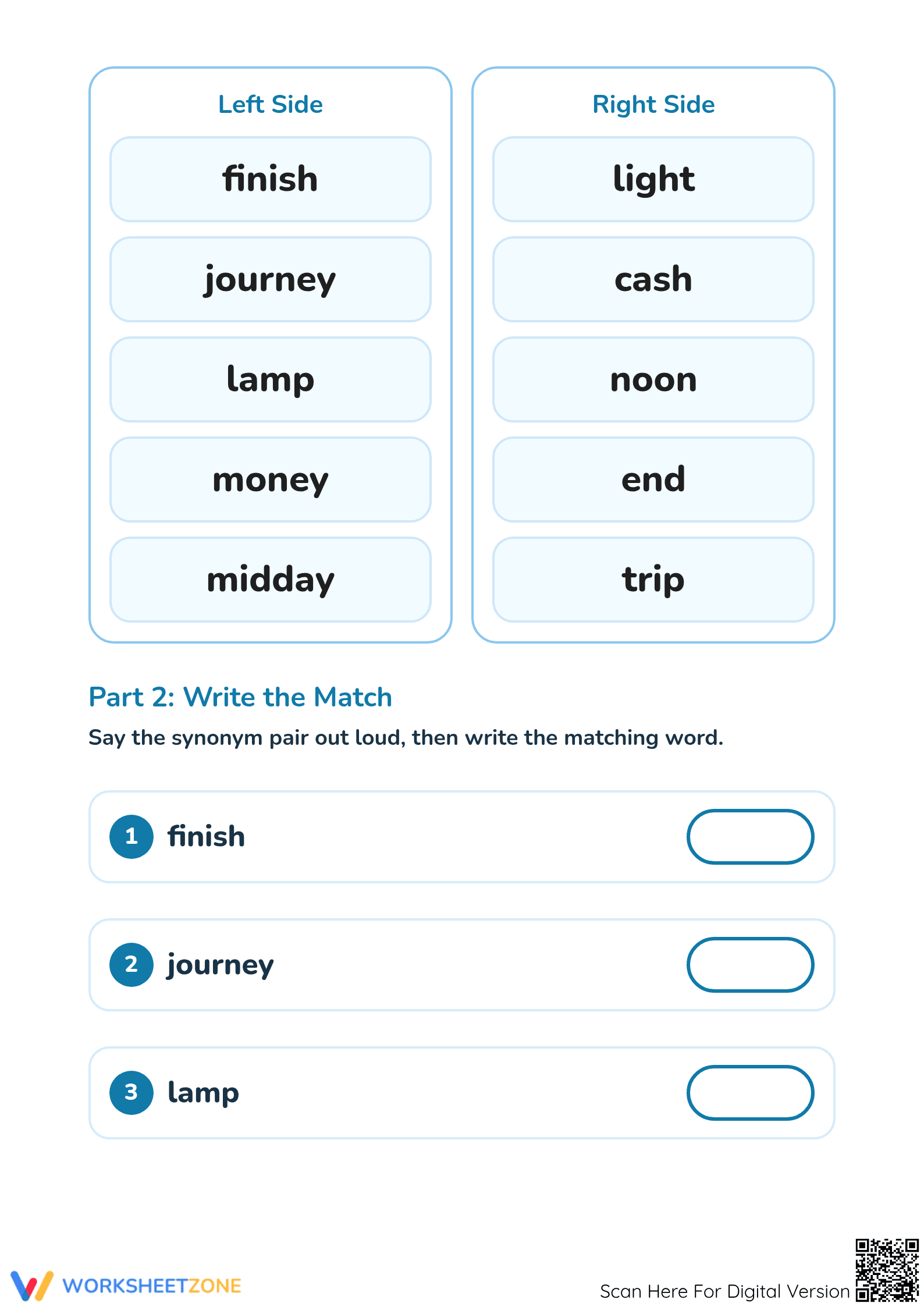
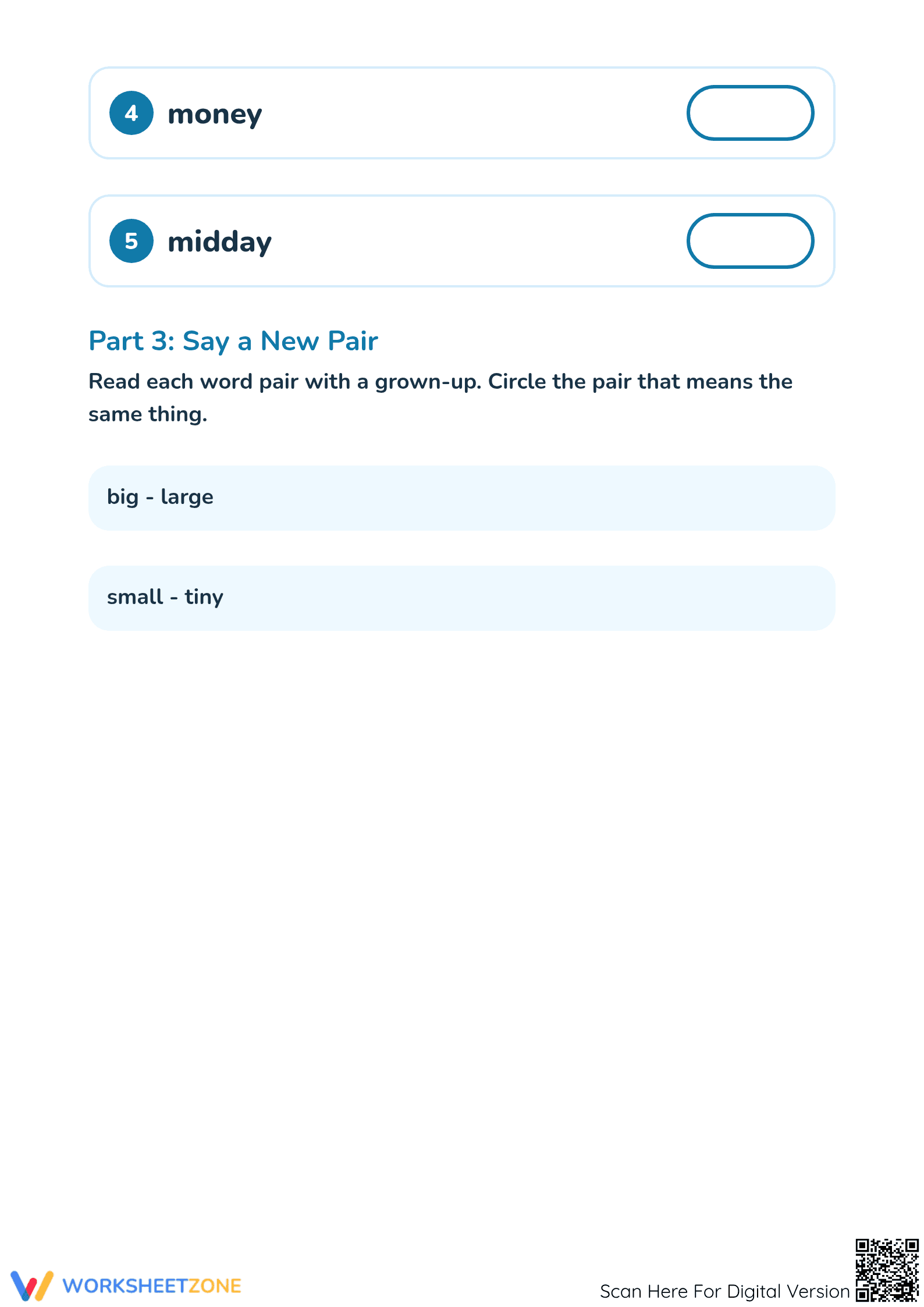
This comprehensive 3-page PDF resource is designed with young learners in mind, featuring large, readable fonts and clear instructional prompts. It includes a visual matching board that pairs words like "journey" with "trip" and "midday" with "noon." The worksheet features 5 writing-based matching tasks and 2 identification exercises where students circle synonym pairs. A full answer key is provided to facilitate quick grading or student self-correction.
Skill Progression
- Guided Practice: The worksheet begins with a visual "matching board" that presents two columns of words. Teachers can use this as an "I Do" model, showing how "lamp" and "light" share a common meaning before students attempt the independent sections.
- Supported Practice: In the second section, students transition to writing the matches. With 5 specific tasks, they practice phonics and letter formation while reinforcing the semantic link between word pairs.
- Independent Practice: The final "Say a New Pair" section challenges students to identify synonyms like "big" and "large" independently. This gradual release of responsibility ensures students move from simple recognition to active application.
Standards Alignment
This resource is explicitly aligned to CCSS.ELA-LITERACY.L.K.5.B, which focuses on relating verbs and adjectives to words with similar but not identical meanings. By engaging with these tasks, students demonstrate their ability to navigate lexical nuances within the English language. This standard code can be copied directly into lesson plans, IEP goals, or district curriculum mapping tools to ensure instructional compliance.
How to Use It
Incorporate this worksheet during the "You Do" phase of a vocabulary lesson. After introducing the concept of synonyms with a picture book, distribute the worksheet for students to complete in pairs or individually. For a formative-assessment observation tip, listen as students "Say the synonym pair out loud" in Part 2 to gauge their auditory recognition and pronunciation of same-meaning words.
Who It's For
This activity is ideal for Kindergarten students working on foundational ELA skills. It is particularly beneficial for English Language Learners (ELLs) who need explicit vocabulary support to bridge gaps in lexical understanding. Pair this resource with a synonym anchor chart or a "Word Friends" classroom display to provide continuous visual scaffolding throughout the instructional week for all learners.
Robust vocabulary development in early years predicts reading comprehension success. This worksheet directly addresses CCSS.ELA-LITERACY.L.K.5.B, requiring Kindergarten students to relate frequently occurring words to their synonyms, like "finish" and "end." Engaging in multi-modal tasks—matching, writing, and speaking—solidifies understanding of lexical word classes. This resource provides scaffolding to help students meet early literacy benchmarks and build communicative confidence.


