




























Views
Downloads
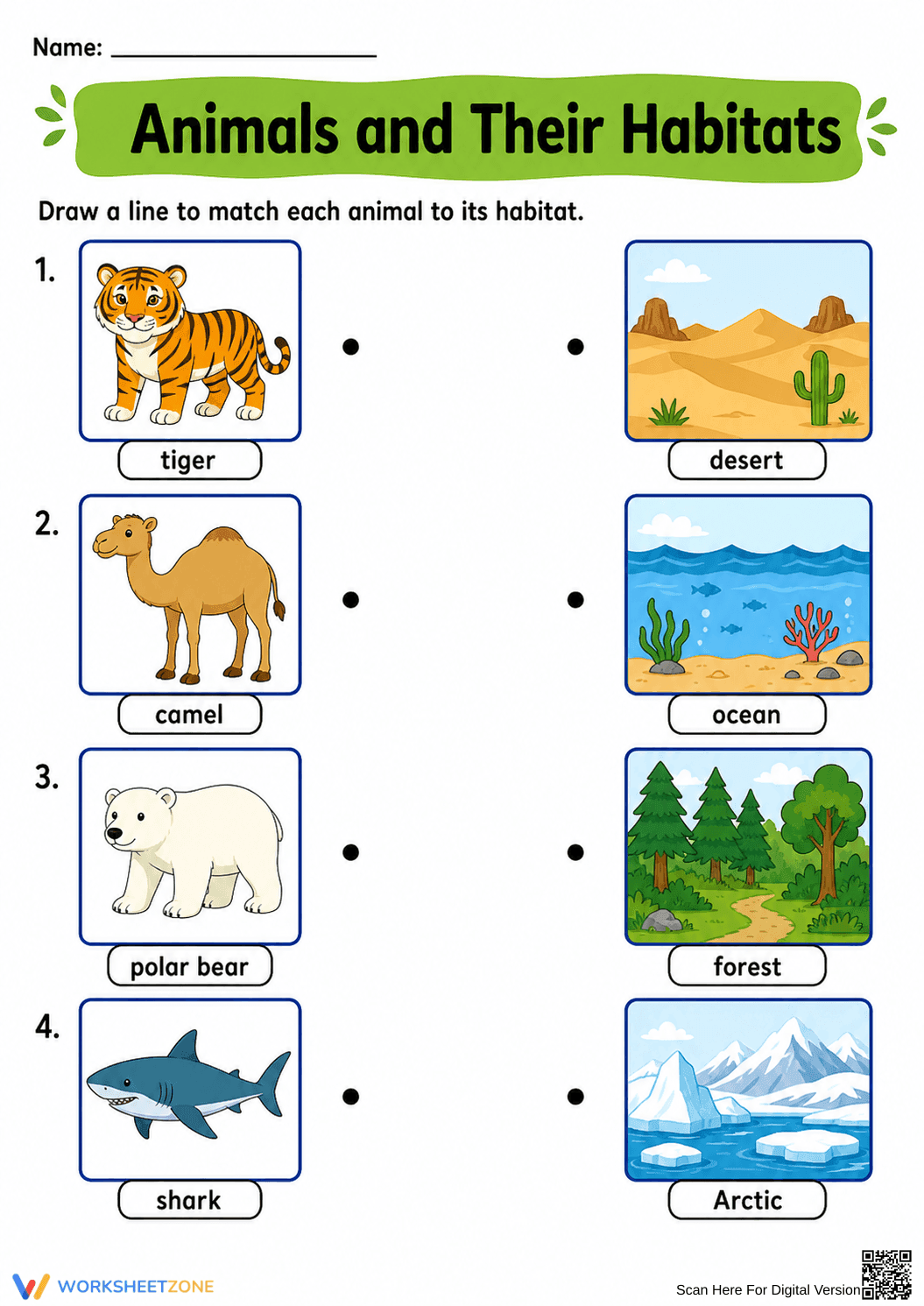

Grade K-1 Animal Habitats — Printable No-Prep Worksheet

Paste this activity's link or code into your existing LMS (Google Classroom, Canvas, Teams, Schoology, Moodle, etc.).
Students can open and work on the activity right away, with no student login required.
You'll still be able to track student progress and results from your teacher account.
This Grade K-1 animal habitats worksheet helps early learners connect living things to their natural environments. Students identify animals—including tigers, camels, polar bears, and sharks—and link them to the desert, ocean, forest, or Arctic. This activity builds foundational biological awareness and critical thinking skills while reinforcing vocabulary through visual and text-based associations.
At a Glance
- Grade: K–1 · Subject: Science
- Standard:
K-ESS3-1— Represent the relationship between animals and the places they live- Skill Focus: Habitat Identification
- Format: 1 page · 4 problems · Answer key included · PDF
- Best For: Independent science centers or quick morning work
- Time: 5–10 minutes
This single-page PDF features four high-quality illustrations of animals paired with their respective habitats. Each task is numbered and includes clear text labels to support emerging readers. The layout is designed for easy matching with large focal points and distinct connecting dots. A complete answer key is provided to facilitate rapid teacher review or student self-correction, ensuring immediate feedback on ecological concepts.
Zero-Prep Workflow
The zero-prep design allows teachers to implement this lesson in under two minutes. First, print the single-page document. Second, distribute it to the class for five minutes of independent work. Third, review the answers as a group, making this an ideal addition to an emergency sub plan or a transition activity between more complex science modules.
Standards Alignment
This worksheet is primarily aligned with NGSS K-ESS3-1, focusing on how animals depend on their surroundings to survive. By matching creatures like the polar bear to the Arctic and the camel to the desert, students demonstrate an understanding of habitat-specific needs. Both standard codes can be copied directly into lesson plans, IEP goals, or district curriculum mapping tools to track student progress in life science.
How to Use It
Use this worksheet as a formative assessment after a direct instruction lesson on biomes. Observing whether a student correctly matches the shark to the ocean provides immediate data on their grasp of environmental relationships. It also works well as a hook activity to gauge prior knowledge about world environments and animal diversity. Expected completion time is 5 to 10 minutes.
Who It's For
Designed for preschool, kindergarten, and first-grade students, this resource is particularly effective for visual learners and English Language Learners (ELLs) due to its heavy reliance on pictorial cues. It pairs naturally with an introductory reading passage about animal homes or a classroom anchor chart displaying different world biomes, providing a tactile way to reinforce abstract biological facts.
The integration of visual matching tasks for early childhood science instruction is supported by research in cognitive development. According to Fisher & Frey (2014), the use of non-linguistic representations and classification activities helps young learners organize complex information into manageable mental frameworks. This K-ESS3-1 aligned resource requires students to identify the unique relationship between animals and their habitats, a core requirement of the Next Generation Science Standards. By engaging with 4 distinct environments—the desert, ocean, forest, and Arctic—students build the habitats schema necessary for more advanced ecological studies in later grades. ScienceDirect TpT Analysis suggests that high-quality, focused matching worksheets are effective for reinforcing specific vocabulary in the early grades without overwhelming students with text. This essential printable serves as a reliable tool for classroom teachers seeking to bridge the gap between observation and scientific categorization in a zero-prep format.


