


























Views
Downloads
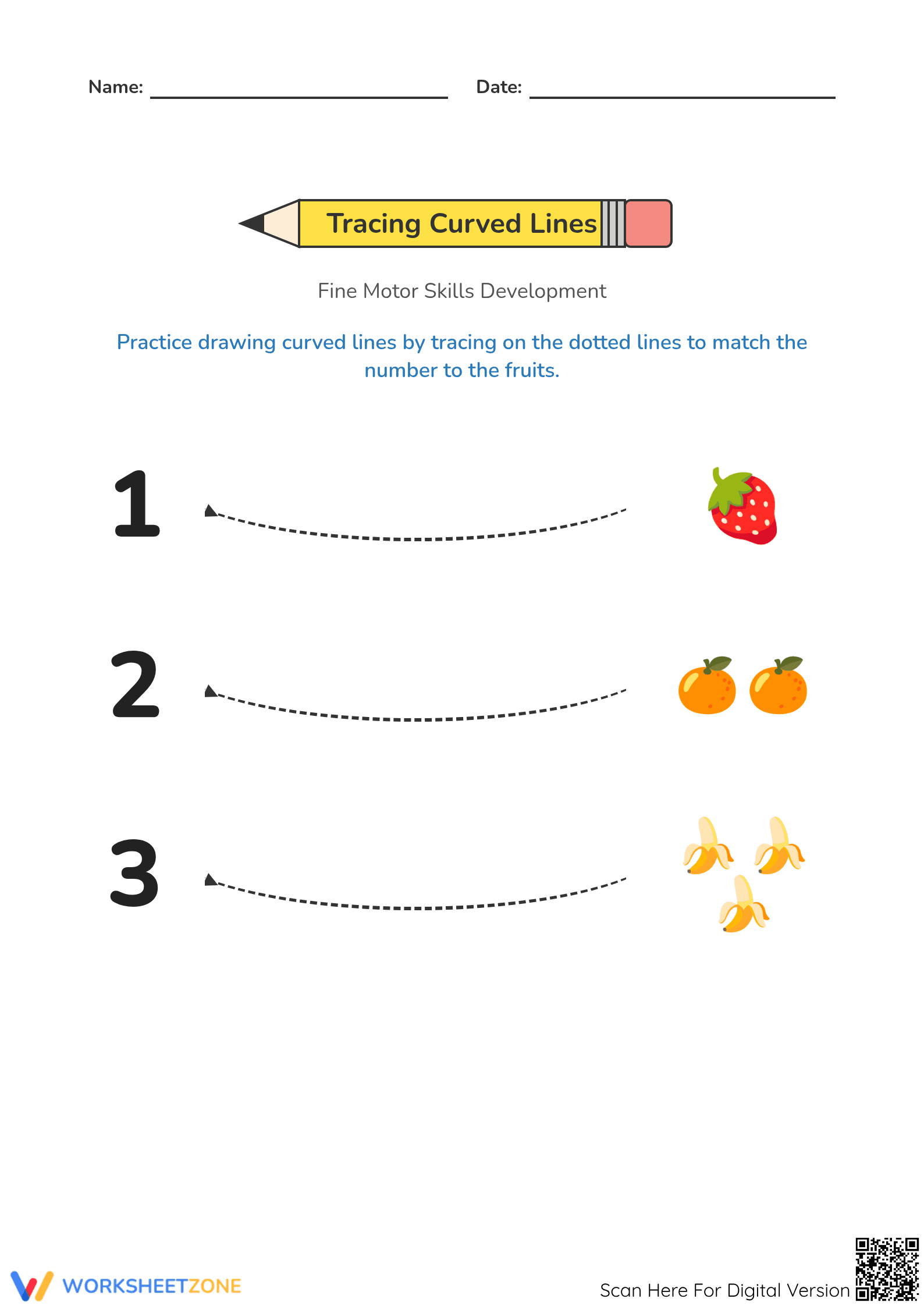

Printable Tracing & Counting Worksheet | Preschool
Paste this activity's link or code into your existing LMS (Google Classroom, Canvas, Teams, Schoology, Moodle, etc.).
Students can open and work on the activity right away, with no student login required.
You'll still be able to track student progress and results from your teacher account.
This printable Preschool worksheet helps early learners develop essential fine motor skills while practicing basic counting. By tracing curved lines to connect numbers to corresponding groups of fruit, students build hand-eye coordination and reinforce their understanding of one-to-one correspondence in a fun, engaging way.
At a Glance
- Grade: Preschool · Subject: Early Math & Literacy
- Standard:
CCSS.MATH.CONTENT.K.CC.B.4— Connect counting to cardinality and quantities- Skill Focus: Tracing curved lines and counting 1-3
- Format: 1 page · 3 problems · No answer key needed · PDF
- Best For: Morning work or centers
- Time: 5–10 minutes
What's Inside
This single-page resource features three tracing tasks for young learners. Students see large numbers (1-3) on the left and corresponding fruits on the right. Dotted curved lines connect the numbers to the fruits, providing a visual guide for tracing. The clean layout ensures preschoolers focus entirely on pencil grip and counting.
Zero-Prep Workflow
This worksheet requires zero teacher preparation.
- Print (1 minute): Simply download the PDF and print the required number of copies. The high-contrast design prints beautifully in both color and grayscale.
- Distribute (1 minute): Hand out the worksheets along with thick pencils, crayons, or washable markers suitable for early learners.
- Review (3 minutes): Briefly model how to start at the number and follow the dotted path to the fruit, counting aloud together.
Total teacher prep time is under two minutes, making this an excellent, reliable option for emergency sub plans or quick morning transitions.
Standards Alignment
This activity aligns with early learning objectives and foundational kindergarten standards, specifically CCSS.MATH.CONTENT.K.CC.B.4: Understand the relationship between numbers and quantities; connect counting to cardinality. It also supports pre-writing fine motor development necessary for future letter formation. Both standard codes can be copied directly into lesson plans, IEP goals, or district curriculum mapping tools.
How to Use It
This tracing activity works perfectly as a morning arrival task or an independent math center after a whole-group counting lesson. While students are working, teachers can conduct quick formative assessments by observing pencil grip and listening to see if students are counting the fruits aloud accurately. Expected completion time ranges from five to ten minutes, depending on the child's fine motor proficiency.
Who It's For
This resource is primarily designed for preschool and pre-kindergarten students who are just beginning to develop their fine motor control and basic number sense. It is also highly beneficial for occupational therapy sessions or special education students needing targeted practice with hand-eye coordination. For a complete lesson, pair this worksheet with physical counting manipulatives or a read-aloud book about fruits and numbers.
Developing early fine motor skills through targeted tracing activities is a critical precursor to successful handwriting and cognitive development. This worksheet addresses CCSS.MATH.CONTENT.K.CC.B.4 by helping students connect counting to cardinality and quantities while simultaneously building the hand strength required for academic tasks. According to a comprehensive EdReports 2024 analysis of early childhood curricula, integrating physical motor tasks with foundational math concepts significantly improves long-term retention and student engagement in the classroom. When preschoolers trace the curved lines from the numeral to the corresponding fruit, they are actively mapping the abstract symbol to a concrete quantity. This dual-focus approach ensures that young learners are not only memorizing numbers but also understanding their physical representation, laying a robust, lasting foundation for future mathematical fluency and essential literacy skills.


