


























Views
Downloads
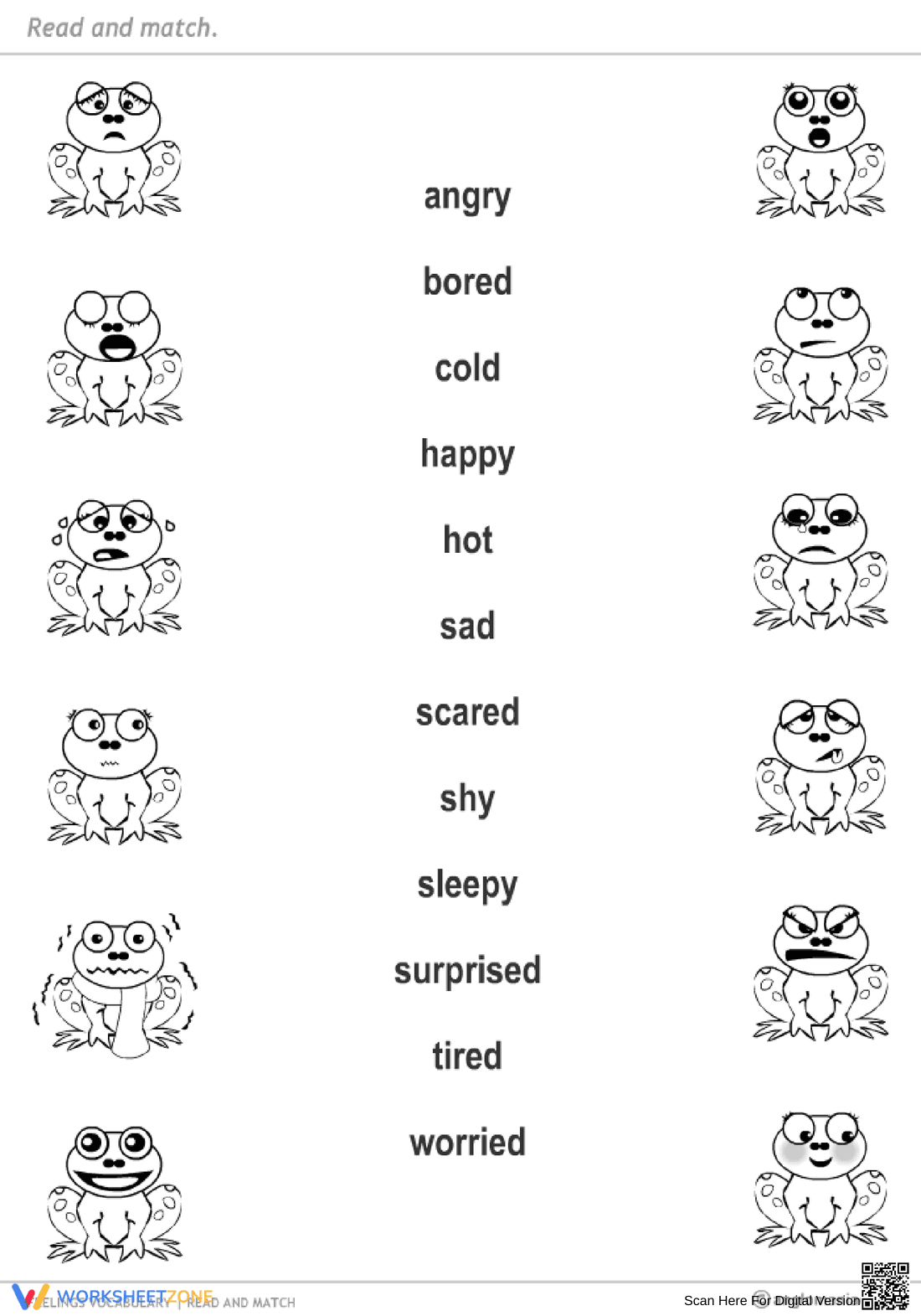

Match the Feeling Worksheet | Essential Kindergarten English
Paste this activity's link or code into your existing LMS (Google Classroom, Canvas, Teams, Schoology, Moodle, etc.).
Students can open and work on the activity right away, with no student login required.
You'll still be able to track student progress and results from your teacher account.
This Kindergarten emotions worksheet helps young learners identify and label feelings through engaging visual cues. By matching expressive frog illustrations to specific vocabulary words, students build essential social-emotional literacy and language skills. It provides a clear, structured way to connect abstract feelings with concrete visual representations and written text.
At a Glance
- Grade: Kindergarten · Subject: English
- Standard:
CCSS.ELA-LITERACY.L.K.5.C— Identify real-life connections between words and their use- Skill Focus: Emotion vocabulary and visual matching
- Format: 1 page · 12 problems · Answer key included · PDF
- Best For: Morning work or social-emotional learning
- Time: 10–15 minutes
The resource features a single-page layout containing 12 distinct frog characters, each displaying a unique facial expression or physical state. Centered between the illustrations is a list of 12 vocabulary words ranging from basic emotions like happy and sad to physical states like hot and cold. The clear black-and-white line art is perfect for printing and allows for optional coloring once the matching task is complete.
This worksheet is designed for immediate classroom implementation with a total teacher prep time of under 2 minutes. Simply print the PDF (30 seconds), distribute the sheets to students (1 minute), and review the answers together using the provided key (5 minutes). Its self-explanatory Read and Match instruction makes it an ideal candidate for emergency sub plans or independent center rotations.
This activity aligns with CCSS.ELA-LITERACY.L.K.5.C, which requires students to identify real-life connections between words and their use. By associating specific facial expressions with descriptive adjectives, students demonstrate an understanding of word meanings in a social-emotional context. Both standard codes can be copied directly into lesson plans, IEP goals, or district curriculum mapping tools.
Use this worksheet during a whole-group circle time to introduce the concept of feelings. Show one frog image and ask students to mimic the face before finding the matching word. As a formative assessment, observe if students can distinguish between similar emotions like tired and sleepy. The activity typically takes 10 to 15 minutes to complete independently during literacy blocks.
This resource is tailored for Kindergarten students, English Language Learners (ELLs) building basic descriptive vocabulary, and students receiving Special Education services focused on social-emotional recognition. It pairs naturally with a read-aloud about emotions or a classroom anchor chart displaying How I Feel Today faces to reinforce the daily application of these terms.
Research from Fisher & Frey (2014) emphasizes the importance of visual scaffolds in early literacy, noting that pairing images with text accelerates vocabulary acquisition for emergent readers. This worksheet utilizes that principle by providing 12 distinct visual anchors for the standard CCSS.ELA-LITERACY.L.K.5.C. By requiring students to decode the word and analyze the corresponding frog's expression, the activity reinforces the connection between linguistic labels and internal states. According to the RAND AIRS 2024 report, structured matching tasks in early childhood education support the development of fine motor skills alongside cognitive categorization. This printable resource offers a high-utility tool for educators to document student progress in identifying real-life connections between words and their use, ensuring that foundational social-emotional language is mastered before moving to complex narrative analysis.


