


























Views
Downloads

Match the Emotions Worksheet | Essential Kindergarten
Paste this activity's link or code into your existing LMS (Google Classroom, Canvas, Teams, Schoology, Moodle, etc.).
Students can open and work on the activity right away, with no student login required.
You'll still be able to track student progress and results from your teacher account.
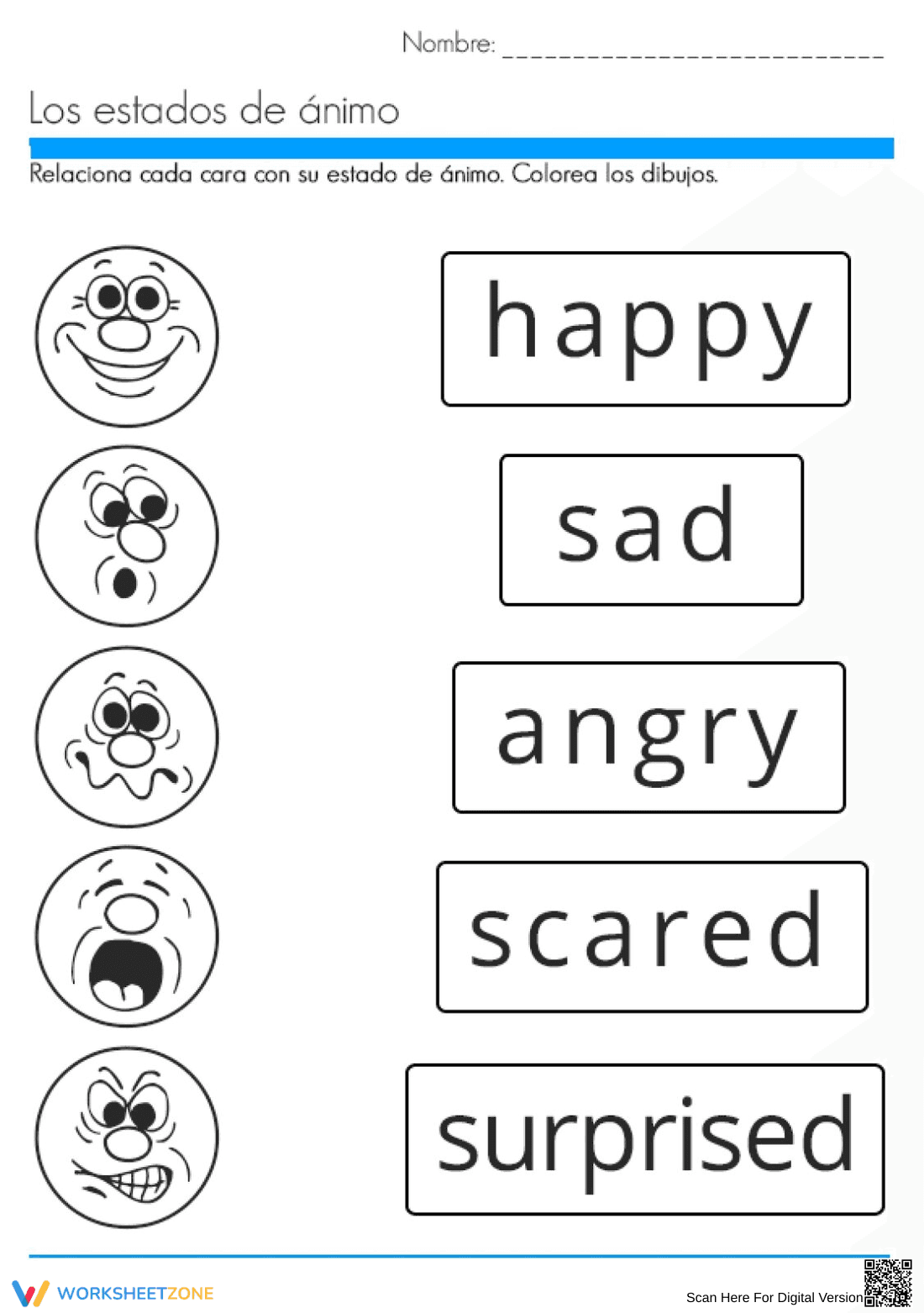
This Kindergarten emotions worksheet helps young learners identify and label five core feelings: happy, sad, angry, scared, and surprised. By connecting visual facial expressions to written English vocabulary, students strengthen their social-emotional literacy and word recognition skills. This resource provides a clear, structured way for children to communicate complex internal states through simple matching.
At a Glance
- Grade: Kindergarten · Subject: English / Behavior
- Standard:
CCSS.ELA-LITERACY.L.K.5.C— Identify real-life connections between words and their use- Skill Focus: Emotion recognition and vocabulary
- Format: 1 page · 5 problems · Answer key included · PDF
- Best For: Social-emotional learning and ESL vocabulary
- Time: 10–15 minutes
This single-page PDF features five distinct emoji-style illustrations representing common human emotions. Opposite the images are five clear text boxes containing the corresponding English words: happy, sad, angry, scared, and surprised. The worksheet includes Spanish-language instructions to support bilingual classrooms or ELL students, encouraging them to draw lines to match the pairs and color the illustrations upon completion.
The zero-prep design allows for immediate classroom implementation. First, print the single-page PDF (30 seconds). Second, distribute the sheets to students during a morning meeting or literacy block (1 minute). Third, review the answers as a whole group to reinforce pronunciation and facial mimicry (5 minutes). Total teacher preparation time is under 2 minutes, making it an ideal choice for substitute folders or transition periods.
This resource aligns with CCSS.ELA-LITERACY.L.K.5.C, which requires students to identify real-life connections between words and their use. By mapping facial expressions to specific adjectives, students demonstrate an understanding of how language describes the human experience. This standard code can be copied directly into lesson plans, IEP goals, or district curriculum mapping tools.
Use this worksheet during a Social-Emotional Learning (SEL) block after reading a story about feelings. As a formative assessment, observe if students can mimic the face before drawing the line. It also serves as an excellent "do-now" activity to gauge the emotional temperature of the classroom. Expect students to complete the matching and coloring within 10 to 15 minutes.
This activity is designed for Kindergarten students, particularly those in dual-language or ESL programs who benefit from the Spanish instructional support. It is also highly effective for students with developmental delays who are working on non-verbal cue recognition. Pair this with a "Feelings Chart" anchor chart for maximum instructional impact.
Research by Fisher & Frey (2014) emphasizes the importance of visual scaffolding in early childhood vocabulary acquisition, particularly when bridging social-emotional concepts with written language. This worksheet utilizes the "gradual release of responsibility" by providing clear visual cues that anchor the abstract concept of "feelings" to concrete English labels. According to the CCSS.ELA-LITERACY.L.K.5.C framework, Kindergarteners who successfully identify these real-life connections are better prepared for the complex character analysis required in later elementary grades. By engaging in these 5 matching tasks, students build the foundational "word-to-world" connections necessary for communicative competence. This resource provides a structured, evidence-based approach to early literacy that supports both linguistic and behavioral development goals in a single, accessible format.


