




























Views
Downloads

Printable Virus Life Cycle Worksheet | Grades 7-10

Paste this activity's link or code into your existing LMS (Google Classroom, Canvas, Teams, Schoology, Moodle, etc.).
Students can open and work on the activity right away, with no student login required.
You'll still be able to track student progress and results from your teacher account.
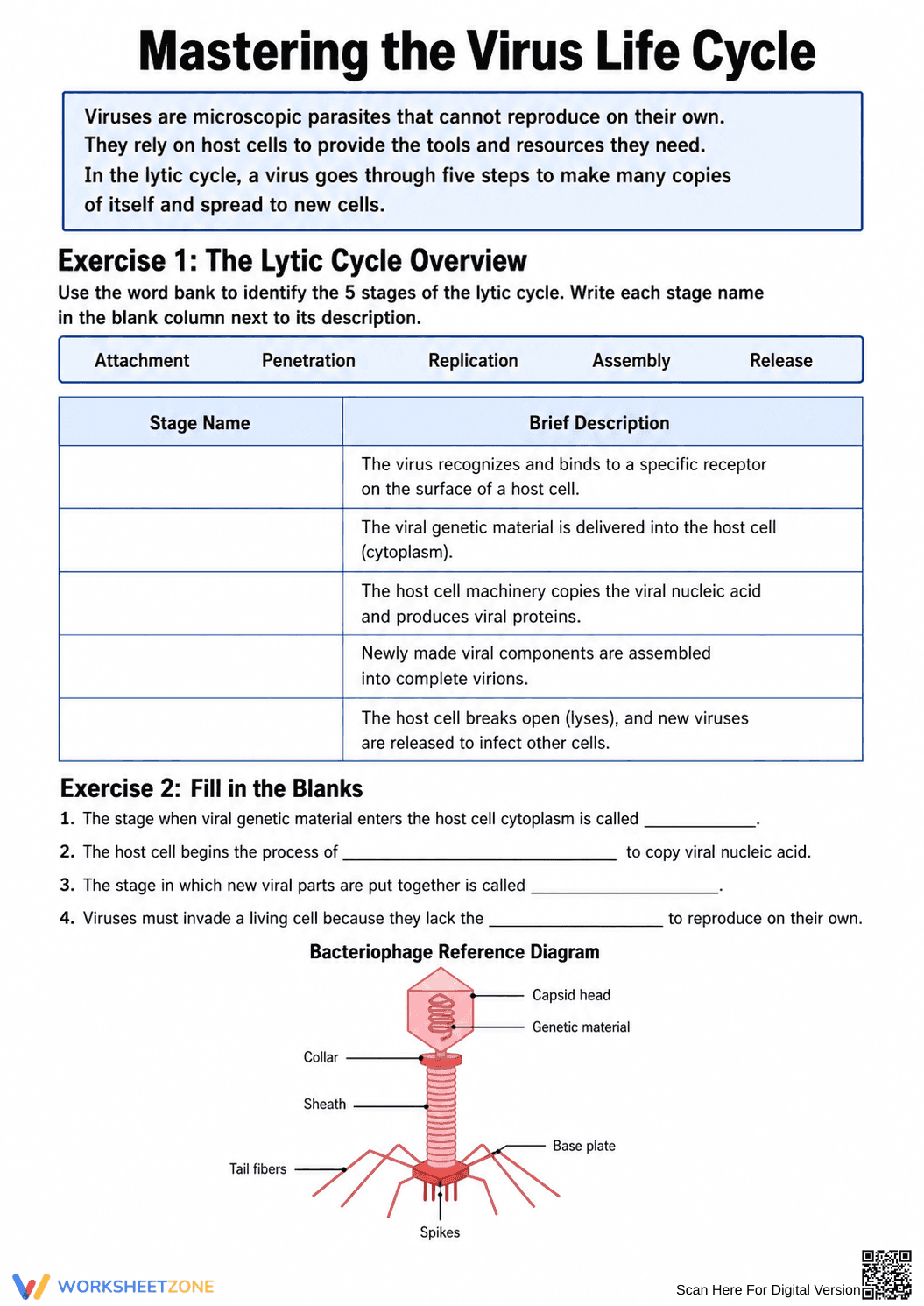
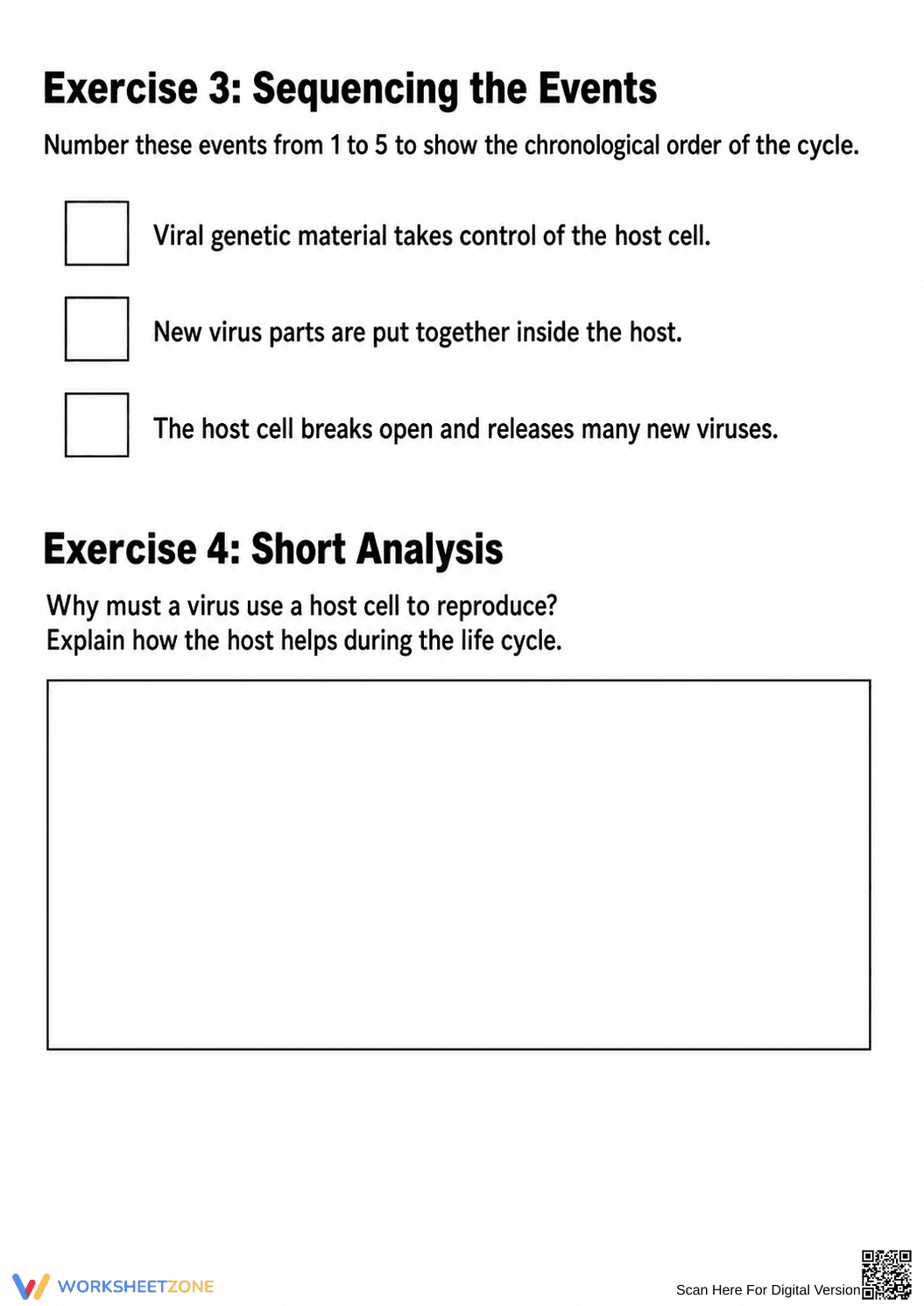
This ready-to-use worksheet helps students master the virus life cycle by breaking down the five stages of the lytic cycle. Students will sequence viral infection events, analyze bacteriophage structures, and explain how viruses hijack host cells to replicate, building essential virology comprehension and scientific vocabulary.
At a Glance
- Grade: 7–10 · Subject: Science
- Standard:
MS-LS1-2— Describe how viruses interact with cellular machinery- Skill Focus: Virus Lytic Cycle
- Format: 2 pages · 13 problems · Answer key included · PDF
- Best For: Independent practice
- Time: 15–25 minutes
This comprehensive two-page resource features four distinct exercise types to reinforce learning. Students begin with a word bank matching activity to identify the five lytic cycle stages, followed by fill-in-the-blank questions to solidify key terminology. The worksheet also includes a chronological sequencing task and a short-answer analysis question. A detailed bacteriophage reference diagram is provided directly on the page to support visual learners.
Zero-Prep Workflow
- Print (1 min): The two-page layout is formatted for immediate printing with clear, legible text and high-contrast diagrams.
- Distribute (1 min): Hand out the worksheets as a standalone assignment. The included reference diagram and word bank mean students can start immediately without extra materials.
- Review (5 mins): Use the included answer key to quickly grade submissions or guide a whole-class review session.
With under two minutes of total teacher prep time required, this resource is an ideal emergency sub plan or a perfect addition to your existing microbiology unit.
This worksheet aligns with MS-LS1-2 by helping students develop an understanding of how cellular functions are impacted when a virus introduces its genetic material into a host. It also supports high school biology foundations by introducing viral replication mechanisms. Both standard codes can be copied directly into lesson plans, IEP goals, or district curriculum mapping tools.
How to Use It
Deploy this worksheet immediately after direct instruction on microorganisms to solidify new concepts. It serves perfectly as an independent classwork assignment or a structured homework task. As students complete the short analysis question, teachers can use their responses as a formative assessment to check if they truly grasp why viruses are obligate intracellular parasites. Expect most students to complete the full sequence of 13 problems within 15 to 25 minutes.
Who It's For
This resource is designed for middle and early high school science students in Grades 7 through 10. The built-in scaffolds, such as the word bank and reference diagram, make it highly accessible for diverse learners, including those who need visual aids to grasp abstract microscopic processes. It pairs excellently with introductory cell biology lessons or interactive digital models of viral infection.
Understanding microscopic processes requires structured, multimodal practice. Aligning with MS-LS1-2, this resource helps students describe how viruses interact with cellular machinery through targeted sequencing and vocabulary exercises. According to EdReports 2024, science instructional materials that combine visual models with explicit vocabulary practice significantly improve student retention of complex biological systems. By integrating a bacteriophage diagram directly alongside matching and sequencing tasks, this worksheet reduces cognitive load and allows learners to focus on the mechanics of the lytic cycle. The progression from simple identification to short-answer analysis ensures that students do not merely memorize terms, but actively construct an understanding of viral replication. This evidence-based approach supports deeper scientific literacy and prepares students for more advanced cellular biology topics.


