




























Views
Plays

Printable ASVAB Ratio and Proportion Worksheet

Paste this activity's link or code into your existing LMS (Google Classroom, Canvas, Teams, Schoology, Moodle, etc.).
Students can open and work on the activity right away, with no student login required.
You'll still be able to track student progress and results from your teacher account.
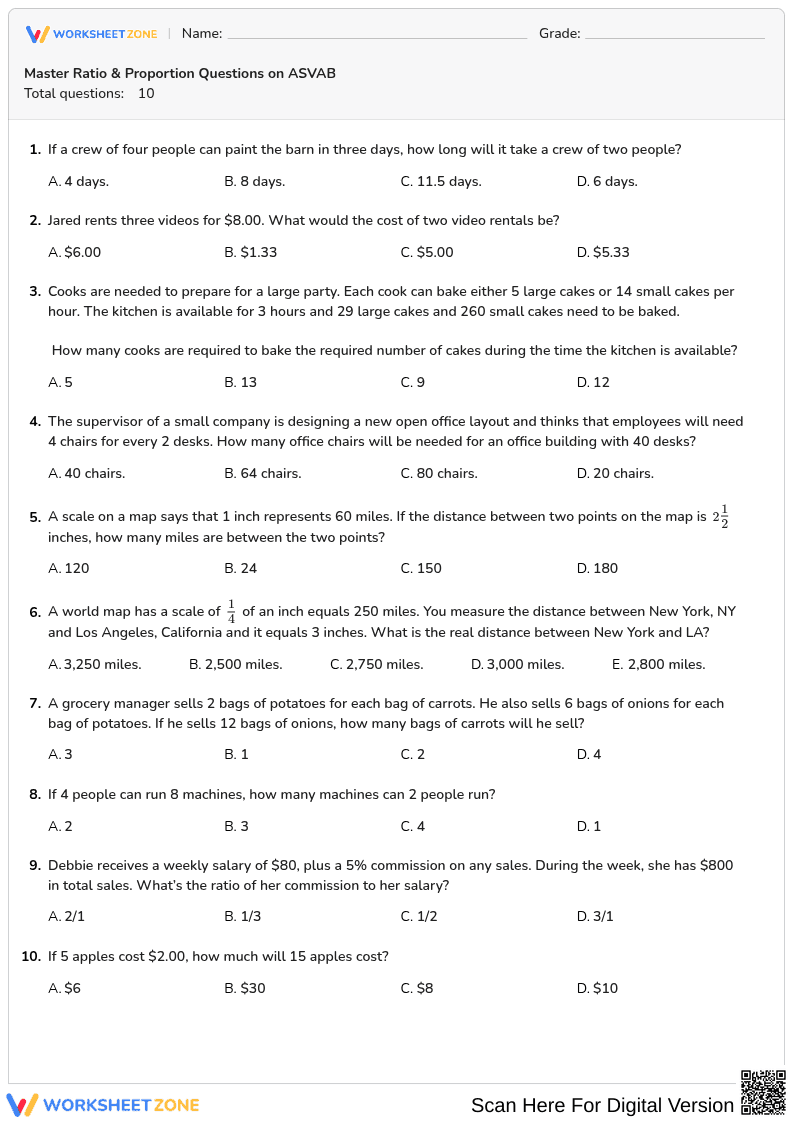
This printable worksheet helps students master ratio and proportion word problems through ten realistic practice questions. Students apply proportional reasoning to solve real-world scenarios involving rates, scales, and percentages. This resource builds the essential mathematical foundations required for success on standardized exams like the ASVAB.
At a Glance
- Grade: 7 · Subject: Mathematics
- Standard:
CCSS.MATH.CONTENT.7.RP.A.3— Solve multi-step ratio and percent problems in real-world contexts- Skill Focus: Ratios, proportions, and unit rates
- Format: 1 page · 10 problems · Answer key included · PDF
- Best For: Independent practice and test preparation
- Time: 20–30 minutes
This single-page PDF contains ten multiple-choice word problems focusing on proportional relationships. The questions cover diverse scenarios including work rates, scale drawings, unit pricing, and commission calculations. Each problem features four distinct options to simulate standardized testing formats, helping learners build confidence and accuracy. A complete answer key is provided for quick grading.
Streamline your lesson planning with a simple three-step workflow that requires under two minutes of teacher preparation. First, print the single-page worksheet for your class. Second, distribute the sheets to students for a focused twenty-minute independent session. Third, review the answers using the included key for immediate feedback. This layout is ideal for emergency sub plans.
This resource aligns directly with the primary standard CCSS.MATH.CONTENT.7.RP.A.3, which requires students to use proportional relationships to solve multistep ratio and percent problems. Additionally, it supports foundational concepts in CCSS.MATH.CONTENT.6.RP.A.3 by applying ratio reasoning to solve real-world mathematical problems. Both standard codes can be copied directly into lesson plans, IEP goals, or district curriculum mapping tools.
Use this worksheet as a post-instruction formative assessment to measure student understanding of rates and proportions. Administer it during the independent practice portion of your lesson, allowing twenty to thirty minutes for completion. While students work, observe how they set up their proportions to identify common misconceptions about inverse relationships.
This practice sheet is designed for middle school students mastering proportional relationships and adult learners preparing for the ASVAB. Teachers can differentiate instruction by pairing this worksheet with a visual anchor chart on cross-multiplication. It serves as an excellent review tool for students who need targeted practice with multi-step word problems.
This worksheet targets the development of proportional reasoning, a critical milestone in mathematical literacy. By focusing on CCSS.MATH.CONTENT.7.RP.A.3, the resource guides students to solve multi-step ratio and percent problems. Research by Fisher & Frey (2014) emphasizes that structured independent practice with word problems reinforces cognitive retrieval and helps transition skills from guided instruction to long-term retention. The ten multiple-choice questions simulate standardized testing conditions, allowing students to apply mathematical concepts to practical scenarios like scale drawings and commission rates. This targeted practice builds the procedural fluency necessary for success on high-stakes assessments. Educators can integrate this tool to support diverse learners, ensuring they meet grade-level expectations while developing problem-solving stamina. Using this structured approach ensures students master ratios.


