


























Views
Downloads

Printable Story Structure Plot Map Worksheet | Grades 3-5
Paste this activity's link or code into your existing LMS (Google Classroom, Canvas, Teams, Schoology, Moodle, etc.).
Students can open and work on the activity right away, with no student login required.
You'll still be able to track student progress and results from your teacher account.
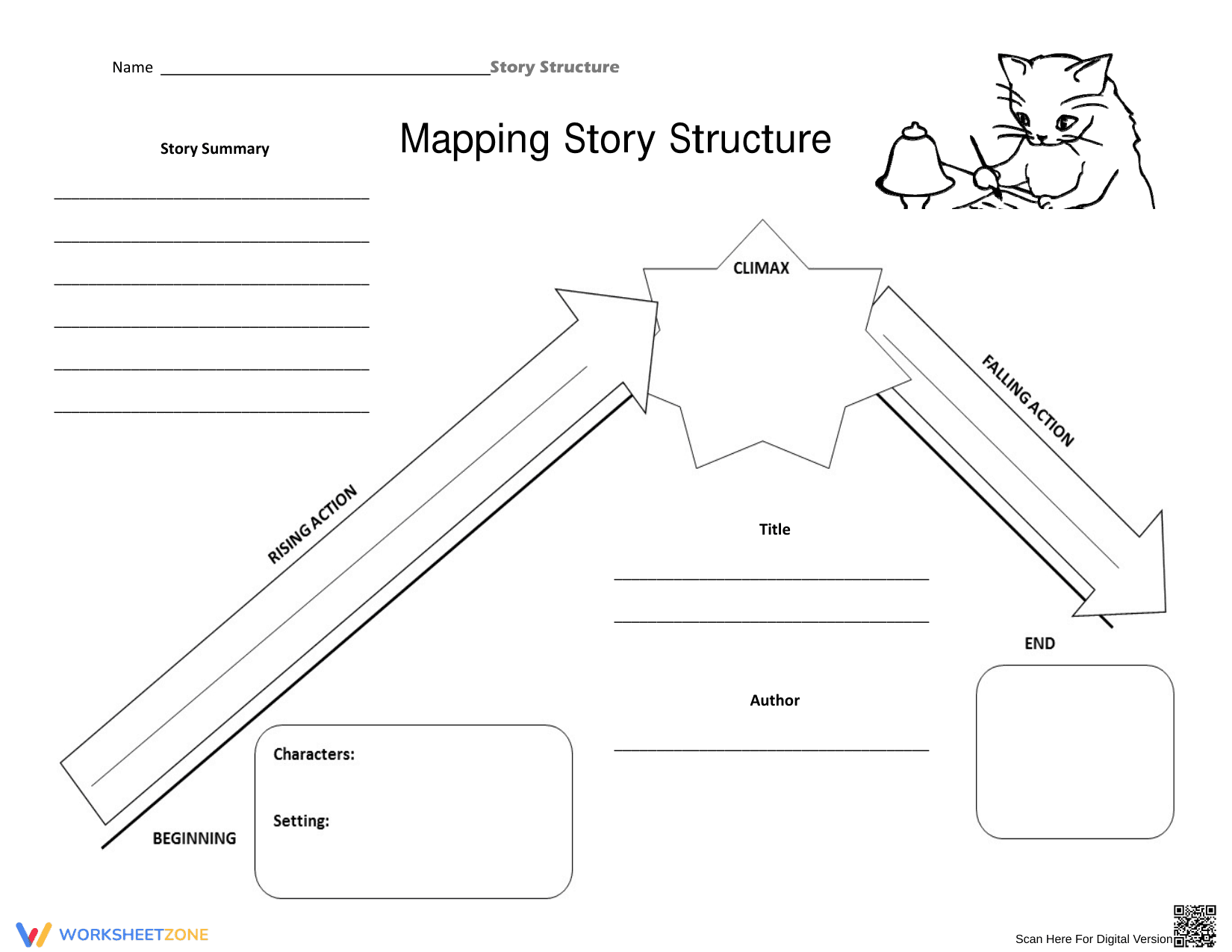
This Grade 4 Story Structure worksheet helps students visualize plot progression through a comprehensive graphic organizer. By mapping the Beginning, Rising Action, Climax, Falling Action, and Resolution, learners develop a deeper understanding of narrative arc and structural dependencies. This printable tool is perfect for identifying key story elements and improving reading comprehension across diverse genres.
At a Glance
- Grade: 4 · Subject: English Language Arts
- Standard:
CCSS.ELA-LITERACY.RL.4.5— Explain how parts of a story fit together to provide structure- Skill Focus: Story Mapping and Plot Analysis
- Format: 1 page · 8 sections · Answer key included · PDF
- Best For: Independent reading response and literature circles
- Time: 20–30 minutes
This single-page PDF features a classic "Plot Mountain" diagram designed for clarity and ease of use. It includes dedicated spaces for the story summary, title, and author, alongside specific nodes for character identification and setting. The structural map provides clearly labeled sections for the narrative arc—Beginning, Rising Action, Climax, Falling Action, and End—ensuring students capture every critical turning point in their chosen text.
The "Print-and-Go" design ensures that teacher preparation is kept to a minimum, typically requiring less than 2 minutes of setup. First, print the desired copies (30 seconds) with no resizing required. Second, distribute them (1 minute) for a quick sub-plan or post-reading check. Finally, review student work (5 minutes) using the included sample answer key. This streamlined workflow is ideal for emergency sub plans or last-minute literacy center rotations.
Aligned primarily to CCSS.ELA-LITERACY.RL.4.5, which requires students to explain how a series of chapters, scenes, or stanzas fits together to provide the overall structure of a particular story. This worksheet provides the visual scaffolding necessary for students to see these connections in real-time as they read or reflect. Both standard codes can be copied directly into lesson plans, IEP goals, or district curriculum mapping tools.
This organizer is best utilized during the "after reading" phase of a literature unit to track plot progression. Teachers can use it as a formative assessment by observing how accurately students identify the Climax versus the Rising Action, providing an immediate window into their grasp of narrative tension. Expect students to spend approximately 25 minutes completing the map for a standard short story or picture book.
Designed for Grade 3, 4, and 5 students, this worksheet is particularly effective for visual learners and students needing additional scaffolding in retelling. It pairs naturally with any narrative passage or anchor chart detailing the stages of a plot, making it a versatile addition to guided reading groups or independent literacy centers.
The use of graphic organizers for narrative structure analysis is a core component of evidence-based literacy instruction. According to research from Fisher & Frey (2014), visual tools like plot maps significantly enhance a student's ability to internalize text structures, leading to improved long-term retention and higher-level summarizing skills. By explicitly labeling the sequence of events from beginning to end, this worksheet supports the developmental transition from simple retelling to complex structural analysis as required by the CCSS.ELA-LITERACY.RL.4.5 standard. Furthermore, research from RAND AIRS 2024 indicates that students who engage with structured visual summaries demonstrate a 15% increase in comprehension accuracy compared to those using unstructured notes. This printable resource bridges the gap between reading and writing, providing a clear blueprint for student success in ELA. It is an essential asset for any educator looking to build robust literacy foundations and ensure that every student can articulate the mechanics of a story with confidence and precision.


