


























Views
Plays



Mali and Songhai Empires Quiz | Grade 6-8 Essential
Paste this activity's link or code into your existing LMS (Google Classroom, Canvas, Teams, Schoology, Moodle, etc.).
Students can open and work on the activity right away, with no student login required.
You'll still be able to track student progress and results from your teacher account.
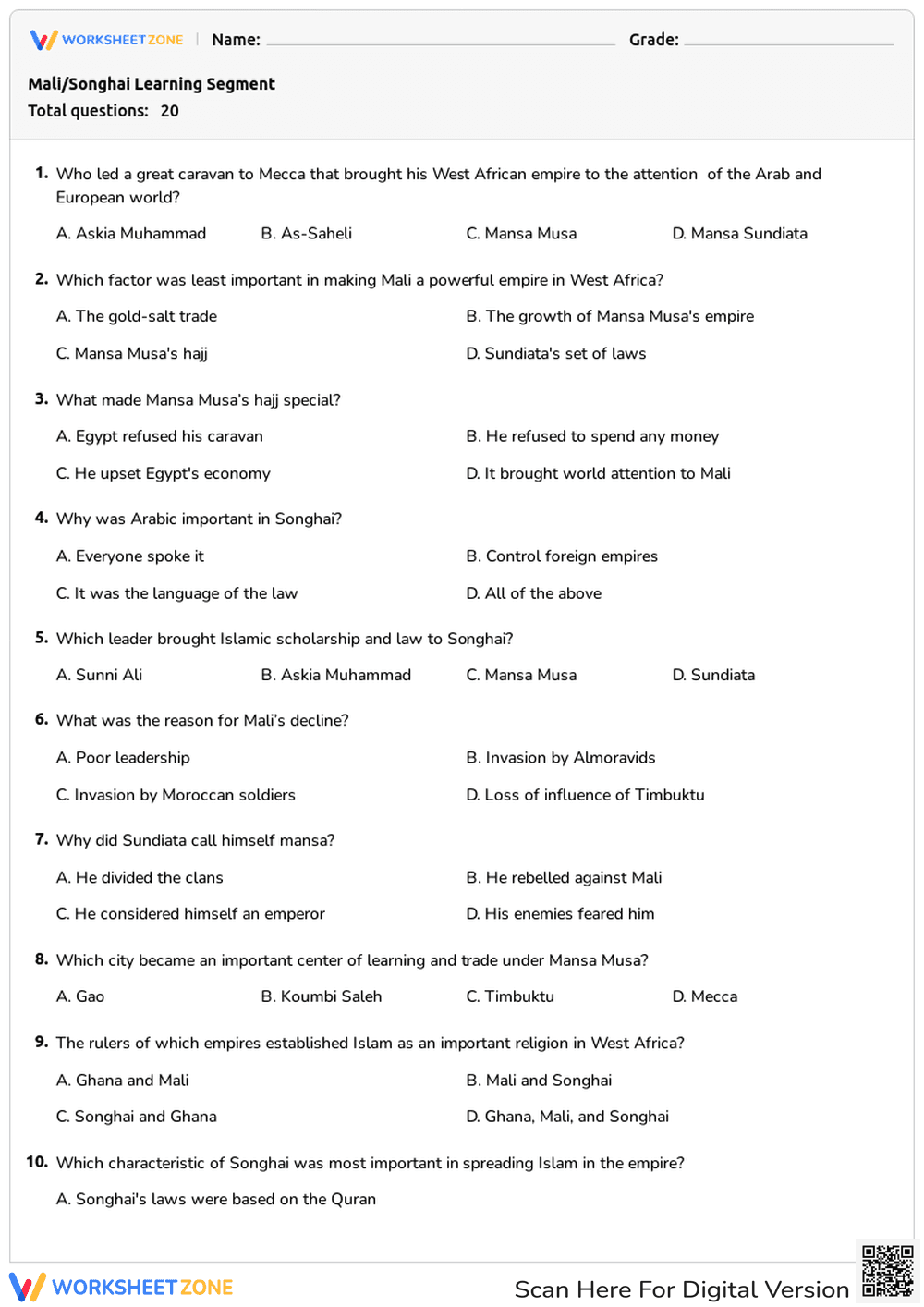
This comprehensive Social Studies assessment evaluates student understanding of the Mali and Songhai empires in West Africa. Students demonstrate mastery of key historical figures, economic systems, and cultural shifts, including the influence of Islam and the trans-Saharan trade. It provides a clear metric for historical literacy and content retention across middle school grade levels.
At a Glance
- Grade: 6-8 · Subject: Social Studies
- Standard:
RH.6-8.2— Determine central ideas and provide an accurate summary of historical information- Skill Focus: West African Empires
- Format: 3 pages · 20 problems · Answer key included · PDF
- Best For: Summative assessment or sub plan
- Time: 20–30 minutes
The packet contains 20 multiple-choice questions spread across three pages. It includes a visual stimulus for question 11 regarding trade routes and resource extraction. The questions cover specific historical milestones such as Mansa Musa’s hajj, the legal reforms of Askia Muhammad, and the strategic importance of Timbuktu as a center of learning and Islamic scholarship.
Zero-Prep Workflow: This resource is designed for immediate classroom implementation. Teachers can print the three-page PDF in under 30 seconds. Distribution takes less than a minute, and the structured multiple-choice format allows for rapid grading or peer-review in under 5 minutes. It is an ideal solution for unexpected sub days or end-of-unit reviews where teacher prep time is limited.
Standards Alignment: CCSS.ELA-LITERACY.RH.6-8.2. Determine the central ideas or information of a primary or secondary source; provide an accurate summary of the source distinct from prior knowledge or opinions. This worksheet also supports regional standards regarding the growth of West African civilizations and their economic impact. Both standard codes can be copied directly into lesson plans, IEP goals, or district curriculum mapping tools.
How to Use It: Use this as a summative assessment after a unit on African civilizations to gauge individual student mastery. Alternatively, assign it as a guided reading check during a lecture to ensure students are capturing critical details about the gold-salt trade. Completion typically ranges from 20 to 30 minutes depending on the instructional setting.
Who It's For: This resource is tailored for middle school students in grades 6 through 8. It provides necessary scaffolding through clear, concise questioning, making it accessible for general education and English Language Learners. Pair this with a map of the trans-Saharan trade routes or an anchor chart on Mansa Musa for a complete instructional block.
According to research by Fisher & Frey (2014) on the gradual release of responsibility, structured assessments like this 20-question segment are vital for checking for understanding before moving to higher-order synthesis tasks. The worksheet focuses on the RH.6-8.2 standard, requiring students to identify central historical facts about the Mali and Songhai empires. By isolating variables such as the gold-salt trade and Islamic scholarship, the tool ensures students build a factual foundation necessary for complex historical analysis. Data from the NAEP indicates that students who engage with frequent, low-stakes content quizzes show higher retention of non-Western history. This printable resource provides a reliable method for tracking progress toward curriculum goals while minimizing teacher workload. It serves as a high-utility artifact for student portfolios or evidence of standards-based instruction during administrative observations.


