


























Views
Downloads

Essential Suffixes Worksheet | Grade 3-4 Vocabulary Ready
Paste this activity's link or code into your existing LMS (Google Classroom, Canvas, Teams, Schoology, Moodle, etc.).
Students can open and work on the activity right away, with no student login required.
You'll still be able to track student progress and results from your teacher account.
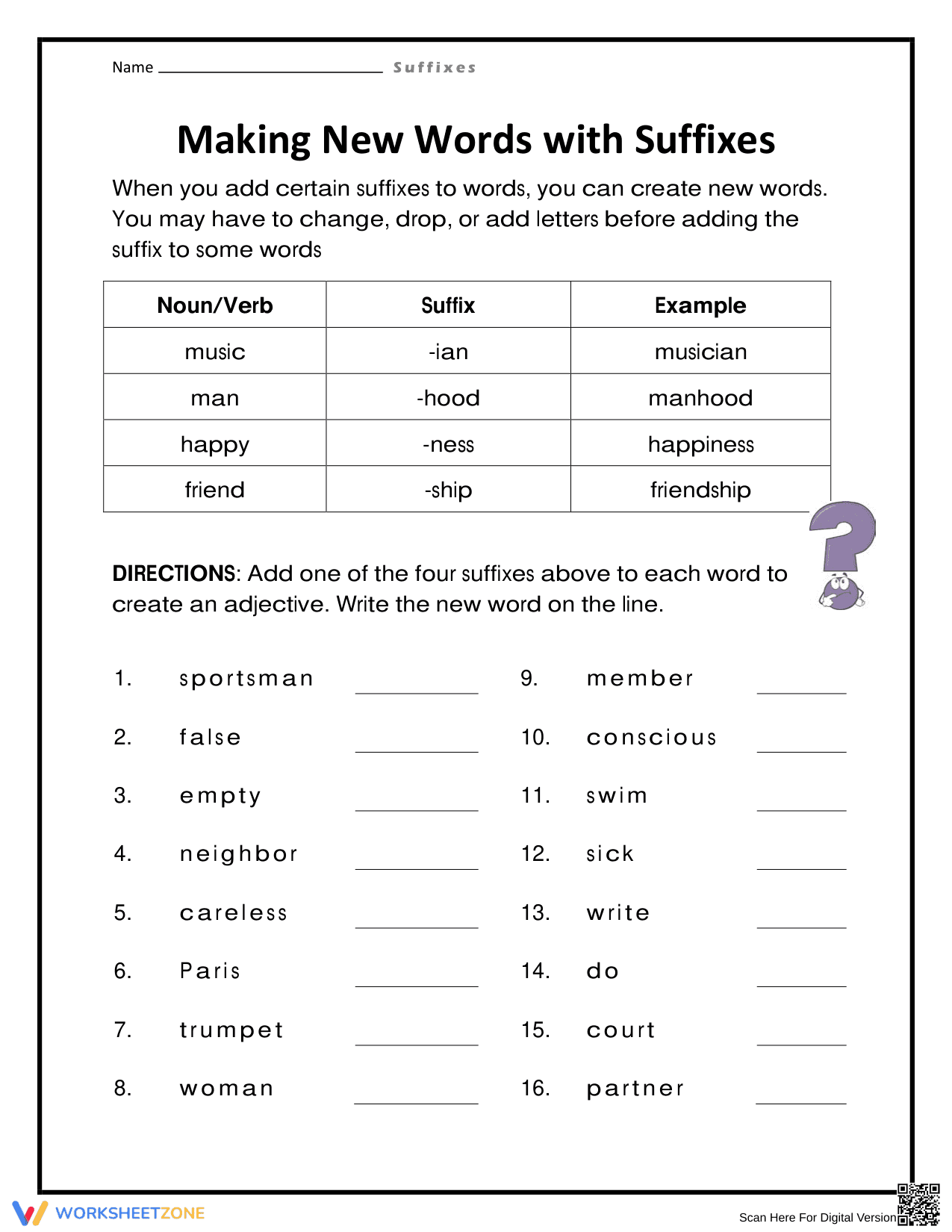
Affix mastery is a foundational step in vocabulary development for elementary students. This "Making New Words with Suffixes" worksheet provides structured practice using common suffixes like -ian, -hood, -ness, and -ship. By transforming base words into new forms, students strengthen their understanding of word parts, improving reading comprehension and writing precision.
At a Glance
- Grade: 3–4 · Subject: ELA Vocabulary
- Standard:
CCSS.ELA-LITERACY.L.3.4.B— Determine the meaning of the new word formed when a known affix is added- Skill Focus: Noun-forming suffixes (-ian, -hood, -ness, -ship)
- Format: 1 page · 16 problems · Answer key included · PDF
- Best For: Independent practice and vocabulary reinforcement
- Time: 15–20 minutes
This resource features a clear instructional table illustrating how specific suffixes change the meaning of words. Students tackle 16 target words, from nouns like "neighbor" to verbs like "swim." The worksheet includes a reference guide for -ian, -hood, -ness, and -ship, with examples like "musician" and "friendship" to support independent student work.
This classroom-ready PDF is designed for immediate use. Teachers can download and print the document in seconds. Distributing the worksheet takes just a minute, and because it includes a self-explanatory reference table, students can work independently. The provided answer key allows for a rapid five-minute review session at the end of the lesson.
The primary alignment is CCSS.ELA-LITERACY.L.3.4.B, requiring students to determine the meaning of new words formed with affixes. By practicing with suffixes that create nouns, students meet Grade 3 and 4 expectations for morphological awareness. Both standard codes can be copied directly into lesson plans, IEP goals, or district curriculum mapping tools.
This worksheet is ideal for follow-up practice or targeted intervention. For a formative assessment, observe students as they complete items 6 (Paris) and 11 (swim) to check for correct spelling changes like doubling consonants. It typically takes 15 to 20 minutes for completion. This resource is perfect for morning work or sub plans.
Designed for Grade 3 and 4, this resource is effective for English Language Learners (ELLs) who benefit from explicit word formation instruction. It also serves students with IEP goals for vocabulary expansion. This worksheet pairs well with a root word anchor chart or a reading passage focused on community roles and personal traits.
Morphological awareness is a critical predictor of reading comprehension. According to research cited in EdReports 2024, explicit instruction in affixes and root words significantly improves a student's ability to decode and understand multisyllabic words. This worksheet targets CCSS.ELA-LITERACY.L.3.4.B by requiring students to apply specific noun-forming suffixes like -ness and -ship to known base words. By completing these 16 tasks, students demonstrate mastery of how suffixes alter word meanings. Fisher & Frey (2014) emphasize that such structured practice supports the gradual release of responsibility, allowing students to move from guided examples to independent application. This resource provides the necessary scaffolding to bridge that gap, ensuring students build a robust vocabulary that supports literacy development across all content areas. It offers a measurable way to track student progress in word analysis and morphological fluency during ELA rotations.


