


























Views
Downloads
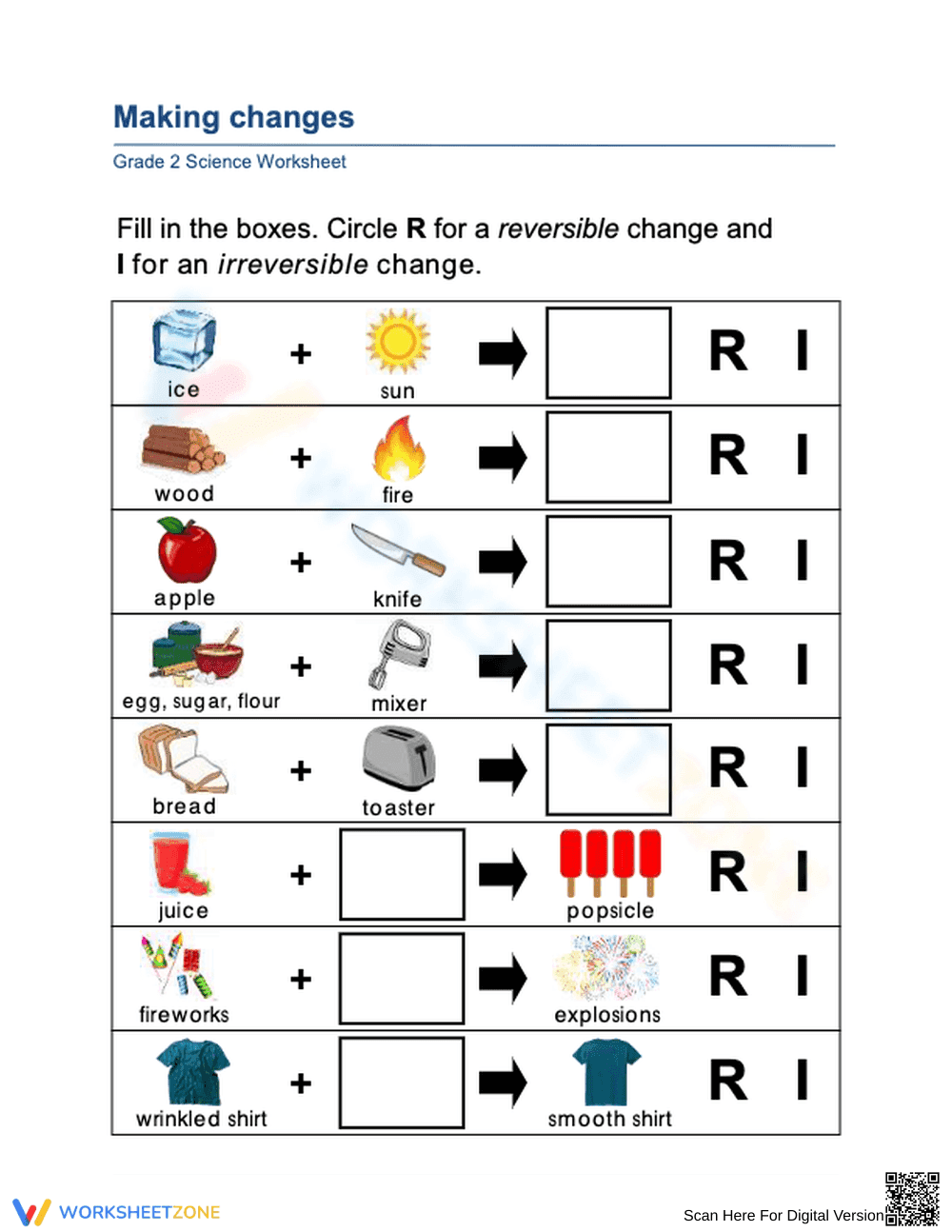

Grade 2 Reversible Changes — Printable No-Prep Worksheet
Paste this activity's link or code into your existing LMS (Google Classroom, Canvas, Teams, Schoology, Moodle, etc.).
Students can open and work on the activity right away, with no student login required.
You'll still be able to track student progress and results from your teacher account.
This Grade 2 science worksheet helps students master the concept of reversible and irreversible changes. By analyzing everyday scenarios like melting ice or burning wood, learners will identify whether a physical or chemical transformation can be undone, building a strong foundation in early physical science concepts.
At a Glance
- Grade: 2 · Subject: Science
- Standard:
2-PS1-4— Identify changes from heating or cooling as reversible or not- Skill Focus: Reversible and Irreversible Changes
- Format: 1 page · 8 problems · Answer key included · PDF
- Best For: Independent practice or morning work
- Time: 10–15 minutes
This resource features a single, highly visual student page containing eight distinct transformation scenarios. For each scenario, students must fill in a missing component—such as the resulting product or the heat source applied—and then circle 'R' for a reversible change or 'I' for an irreversible change. A complete, color-coded answer key is provided on the second page to ensure quick and accurate grading.
Designed for immediate classroom use, this resource requires absolutely zero teacher setup. Follow this simple workflow:
- Print (1 minute): Generate copies of the single-page PDF for your entire class.
- Distribute (1 minute): Hand out the assignment as a standalone activity or alongside a science lesson.
- Review (2 minutes): Use the included answer key to quickly check student comprehension or facilitate a whole-class review.
With a total prep time of under two minutes, this worksheet is an excellent addition to any emergency sub plan or busy teaching schedule.
This activity is directly aligned with the Next Generation Science Standard 2-PS1-4: Construct an argument with evidence that some changes caused by heating or cooling can be reversed and some cannot. It also supports foundational understanding of matter and its interactions. Both standard codes can be copied directly into lesson plans, IEP goals, or district curriculum mapping tools.
Deploy this worksheet during the independent practice phase of a physical science unit, immediately following direct instruction on states of matter. It also serves as an effective formative assessment tool. While students work, observe whether they can correctly distinguish between physical changes (like melting ice) and chemical changes (like baking a cake or burning wood). Expect most second graders to complete the eight scenarios within 10 to 15 minutes.
This printable is ideal for second-grade general education students, though it can easily be used for review in third grade. The heavy use of visual cues and familiar real-world examples makes it highly accessible for English Language Learners and students requiring visual scaffolds. Pair this worksheet with a hands-on demonstration, such as melting an ice cube or toasting bread, to solidify the concepts before independent practice.
Understanding how matter transforms is a critical stepping stone in early elementary science education. Aligning with 2-PS1-4, this resource requires students to identify changes from heating or cooling as reversible or not. According to a ScienceDirect TpT Analysis, providing students with highly visual, real-world examples of scientific phenomena significantly increases engagement and long-term retention of abstract concepts. When young learners connect theoretical ideas—like irreversible chemical reactions—to familiar events such as cooking an egg or burning wood, they develop stronger analytical skills. This targeted practice ensures students can confidently categorize physical and chemical transformations, laying the groundwork for more advanced chemistry topics in later grades. By integrating clear visual scaffolds with structured decision-making tasks, educators can effectively support diverse learning needs while maintaining rigorous academic standards.


