


























Views
Downloads
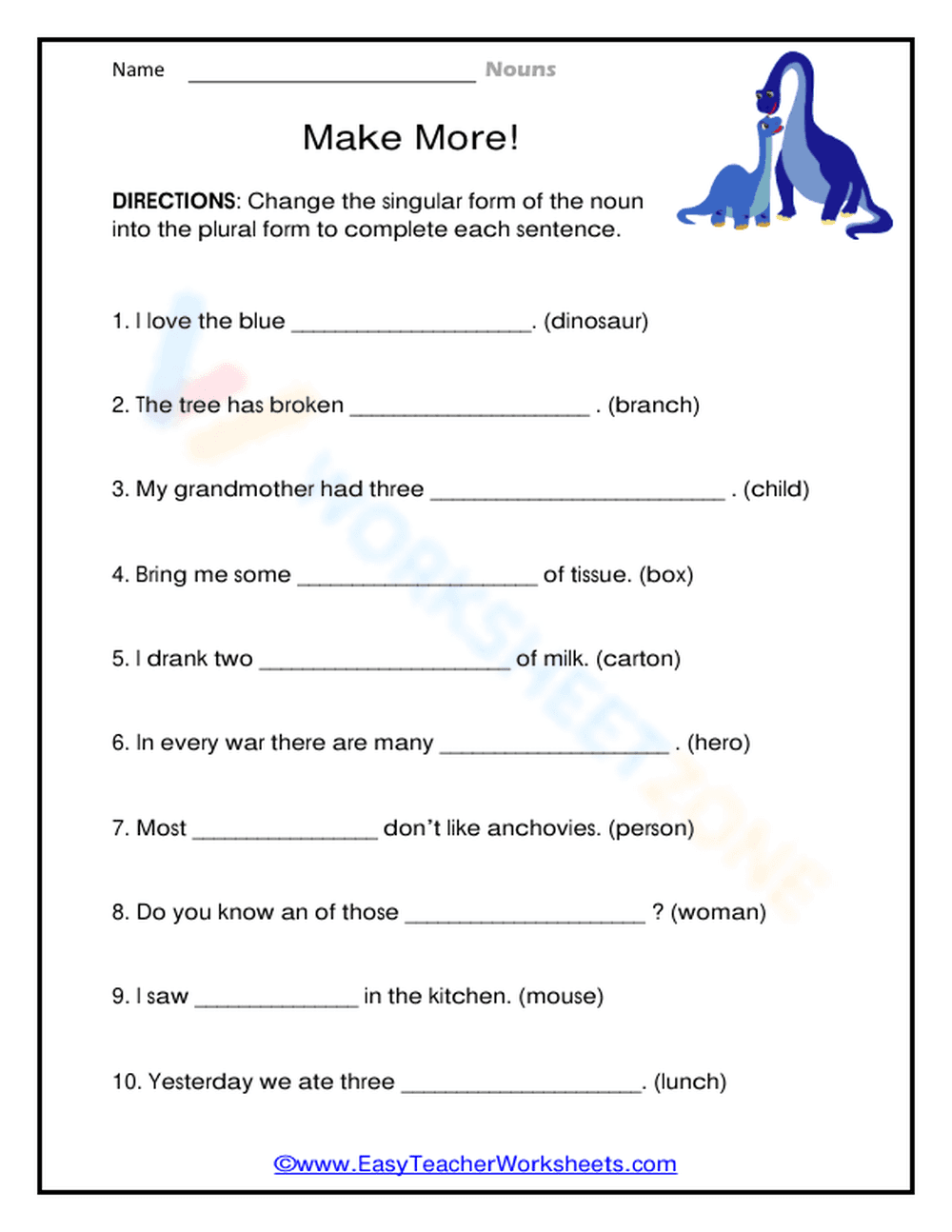

Essential Plural Nouns Worksheet | Grade 2-3 Grammar
Paste this activity's link or code into your existing LMS (Google Classroom, Canvas, Teams, Schoology, Moodle, etc.).
Students can open and work on the activity right away, with no student login required.
You'll still be able to track student progress and results from your teacher account.
This essential grammar resource focuses on pluralization for elementary learners. By transforming singular nouns into plurals within sentences, students develop a practical understanding of regular and irregular rules. This practice ensures that young writers can accurately express quantity and maintain grammatical consistency in their work.
At a Glance
- Grade: 2–3 · Subject: English Language Arts
- Standard:
CCSS.ELA-LITERACY.L.2.1.B— Form and use frequently occurring irregular plural nouns correctly in sentences- Skill Focus: Regular and Irregular Plural Nouns
- Format: 1 page · 10 problems · Answer key included · PDF
- Best For: Independent grammar practice and formative assessment
- Time: 15–20 minutes
This single-page PDF features 10 carefully constructed fill-in-the-blank sentences designed to challenge and support Grade 2 and 3 students. Each task provides a singular noun in parentheses at the end of the line, requiring the student to determine and write the correct plural form. The worksheet covers a wide range of pluralization rules, including adding "-s" or "-es" and identifying irregular forms that change spelling entirely.
Skill Progression
- Guided practice: The worksheet begins with familiar objects like dinosaurs and cartons to build initial confidence with basic pluralization.
- Supported practice: Students then apply specific rules for nouns ending in "ch," "sh," or "o," such as branch and hero, requiring closer attention to spelling.
- Independent practice: The final section introduces challenging irregular plurals like children, people, and mice, requiring students to recall non-standard spelling patterns.
This gradual release model supports long-term retention of grammar mechanics through an I Do, We Do, You Do instructional framework.
Standards Alignment
The primary focus is CCSS.ELA-LITERACY.L.2.1.B, which requires students to form and use frequently occurring irregular plural nouns. It also supports CCSS.ELA-LITERACY.L.3.1.B by incorporating both regular and irregular plural forms. Both standard codes can be copied directly into lesson plans, IEP goals, or district curriculum mapping tools to ensure instructional alignment.
How to Use It
This resource is effective during the independent practice phase. After direct instruction on plural rules, use this worksheet to assess understanding. It serves as a formative-assessment tool by highlighting where students struggle with irregular forms. The worksheet takes 15 to 20 minutes to complete, making it an ideal exit ticket or bell-ringer activity.
Who It's For
Designed for second and third-grade students, this worksheet is also an excellent intervention tool for older learners who need a refresher on irregular noun forms. The clear layout provides helpful scaffolds for English Language Learners (ELLs) developing morphological awareness. It pairs naturally with a plural nouns anchor chart or a shared reading passage.
Effective grammar instruction requires students to move beyond isolated rote memorization toward applying rules within meaningful linguistic contexts. This worksheet directly addresses the CCSS.ELA-LITERACY.L.2.1.B standard by requiring learners to produce plural forms for a mix of regular and irregular nouns, such as hero, woman, and child. Research by Fisher & Frey (2014) emphasizes the importance of the gradual release of responsibility, which is mirrored here through the progression from simple pluralization to more complex irregular transformations. By embedding the 10 tasks within complete sentences, the resource reinforces the syntactic role of nouns rather than just their spelling. This approach aligns with evidence-based practices for literacy development, ensuring that students internalize the underlying patterns of English morphology. Educators can rely on this printable guide to provide high-quality, targeted practice that bridges the gap between identifying parts of speech and using them correctly in academic writing.


