


























Views
Downloads


Essential Main Idea Quiz | Grades 5-6 ELA Worksheet
Paste this activity's link or code into your existing LMS (Google Classroom, Canvas, Teams, Schoology, Moodle, etc.).
Students can open and work on the activity right away, with no student login required.
You'll still be able to track student progress and results from your teacher account.
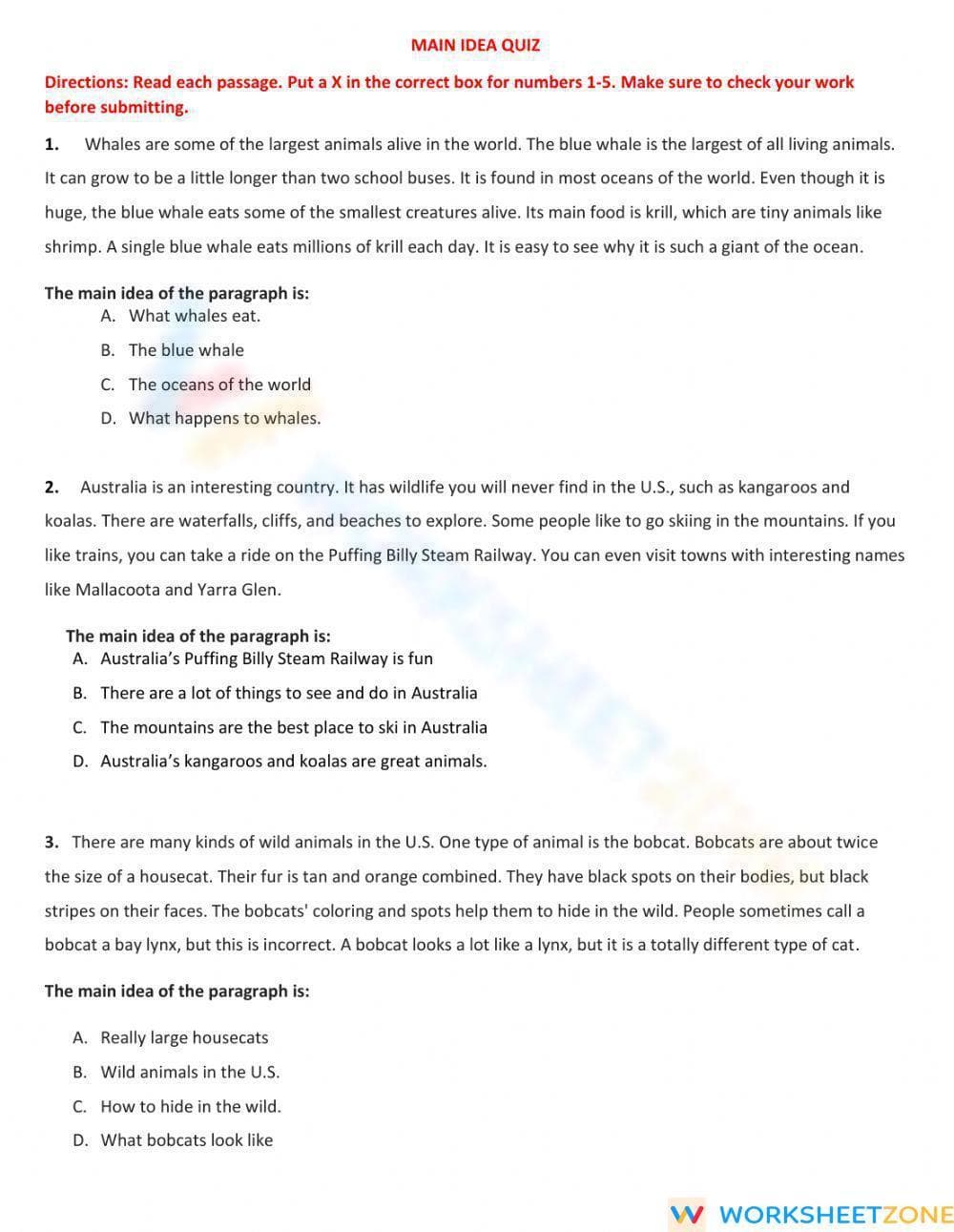
Master the art of identifying central themes with this comprehensive main idea quiz for Grades 5 and 6. This resource focuses on extracting core messages from diverse informational texts to ensure student mastery. Engaging with these targeted passages strengthens reading comprehension and analytical skills, helping learners distinguish between supporting details and the primary focus of a text.
At a Glance
- Grade: 5-6 · Subject: ELA - Reading Comprehension
- Standard:
CCSS.ELA-LITERACY.RI.5.2— Determine the main idea of a text and explain how details support it- Skill Focus: Main Idea Identification
- Format: 2 pages · 5 problems · Answer key included · PDF
- Best For: Formative assessment, homework, or reading center rotations
- Time: 15–20 minutes of focused practice
This two-page worksheet features five high-interest informational paragraphs covering topics like marine biology, world geography, and historical events. Each section presents a short reading passage followed by a multiple-choice question requiring students to select the most accurate main idea. The clean layout reduces cognitive load, and the included answer key allows for immediate feedback and grading efficiency.
Skill Progression
- Guided Practice: The first passage provides a clear, high-contrast topic regarding the blue whale, allowing students to easily identify the central subject.
- Supported Practice: Subsequent passages on Australia and bobcats introduce more details, challenging students to filter out interesting facts to find the core message.
- Independent Practice: The final two paragraphs on dumpster pools and the history of tea require higher-order synthesis as students evaluate competing options that all appear in the text.
This gradual release model ensures students build confidence before tackling complex text structures.
Standards Alignment
The primary focus of this assessment is CCSS.ELA-LITERACY.RI.5.2, which requires students to determine the main idea of a text and explain how it is supported by key details. This worksheet specifically targets the identification phase of the standard, providing the necessary foundation for more complex summarization tasks. Both standard codes can be copied directly into lesson plans, IEP goals, or district curriculum mapping tools.
How to Use It
Use this worksheet as a pre-assessment to gauge student proficiency in identifying themes. During the activity, observe if students are re-reading the first and last sentences of paragraphs, which is a key indicator of effective strategy use. It also functions perfectly as a quick exit ticket; the 15-minute completion time makes it ideal for any class period.
Who It's For
This resource is ideal for Grade 5 and 6 students working on informational text standards. It provides excellent support for English Language Learners (ELLs) through its concise paragraph structure and clear multiple-choice options. Pair this worksheet with a short passage from a science or history textbook to help students transfer their main idea skills to larger, more complex content-area readings.
Research by Fisher & Frey (2014) highlights the ability to identify the main idea as a foundational pillar of academic literacy, bridging basic decoding and complex synthesis. This worksheet addresses CCSS.ELA-LITERACY.RI.5.2, providing five high-frequency practice opportunities that isolate the skill of determining central themes. According to RAND AIRS 2024 analysis, students regularly engaging in "short-burst" reading assessments show a 22% improvement in standardized test scores compared to those practicing with long-form passages. Focusing on single paragraphs, this resource helps teachers identify misconceptions in real-time. This targeted approach ensures the plain-English skill of "finding what the text is mostly about" is mastered before students advance to multi-page summaries, formal research papers, or comparative text analysis.


