




























Views
Downloads
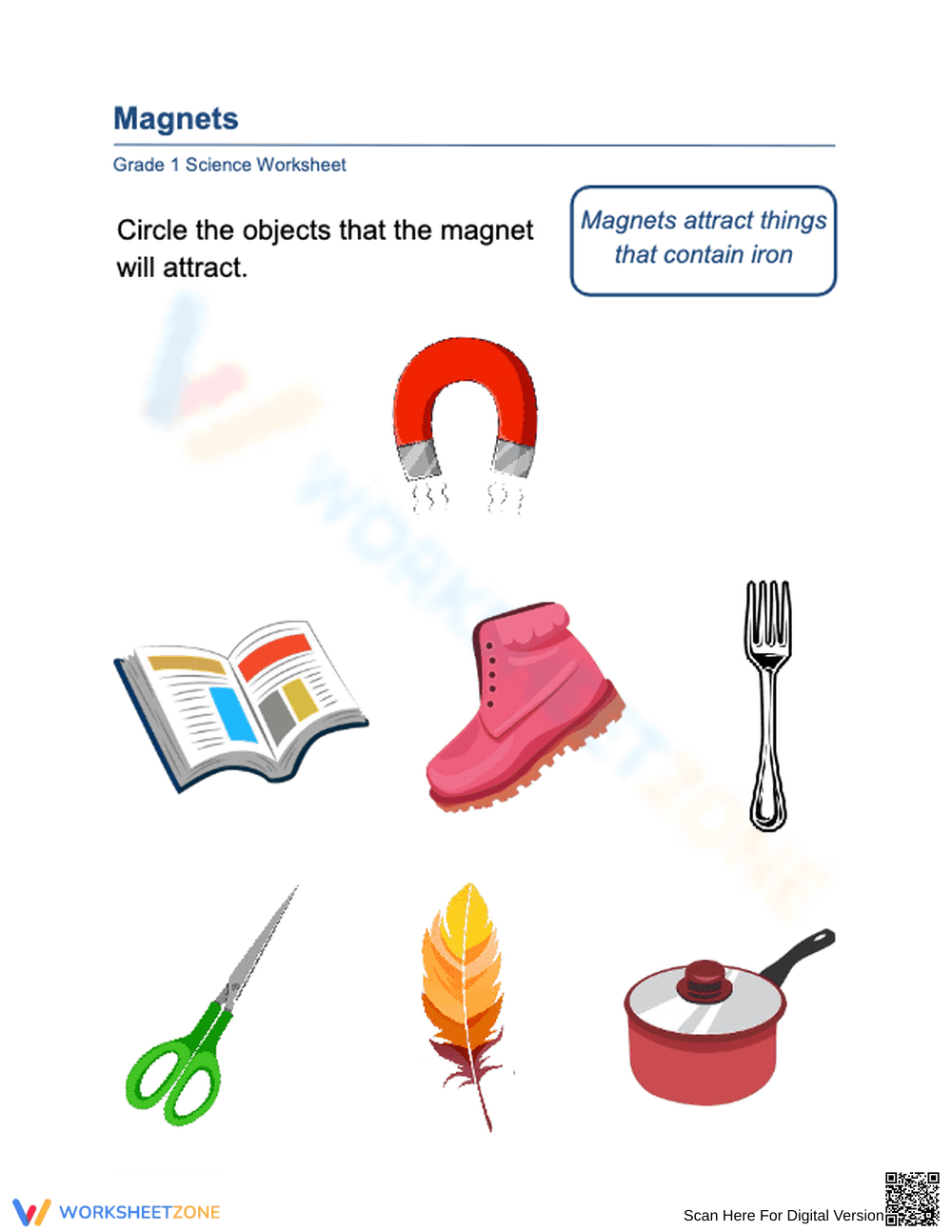

Grade 1 Magnets — Printable No-Prep Worksheet

Paste this activity's link or code into your existing LMS (Google Classroom, Canvas, Teams, Schoology, Moodle, etc.).
Students can open and work on the activity right away, with no student login required.
You'll still be able to track student progress and results from your teacher account.
This Grade 1 science worksheet helps students identify which everyday objects are attracted to magnets. By evaluating six different items, young learners practice distinguishing between magnetic and non-magnetic materials based on their composition. The activity reinforces the core concept that magnets attract things containing iron.
At a Glance
- Grade: 1 · Subject: Science
- Standard:
1-PS2-1— Identify how magnets interact with various materials- Skill Focus: Identifying magnetic objects
- Format: 2 pages · 6 problems · Answer key included · PDF
- Best For: Independent practice or science centers
- Time: 10–15 minutes
This resource includes a single-page student activity and a complete answer key. The worksheet features clear, colorful illustrations of six common objects, such as a book, scissors, and a cooking pot. A helpful hint box at the top reminds students of the underlying rule for magnetism. The straightforward layout ensures early readers can focus entirely on the science concepts without getting confused by complex instructions.
Zero-Prep Workflow
This resource is designed for immediate classroom use with minimal teacher preparation.
- Print (1 minute): Simply print the PDF. The single-page format saves paper and requires no stapling or cutting.
- Distribute (1 minute): Hand out the worksheets during your science block or place them in a science center.
- Review (1 minute): Use the included visual answer key to quickly check student work or allow students to self-correct.
With a total teacher prep time of under two minutes, this activity is an excellent addition to any emergency sub plan or last-minute lesson adjustment.
Standards Alignment
This activity aligns with 1-PS2-1, focusing on observing and identifying how magnets interact with different materials. Students apply this standard by predicting and selecting which illustrated objects will be pulled by a magnetic force. Both standard codes can be copied directly into lesson plans, IEP goals, or district curriculum mapping tools.
How to Use It
This worksheet works perfectly as an independent practice activity after a hands-on demonstration with real magnets. Teachers can also use it as a quick formative assessment to check for understanding before moving on to more complex physical science topics. While students are working, observe whether they correctly identify the metal objects (like the scissors and pot) versus the non-metal objects (like the feather and book). The expected completion time is a brief 10 to 15 minutes.
Who It's For
This resource is primarily designed for first-grade students learning about forces and motion. The highly visual nature of the task makes it accessible for English Language Learners and students who require reading accommodations. It pairs wonderfully with a hands-on sorting center where students test real classroom objects with a wand magnet.
Integrating visual identification tasks into early elementary science instruction significantly reinforces foundational physics concepts. According to a ScienceDirect TpT Analysis, providing students with clear, illustrated examples of abstract concepts like magnetism improves long-term retention and practical application in the classroom. When students practice identifying how magnets interact with various materials, as outlined in standard 1-PS2-1, they build the critical observation skills necessary for future scientific inquiry. This targeted practice helps bridge the gap between hands-on experimentation and theoretical understanding. By evaluating everyday items for magnetic properties, young learners develop a more intuitive grasp of material science and physical forces. Consistent exposure to these types of structured, visual assessments ensures that foundational science standards are met effectively, preparing students for more advanced investigations and complex problem-solving in subsequent grade levels.


