




























Views
Downloads

Printable Magnetism Vocabulary Sheet | Grades 3-4 Science

Paste this activity's link or code into your existing LMS (Google Classroom, Canvas, Teams, Schoology, Moodle, etc.).
Students can open and work on the activity right away, with no student login required.
You'll still be able to track student progress and results from your teacher account.
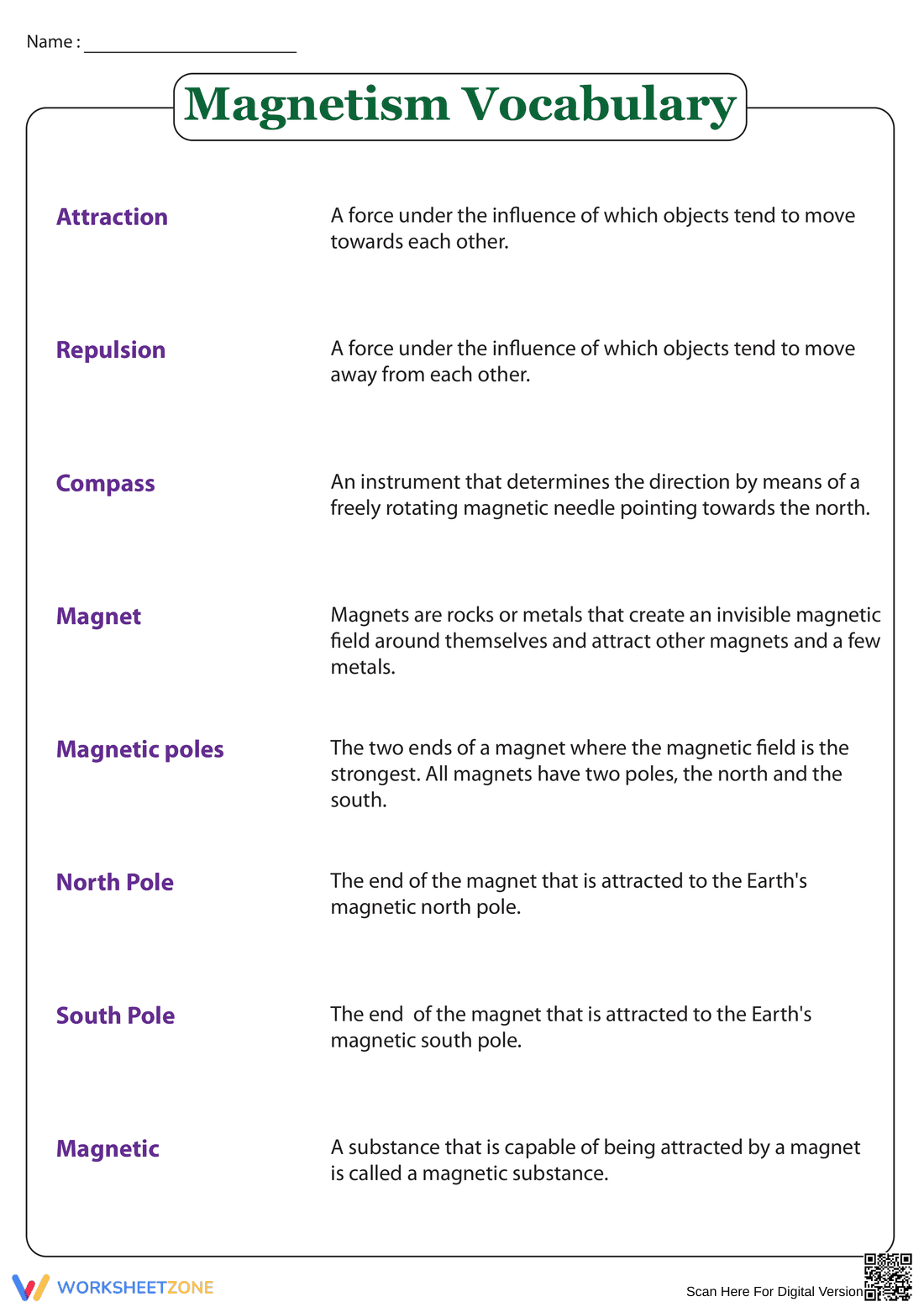
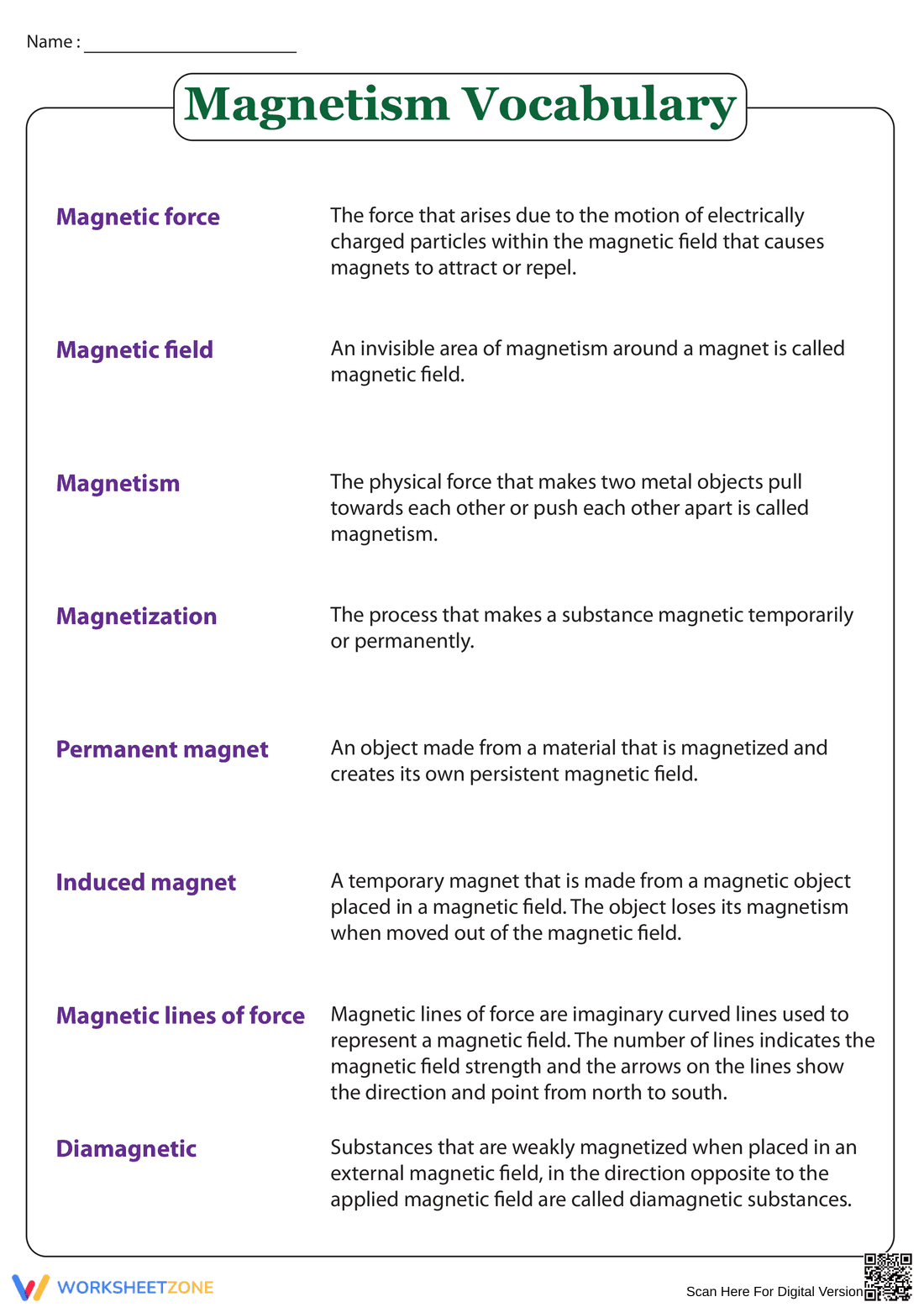
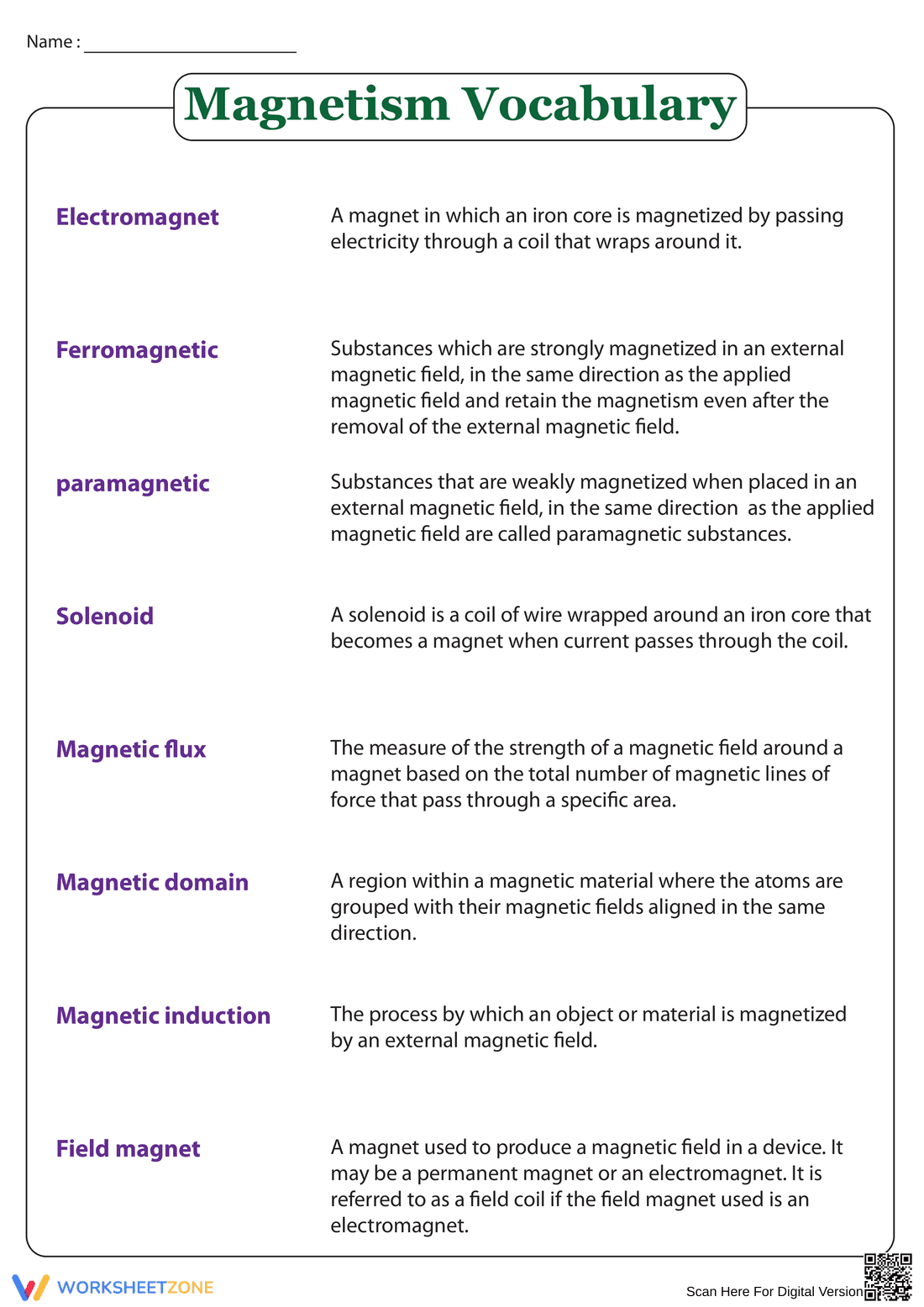
Master the core language of physical science with this comprehensive Magnetism Vocabulary worksheet. Designed for Grade 3 and Grade 4 students, this resource defines eight essential terms to help learners describe magnetic forces and interactions accurately. Students will gain the precise terminology needed to explain attraction, repulsion, and pole orientation in scientific discussions and experiments.
At a Glance
- Grade: 3-4 · Subject: Science
- Standard:
3-PS2-3— Determine cause and effect relationships of magnetic interactions between two objects- Skill Focus: Scientific Vocabulary Acquisition
- Format: 1 page · 8 terms · Reference sheet included · PDF
- Best For: Science vocabulary introduction or notebook reference
- Time: 10–15 minutes
This single-page PDF features eight high-frequency science terms: Attraction, Repulsion, Compass, Magnet, Magnetic poles, North Pole, South Pole, and Magnetic. Each term is paired with a concise, grade-appropriate definition that clarifies complex concepts like force influence and magnetic fields. The clean layout makes it an ideal reference tool for students to keep in their science journals or folders.
Zero-Prep Workflow
This resource is designed for immediate classroom integration with a total teacher prep time of under one minute. Simply print the document and distribute it to your students during your magnetism unit. It serves as a perfect "no-prep" sub plan addition or a quick-reference guide that students can consult during hands-on laboratory activities or while completing independent writing assignments.
Standards Alignment
This worksheet is primarily aligned to `3-PS2-3`, where students must determine cause and effect relationships of magnetic interactions. By mastering terms like attraction and repulsion, students build the linguistic foundation required to describe these physical phenomena. This code can be copied directly into lesson plans, IEP goals, or district curriculum mapping tools to ensure instructional consistency.
How to Use It
Distribute this sheet before beginning direct instruction on magnets to pre-teach essential domain-specific vocabulary. During independent practice, encourage students to use the definitions to label their own diagrams of magnetic fields or to explain the results of a "attract or repel" experiment. For a quick formative assessment, ask students to describe a real-world example for three of the terms listed.
Who It's For
This resource is tailored for elementary students in Grades 3 and 4, including English Language Learners who benefit from clear, isolated definitions. It pairs naturally with hands-on magnet kits, science reading passages, or anchor charts. Teachers can use it for whole-class instruction, small-group remediation, or as a support tool for students with IEPs focusing on vocabulary development.
According to research from EdReports (2024), the acquisition of domain-specific vocabulary is a critical predictor of success in elementary science comprehension. This Magnetism Vocabulary worksheet directly addresses the 3-PS2-3 standard by providing the linguistic scaffolding students need to articulate complex physical interactions. By focusing on eight core terms, the resource reduces cognitive load during the introductory phase of a physics unit, allowing students to transition more smoothly from observation to scientific explanation. This approach aligns with the gradual release of responsibility model, ensuring that learners have a reliable reference as they move toward independent mastery of magnetic force concepts. The precision of these definitions supports the development of academic language, which is essential for meeting the rigor of state and national science frameworks.


