


























Views
Downloads



Essential Mad Libs Vocabulary Worksheet | College ELA
Paste this activity's link or code into your existing LMS (Google Classroom, Canvas, Teams, Schoology, Moodle, etc.).
Students can open and work on the activity right away, with no student login required.
You'll still be able to track student progress and results from your teacher account.
This comprehensive college-level English Language Arts worksheet utilizes the iconic lyrics of "Iron Man" to challenge students' vocabulary and understanding of parts of speech. By identifying and filling in seventeen specific blanks, learners engage with complex sentence structures and context clues to restore the narrative flow of this classic text while sharpening their creative writing skills.
At a Glance
- Grade: College · Subject: English Language Arts (ELA)
- Standard:
CCSS.ELA-LITERACY.L.11-12.4— Determine or clarify the meaning of unknown and multiple-meaning words and phrases- Skill Focus: Contextual Vocabulary & Parts of Speech
- Format: 3 pages · 17 problems · Answer key included · PDF
- Best For: Vocabulary reinforcement and creative writing practice
- Time: 20–30 minutes
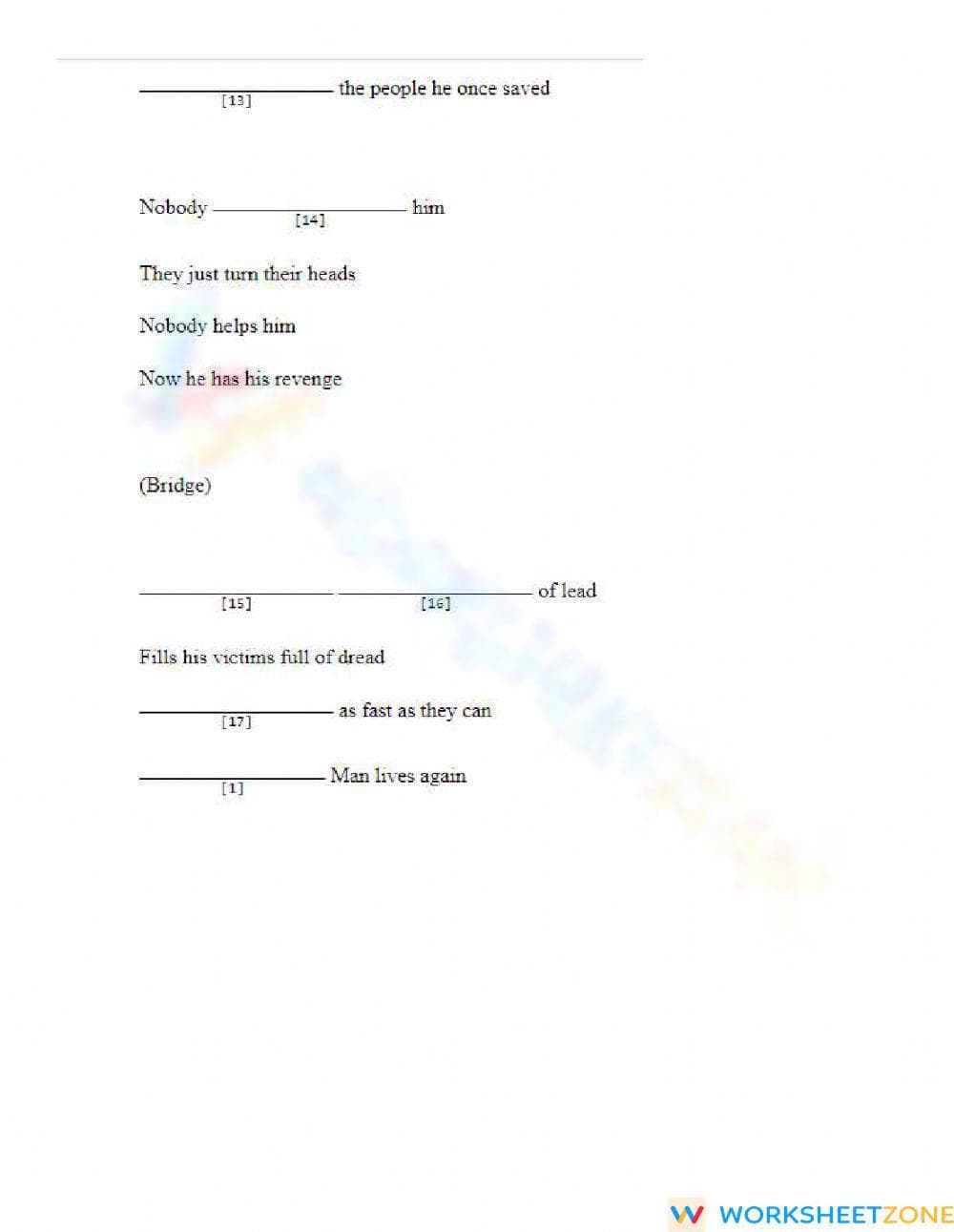
Inside this three-page PDF, students will find a "Mad Libs" style arrangement of the "Iron Man" lyrics. The worksheet features seventeen numbered blanks specifically placed to target various parts of speech, including nouns, verbs, and adjectives. The layout is clean and professional, providing ample space for students to write their choices, followed by the complete text for review and discussion of word choice impact.
The worksheet follows a structured skill progression designed to move students from simple identification to complex application.
- Guided practice: The first five blanks focus on high-frequency nouns and verbs with strong context clues to establish the setting and character.
- Supported practice: Problems six through twelve introduce more abstract concepts, requiring students to consider tone and atmosphere within the lyrics.
- Independent practice: The final five tasks demand higher-order linguistic choices where multiple valid synonyms exist, forcing a final decision based on poetic rhythm.
This sequence allows students to build confidence before tackling the more nuanced lyrical gaps toward the conclusion of the text.
This resource is primary aligned with CCSS.ELA-LITERACY.L.11-12.4, focusing on the ability of students to determine or clarify the meaning of words and phrases by using context clues. Additionally, it supports standards related to conventions of standard English grammar and usage. Both standard codes can be copied directly into lesson plans, IEP goals, or district curriculum mapping tools.
Use this worksheet as a low-stakes formative assessment during a unit on modern poetry or lyricism to gauge student grasp of part-of-speech function. Alternatively, assign it as a creative "hook" before a deeper analysis of the text's themes; observe how students' word choices change the original's ominous tone. Completion typically takes twenty minutes, followed by a ten-minute peer review session.
This worksheet is designed for college-level students or advanced high schoolers who benefit from unconventional ELA materials. It is particularly effective for learners who respond well to pop-culture integrations and provides excellent differentiation through the open-ended nature of the blanks. It pairs naturally with a comparative analysis of industrial-era literature or an anchor chart on advanced descriptive adjectives.
According to the RAND AIRS 2024 report on literacy engagement, incorporating familiar cultural texts like song lyrics significantly increases student persistence when tackling complex vocabulary tasks. This worksheet addresses CCSS.ELA-LITERACY.L.11-12.4 by requiring learners to apply context-clue strategies across seventeen distinct linguistic gaps. By transforming the traditional fill-in-the-blank exercise into a creative reconstruction of a narrative, the resource bridges the gap between mechanical grammar drills and authentic literary appreciation. Students must analyze the surrounding syntax to determine the appropriate part of speech, effectively demonstrating mastery of academic language in a non-traditional setting. The multi-page format allows for a sustained focus on narrative continuity, while the variety of task types ensures a comprehensive review of essential vocabulary. This approach aligns with modern evidence-based practices that prioritize contextualized learning over isolated rote memorization, providing a robust framework for advanced ELA instruction and measurable student growth.


