


























Views
Downloads

Grade K Counting & Addition — Printable No-Prep Worksheet
Paste this activity's link or code into your existing LMS (Google Classroom, Canvas, Teams, Schoology, Moodle, etc.).
Students can open and work on the activity right away, with no student login required.
You'll still be able to track student progress and results from your teacher account.
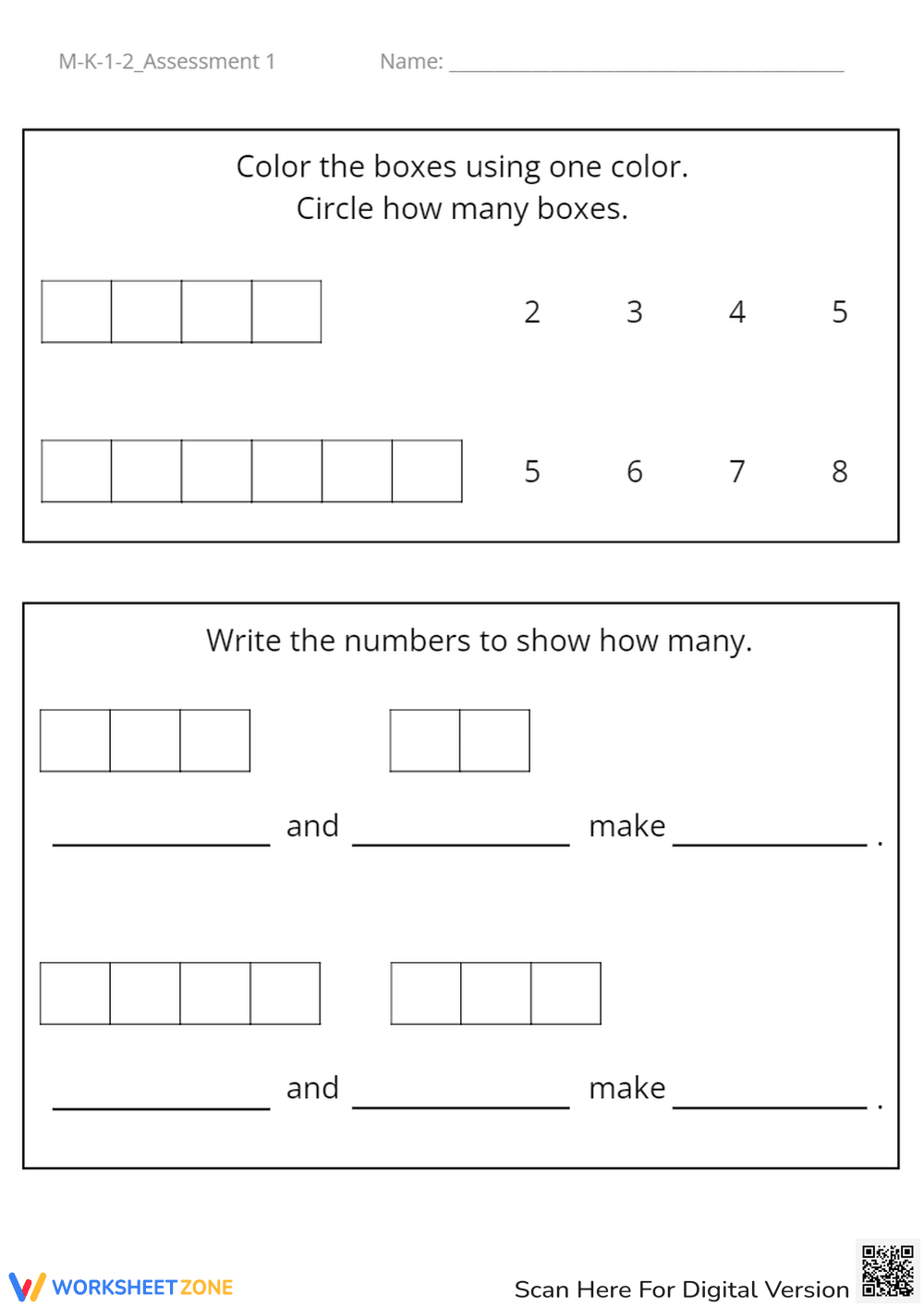
This Kindergarten math worksheet helps students practice counting objects and composing basic numbers. Young learners count shaded boxes, identify the correct numeral, and complete simple addition sentences using visual models. This foundational practice builds early number sense and prepares students for formal addition operations.
At a Glance
- Grade: K · Subject: Math
- Standard:
CCSS.MATH.CONTENT.K.OA.A.1— Represent addition with objects or drawings- Skill Focus: Counting and composing numbers
- Format: 1 page · 4 problems · PDF
- Best For: Independent practice or assessment
- Time: 10–15 minutes
This single-page resource features two distinct task types to evaluate early math skills. The top section includes two multiple-choice counting problems where students color boxes and circle the corresponding number. The bottom section presents two visual addition problems, prompting students to count separate groups of boxes and fill in sentence frames to show how two quantities combine to make a total. The clean layout minimizes visual distractions for early learners.
Designed for immediate classroom implementation, this worksheet requires zero teacher preparation. Print: Generate copies for the entire class in under one minute. Distribute: Hand out to students with crayons and pencils (1 minute). Review: Quickly check student responses using the straightforward visual format (3 minutes). Total teacher prep time is under two minutes, making this an ideal resource for morning work, math centers, or emergency substitute plans.
This activity aligns directly with CCSS.MATH.CONTENT.K.OA.A.1: Represent addition and subtraction with objects, fingers, mental images, drawings, sounds, acting out situations, verbal explanations, expressions, or equations. It also supports basic counting and cardinality standards by requiring students to quantify visual arrays. Both standard codes can be copied directly into lesson plans, IEP goals, or district curriculum mapping tools.
Deploy this worksheet during math centers as an independent activity after direct instruction on combining groups. Alternatively, use it as a quick formative assessment at the end of a counting unit to gauge student mastery. While students work, observe whether they count each box individually (one-to-one correspondence) or if they can subitize the small groups. Expected completion time ranges from 10 to 15 minutes depending on the student's counting fluency.
This resource is primarily designed for Kindergarten students developing early numeracy skills. It also serves as an effective intervention tool for first-grade students who need additional support with basic addition concepts. The visual scaffolds make it accessible for diverse learners, including English Language Learners who benefit from the clear connection between pictures and numbers. Pair this worksheet with physical manipulatives like counting blocks to provide a tactile learning experience before moving to the paper-based task.
Effective early math instruction relies heavily on visual representations to bridge the gap between concrete objects and abstract numerals. This worksheet targets CCSS.MATH.CONTENT.K.OA.A.1, requiring students to represent addition with objects or drawings. According to Fisher & Frey (2014), providing students with structured visual models significantly increases their ability to grasp foundational mathematical concepts and reduces cognitive load during independent practice. By combining simple counting tasks with introductory sentence frames, this resource ensures that young learners build a robust understanding of how quantities combine. The clear, distraction-free layout supports sustained attention, allowing students to focus entirely on the mathematical relationships presented in the visual arrays. Integrating these types of targeted, standards-aligned activities into daily routines establishes a strong baseline for future arithmetic fluency and overall mathematical reasoning.


