


























Views
Downloads
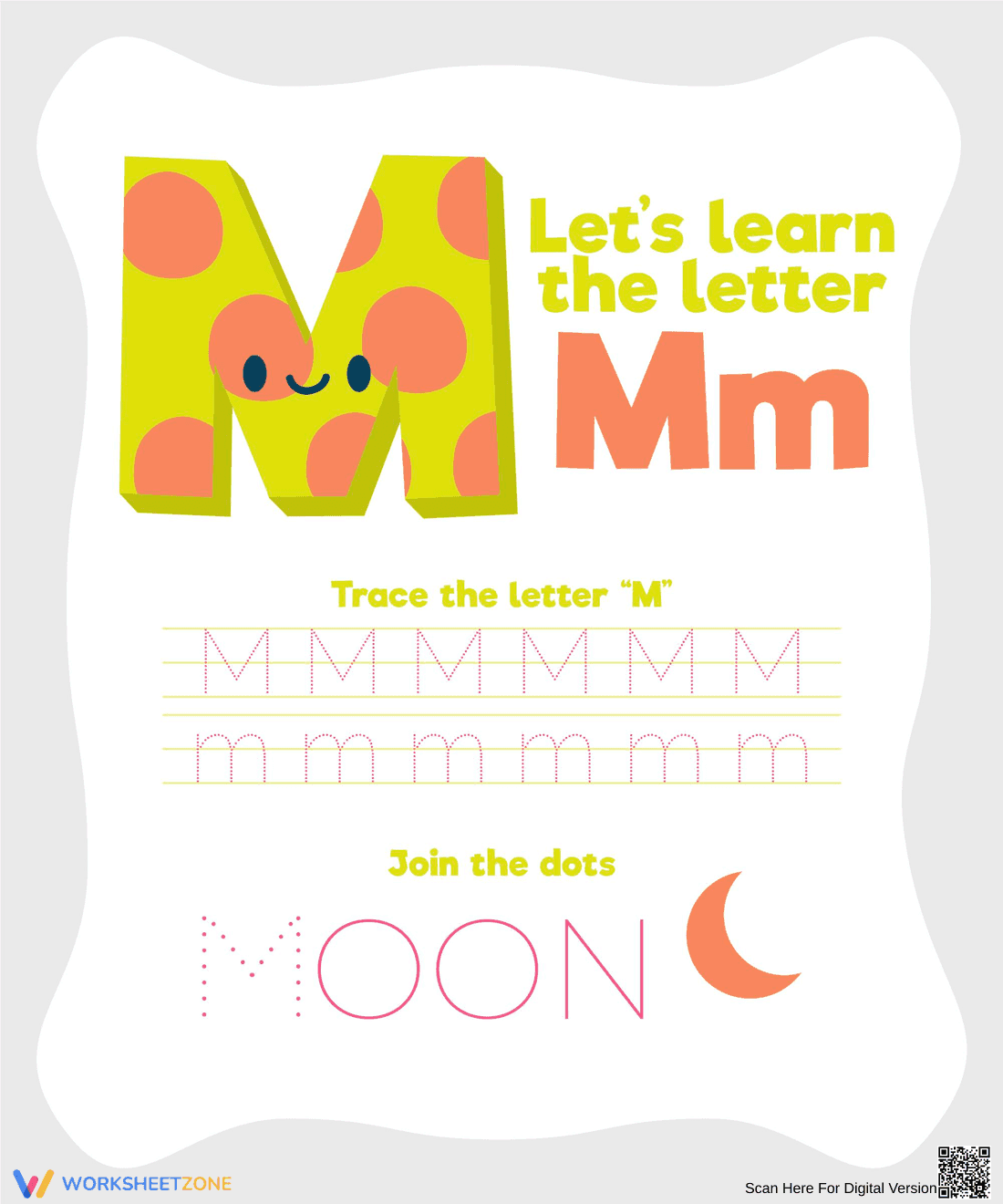

Letter M Tracing Worksheet | Essential Kindergarten Practice
Paste this activity's link or code into your existing LMS (Google Classroom, Canvas, Teams, Schoology, Moodle, etc.).
Students can open and work on the activity right away, with no student login required.
You'll still be able to track student progress and results from your teacher account.
This Kindergarten letter M tracing worksheet provides foundational handwriting practice for early learners. Students develop fine motor control by tracing uppercase and lowercase letters before completing a thematic dot-to-dot activity. By connecting the letter "M" to the word "Moon," children strengthen phonemic awareness and letter-sound recognition in a single, engaging page.
At a Glance
- Grade: Kindergarten · Subject: English
- Standard:
CCSS.ELA-LITERACY.L.K.1.A— Print many upper- and lowercase letters correctly- Skill Focus: Letter M formation
- Format: 1 page · 15 tasks · No answer key required · PDF
- Best For: Morning work or literacy centers
- Time: 10–15 minutes
The worksheet features a clear, structured layout designed for young writers. It includes 7 uppercase "M" tracing prompts and 7 lowercase "m" prompts on primary-ruled lines. Below the tracing rows, a "Join the dots" activity allows students to form the word "MOON," reinforcing the letter's sound through visual association with a familiar object.
This resource is designed for a zero-prep classroom environment. First, print the single-page PDF (30 seconds). Second, distribute to students during independent work time or as a quiet morning activity (1 minute). Third, review student letter formation by checking for proper stroke order and line placement (30 seconds). Total teacher preparation time is under two minutes, making it an ideal sub plan addition.
This activity aligns with `CCSS.ELA-LITERACY.L.K.1.A`, which requires students to print many upper- and lowercase letters. It also supports `CCSS.ELA-LITERACY.RF.K.1.B` by helping students recognize that spoken words are represented in written language by specific sequences of letters. Both standard codes can be copied directly into lesson plans, IEP goals, or district curriculum mapping tools.
Use this worksheet during the "You Do" phase of a gradual release lesson on the letter M. It serves as an excellent formative assessment tool; observe students as they trace to ensure they are starting their strokes from the top down. Expect completion within 10 to 15 minutes depending on the student's fine motor development and previous exposure to writing tools.
This resource is ideal for Kindergarten students, preschool learners ready for writing, and occupational therapy sessions focusing on grip strength. It pairs naturally with a read-aloud about the moon or a phonics anchor chart featuring the letter M. The simple design ensures students stay focused on the task without visual distraction.
According to the RAND AIRS 2024 report, consistent tactile engagement with letter forms is a critical predictor of early literacy success. This worksheet addresses that need by providing 14 specific tracing opportunities that bridge the gap between visual recognition and motor execution. Research from Fisher & Frey (2014) emphasizes that short, focused bursts of independent practice—like the 15 tasks provided here—help solidify the "I Do, We Do, You Do" instructional model. By integrating a dot-to-dot word activity, the worksheet also supports orthographic mapping, helping students connect the phoneme /m/ to its grapheme representation. This dual-approach ensures that students are not just mimicking shapes but are building the cognitive pathways necessary for fluent reading and writing. The inclusion of the CCSS.ELA-LITERACY.L.K.1.A standard ensures that this practice remains aligned with national benchmarks for Kindergarten readiness and foundational language skills.


