


























Views
Downloads

Printable Integer Match Game | Grade 6 Math
Paste this activity's link or code into your existing LMS (Google Classroom, Canvas, Teams, Schoology, Moodle, etc.).
Students can open and work on the activity right away, with no student login required.
You'll still be able to track student progress and results from your teacher account.
This interactive integer match game helps sixth-grade students connect positive and negative numbers to real-world scenarios. Students practice identifying integers representing situations like temperature changes, financial transactions, and elevations. The hands-on format reinforces conceptual understanding of rational numbers while keeping learners actively engaged.
At a Glance
- Grade: 6 · Subject: Math
- Standard:
CCSS.MATH.CONTENT.6.NS.C.5— Use integers to represent real-world quantities- Skill Focus: Real-world integers
- Format: 2 pages · 10 problems · Answer key included · PDF
- Best For: Partner practice and math centers
- Time: 15–20 minutes
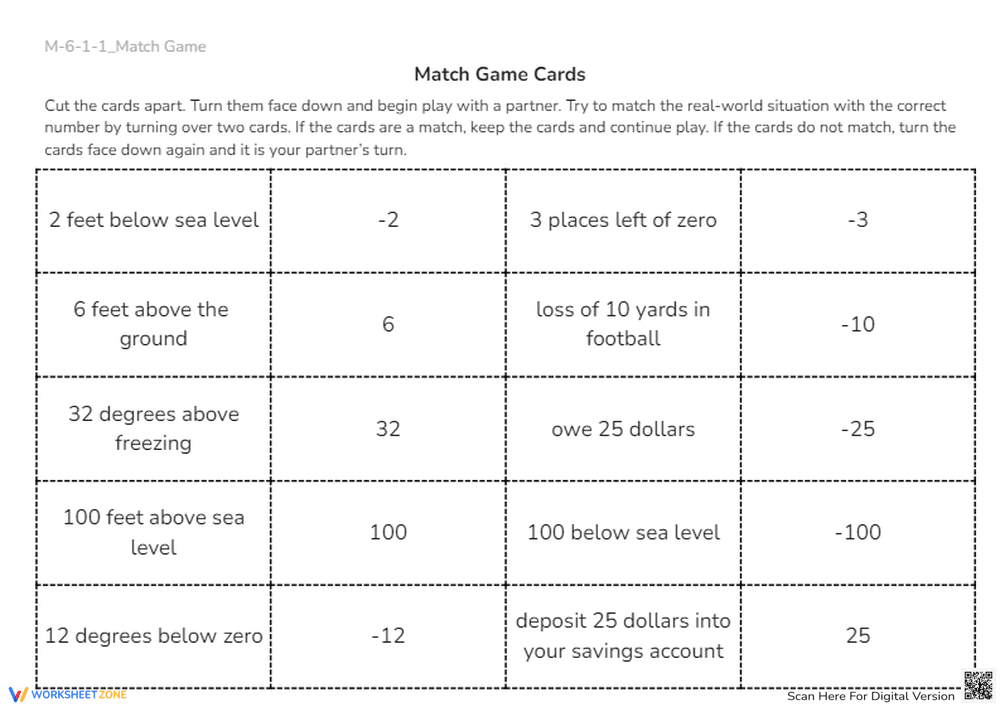
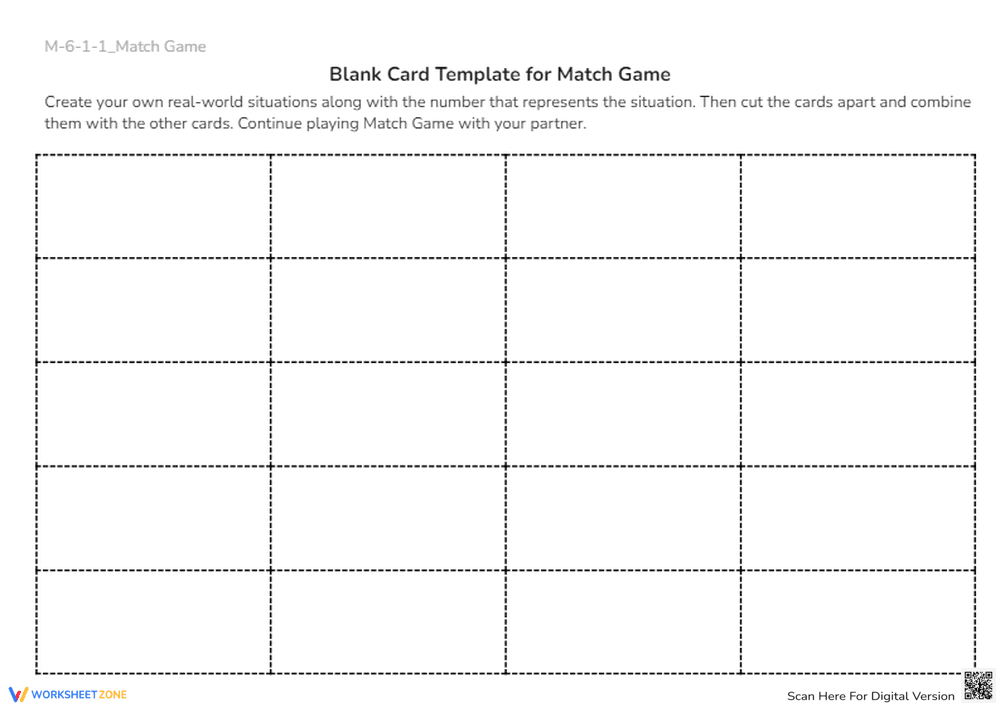
This resource includes two pages designed for immediate classroom application. The first page features 20 printable cards forming 10 distinct matching pairs, pairing descriptive text with corresponding integer values. The uncut first page serves as a convenient reference key for teachers. The second page provides a blank template, allowing students to generate their own real-world situations and integer pairs to extend the activity.
Zero-Prep Workflow
- Print (1 minute): Generate copies of the card sets for each student pair. The black-and-white design ensures quick, ink-friendly reproduction.
- Distribute (2 minutes): Hand out scissors and the printed sheets. Students can cut the cards themselves, eliminating teacher prep time.
- Review (2 minutes): Briefly model one match, such as pairing "2 feet below sea level" with "-2", then let students begin.
Total teacher preparation requires under two minutes, making this an excellent option for quick math centers or emergency substitute plans.
Standards Alignment
This activity aligns directly with CCSS.MATH.CONTENT.6.NS.C.5, requiring students to understand that positive and negative numbers describe quantities having opposite directions or values. Students use positive and negative numbers to represent quantities in real-world contexts. Both standard codes can be copied directly into lesson plans, IEP goals, or district curriculum mapping tools.
How to Use It
Deploy this matching game during guided math stations or as a collaborative partner activity after introductory direct instruction on integers. As students play, circulate and observe their discussions; listen for correct vocabulary usage, such as distinguishing between "loss" and "deposit." The blank template serves as an excellent formative assessment, revealing whether students can accurately conceptualize their own negative number scenarios. Expect the core matching activity to take 15 minutes, with an additional 10 minutes if utilizing the blank extension cards.
Who It's For
This resource targets sixth-grade math students developing foundational number sense regarding rational numbers. The tactile nature of the card sort supports kinesthetic learners and provides a low-stakes environment for peer collaboration. Pair this game with an anchor chart detailing common integer keywords (e.g., withdraw, ascend, below zero) to support English Language Learners or students requiring additional vocabulary scaffolding.
Effective mathematics instruction relies heavily on connecting abstract numerical concepts to concrete, lived experiences. According to a 2024 report by EdReports, instructional materials that explicitly link mathematical symbols to real-world contexts significantly improve student retention and conceptual transfer. This resource directly supports CCSS.MATH.CONTENT.6.NS.C.5 by requiring students to use integers to represent real-world quantities. By physically manipulating cards that pair situations like financial debt or temperature drops with their corresponding negative integers, learners bridge the gap between abstract notation and practical application. The inclusion of a student-generated card template further reinforces this cognitive link, demanding higher-order application of the standard. Utilizing hands-on matching activities provides educators with immediate, observable data on student comprehension while fostering collaborative problem-solving skills essential for middle-grade mathematics mastery.


