


























Views
Downloads

4.NBT.B.6 Worksheet: Partial Quotients — Grade 4 Aligned
Paste this activity's link or code into your existing LMS (Google Classroom, Canvas, Teams, Schoology, Moodle, etc.).
Students can open and work on the activity right away, with no student login required.
You'll still be able to track student progress and results from your teacher account.
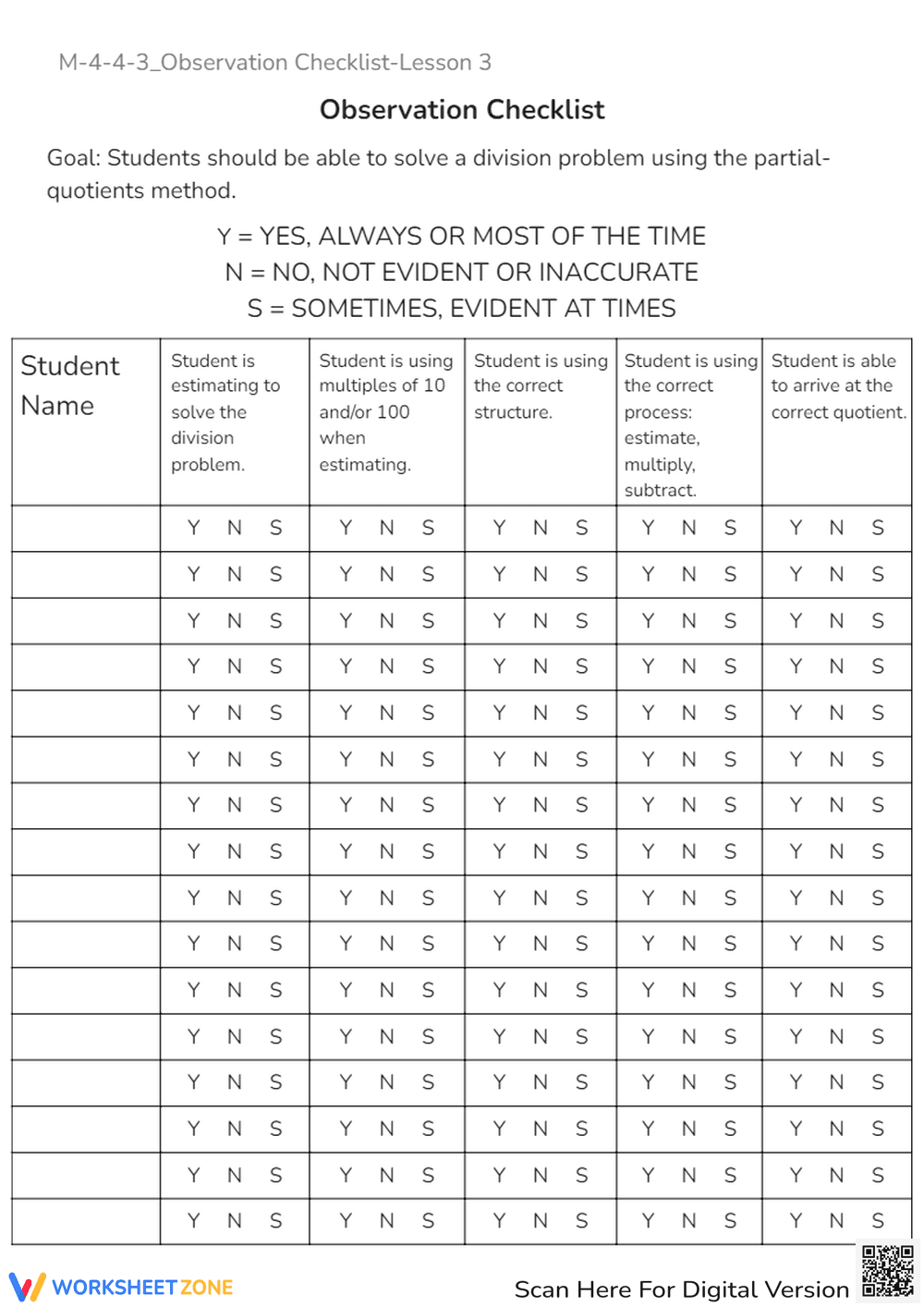
This Grade 4 math observation checklist provides teachers with a structured tool to assess student mastery of the partial quotients division method. By tracking specific behavioral indicators during active problem-solving, educators can quickly identify where students struggle with estimation, place value, or subtraction steps.
At a Glance
- Grade: Grade 4 · Subject: Math
- Standard:
CCSS.MATH.CONTENT.4.NBT.B.6— Find whole-number quotients and remainders with up to four-digit dividends using place value strategies- Skill Focus: Partial quotients division strategy tracking
- Format: 1 printable page · 5 assessment criteria · Rubric included · PDF format
- Best For: Formative assessment during small group math workshop rotations
- Time: 10–15 minutes
This single-page tool features a grid to track 16 students. The checklist outlines 5 observable behaviors essential to the partial quotients method, including estimating with multiples of 10 or 100, setting up the division structure, and executing the estimate-multiply-subtract cycle. A simple rating scale allows teachers to record observations without disrupting instruction.
The checklist maps to the progression of division mastery. The 5 criteria function as a rubric: estimating with multiples of 10 or 100 represents the Approaching level, executing the correct structure represents the Meeting level, and arriving at the correct quotient represents the Exceeding level. Teachers can enter these scores directly into gradebooks or IEP progress notes.
This resource aligns to standard CCSS.MATH.CONTENT.4.NBT.B.6, which requires students to find whole-number quotients and remainders with up to four-digit dividends and one-digit divisors using place value strategies. It also supports mathematical practice standards related to precision. Both standard codes can be copied directly into lesson plans, IEP goals, or district curriculum mapping tools.
How to Use It
Use this checklist during small-group math instruction to monitor students solving division problems. Observe one student at a time for 2 minutes, marking progress across the 5 criteria to gather formative data. This process takes 15 minutes per group and highlights misconceptions to address in future mini-lessons.
Who It's For
This tool is designed for fourth-grade teachers, special educators, and math interventionists tracking progress on multi-digit division. It is useful for differentiating instruction, pinpointing whether a student struggles with basic facts or procedural steps. Pair this checklist with a direct instruction lesson on partial quotients or division task cards.
This assessment tool aligns with the Common Core State Standard CCSS.MATH.CONTENT.4.NBT.B.6 to measure student proficiency in using the partial quotients division strategy. According to research from EdReports 2024, formative assessment tools that break down complex mathematical algorithms into discrete, observable steps significantly improve a teacher's ability to target instruction and address student misconceptions in real time. By focusing on specific sub-skills—such as estimating with multiples of ten, maintaining place value structure, and executing the subtraction sequence—this checklist provides actionable data that supports the gradual release of responsibility model. Educators can use these structured observations to document growth, guide small-group interventions, and ensure students develop a conceptual understanding of division rather than relying solely on rote memorization. This systematic approach to tracking student progress ensures that all learners receive the targeted support necessary to achieve mastery of multi-digit division.


