


























0
Views
0
Downloads

0.0
0
Save
0 Likes
Share
Rectangle Measurement: Estimate & Measure Length - Inches & Centimeters
0 Views
0 Downloads
Paste this activity's link or code into your existing LMS (Google Classroom, Canvas, Teams, Schoology, Moodle, etc.).
Students can open and work on the activity right away, with no student login required.
You'll still be able to track student progress and results from your teacher account.
Information
Description
What It Is:
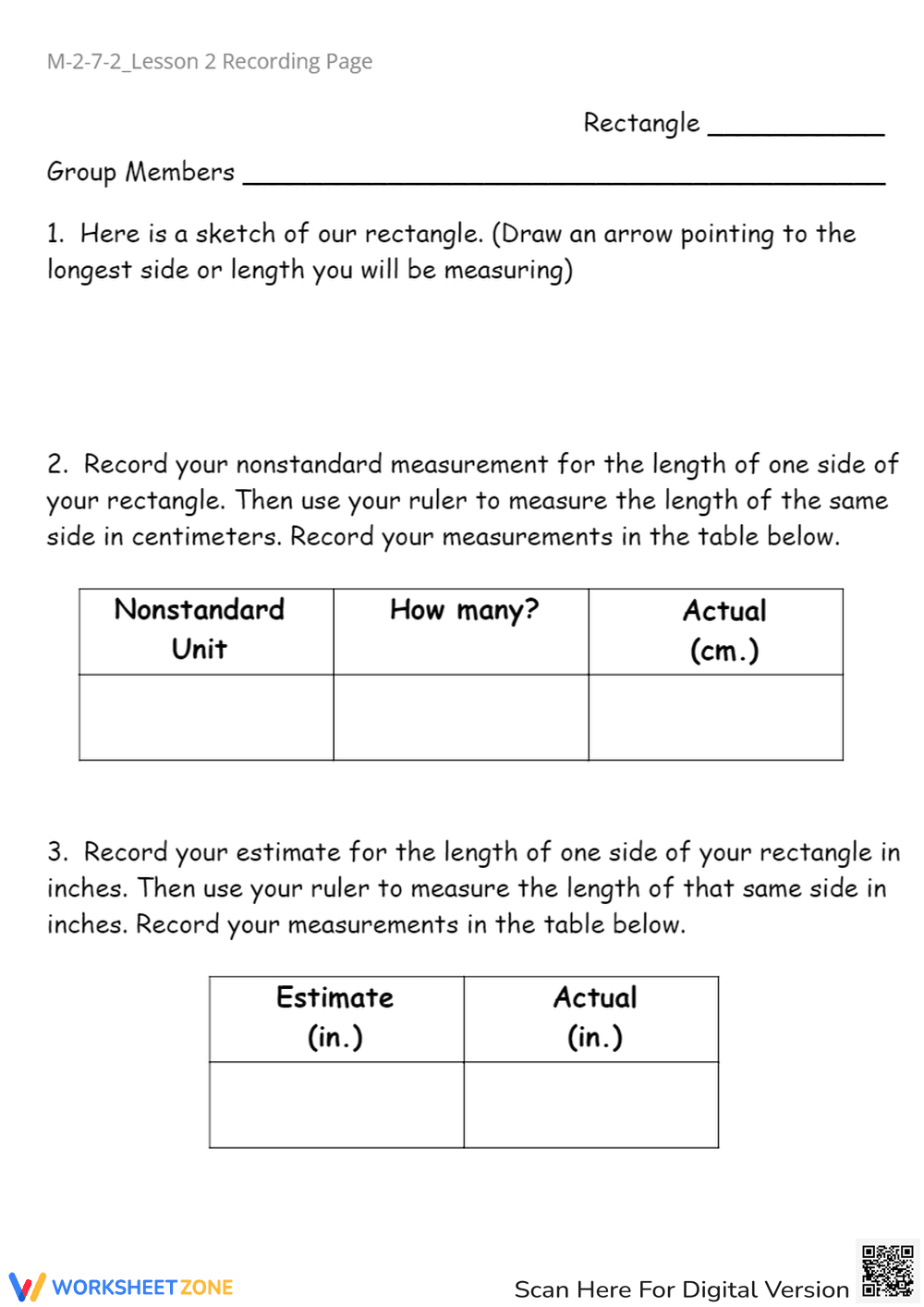
This is a math worksheet focused on measurement. Students are asked to sketch a rectangle and identify its longest side. They then use a nonstandard unit to measure the length of one side, followed by measuring the same side in centimeters using a ruler. Finally, students estimate the length of a side in inches and then measure it with a ruler, recording both measurements. The worksheet includes tables for recording data.
Grade Level Suitability:
This worksheet is suitable for 2nd or 3rd grade. It involves basic measurement concepts, using rulers, estimating length, and recording data in tables, which are skills typically introduced in these grades.
Why Use It:
This worksheet helps students develop measurement skills, including using nonstandard units, estimating length, and using rulers to measure in centimeters and inches. It also reinforces the concept of a rectangle and its sides. The activity encourages comparison between estimated and actual measurements, improving estimation skills.
How to Use It:
First, have students draw a rectangle and label its longest side. Then, provide nonstandard units (e.g., paperclips, erasers) for them to measure one side of the rectangle. Students record the number of units used. Next, they measure the same side in centimeters using a ruler and record the actual measurement. Finally, they estimate the length of the same side in inches, then measure it with a ruler and record both values.
Target Users:
This worksheet is ideal for elementary school students in the 2nd and 3rd grade learning about measurement, geometry, and using rulers. It's also helpful for students who need practice with estimating length and recording data.
This is a math worksheet focused on measurement. Students are asked to sketch a rectangle and identify its longest side. They then use a nonstandard unit to measure the length of one side, followed by measuring the same side in centimeters using a ruler. Finally, students estimate the length of a side in inches and then measure it with a ruler, recording both measurements. The worksheet includes tables for recording data.
Grade Level Suitability:
This worksheet is suitable for 2nd or 3rd grade. It involves basic measurement concepts, using rulers, estimating length, and recording data in tables, which are skills typically introduced in these grades.
Why Use It:
This worksheet helps students develop measurement skills, including using nonstandard units, estimating length, and using rulers to measure in centimeters and inches. It also reinforces the concept of a rectangle and its sides. The activity encourages comparison between estimated and actual measurements, improving estimation skills.
How to Use It:
First, have students draw a rectangle and label its longest side. Then, provide nonstandard units (e.g., paperclips, erasers) for them to measure one side of the rectangle. Students record the number of units used. Next, they measure the same side in centimeters using a ruler and record the actual measurement. Finally, they estimate the length of the same side in inches, then measure it with a ruler and record both values.
Target Users:
This worksheet is ideal for elementary school students in the 2nd and 3rd grade learning about measurement, geometry, and using rulers. It's also helpful for students who need practice with estimating length and recording data.


