


























Views
Downloads

Kindergarten Word Scramble | Essential ELA Worksheet
Paste this activity's link or code into your existing LMS (Google Classroom, Canvas, Teams, Schoology, Moodle, etc.).
Students can open and work on the activity right away, with no student login required.
You'll still be able to track student progress and results from your teacher account.
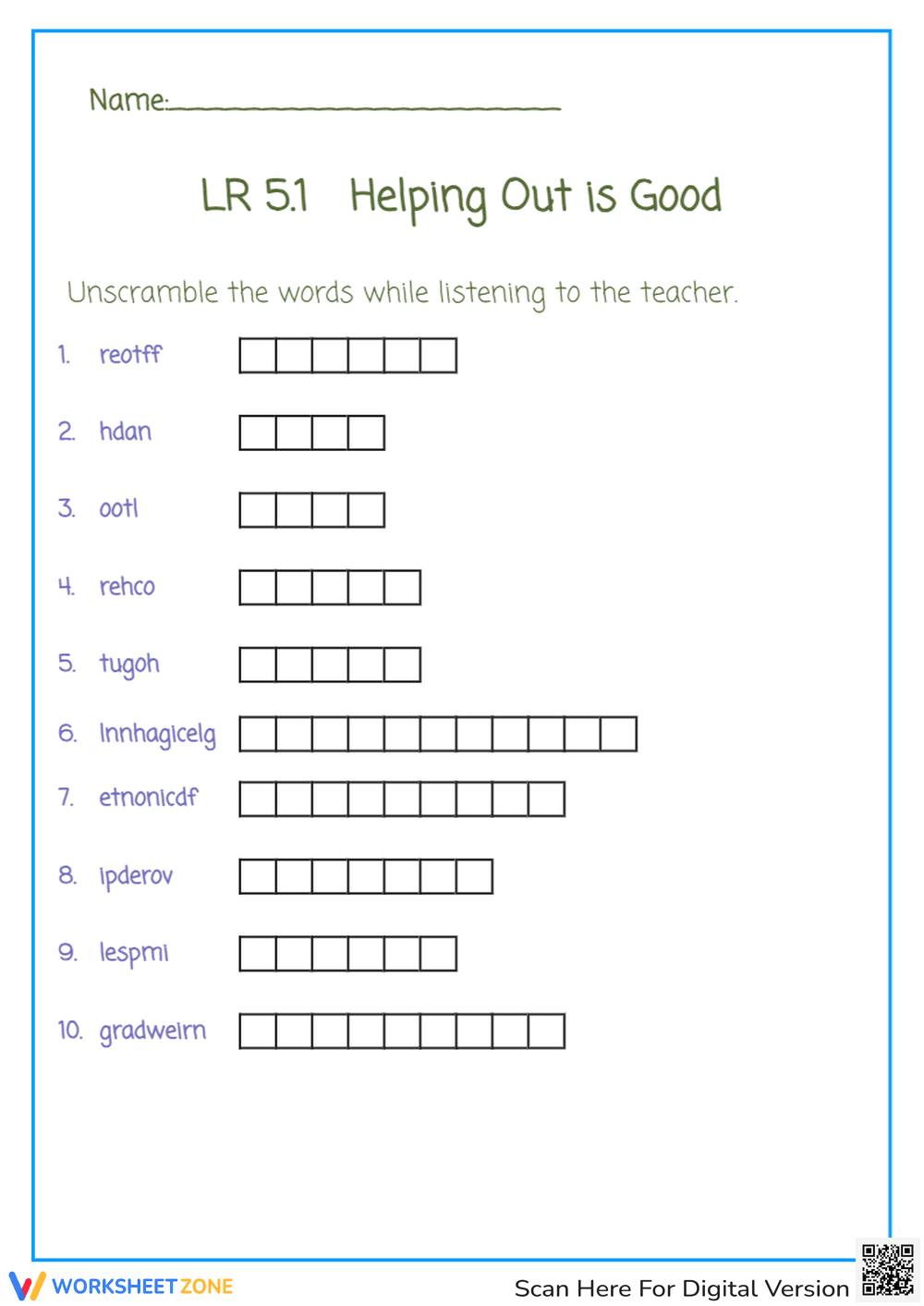
This Kindergarten vocabulary worksheet helps students develop phonemic awareness and spelling accuracy through a structured word unscramble activity. By rearranging letters to form familiar words, learners strengthen their letter-sound recognition and cognitive processing. This resource provides a focused way to reinforce unit-specific vocabulary while practicing fine motor skills through writing.
At a Glance
- Grade: Kindergarten · Subject: ELA
- Standard:
CCSS.ELA-LITERACY.L.K.2.D— Spell simple words phonetically, drawing on knowledge of sound-letter relationships- Skill Focus: Vocabulary & Spelling
- Format: 1 page · 10 problems · Answer key included · PDF
- Best For: Whole-class listening and spelling practice
- Time: 15–20 minutes
The worksheet features 10 distinct word scramble tasks designed for early learners. Each item provides a scrambled string of letters alongside a clear letter-box grid to guide student writing. This visual structure helps children understand word length and letter placement. The layout is clean and distraction-free, ensuring that students remain focused on the linguistic task at hand during teacher-led instruction.
Zero-Prep Workflow
- Print: Generate the single-page PDF for your class in under 30 seconds.
- Distribute: Hand out the sheets and read the target words aloud to provide auditory scaffolding for 10 minutes.
- Review: Check the correct spellings as a group using the included answer key for immediate feedback in 5 minutes.
This activity is aligned with CCSS.ELA-LITERACY.L.K.2.D, which requires students to spell simple words phonetically by drawing on their knowledge of sound-letter relationships. By engaging with scrambled letters, students must mentally manipulate phonemes and graphemes to reconstruct the correct word. This standard code can be copied directly into lesson plans, IEP goals, or district curriculum mapping tools.
Use this worksheet during the guided practice phase of a literacy block. As you say each word, students work to find the matching scrambled letters and write the word correctly. It also serves as an excellent formative assessment tool; observe which students struggle with letter sequencing to identify those needing additional phonics intervention. Expected completion time is 15 to 20 minutes.
This worksheet is ideal for Kindergarten students or first-grade learners requiring remedial spelling support. It works best when paired with a vocabulary anchor chart or a direct instruction lesson on the Helping Out theme. The inclusion of letter boxes provides necessary differentiation for students still developing spatial awareness in their handwriting.
Research by Fisher & Frey (2014) emphasizes the importance of the gradual release of responsibility, particularly in early literacy. This worksheet facilitates that model by providing a structured environment where students move from auditory recognition to independent orthographic construction. By focusing on CCSS.ELA-LITERACY.L.K.2.D, the activity ensures that students are not just memorizing strings of letters but are actively engaging in the phonetic decoding and encoding processes essential for reading fluency. The 10-task format is specifically calibrated to the attention spans of five-year-olds, preventing cognitive overload while still providing enough repetition to solidify new vocabulary. According to recent NAEP data, early intervention in phonemic manipulation is a primary predictor of later reading success. This printable resource offers a practical, evidence-based method for teachers to integrate high-frequency vocabulary into daily routines without increasing administrative burden or preparation time.


