




























Views
Downloads

Essential Partial Quotients Worksheet | Grade 4-5 Math

Paste this activity's link or code into your existing LMS (Google Classroom, Canvas, Teams, Schoology, Moodle, etc.).
Students can open and work on the activity right away, with no student login required.
You'll still be able to track student progress and results from your teacher account.
This Grade 4-5 math worksheet provides students with targeted practice in long division using the partial quotients strategy. By breaking down large dividends into manageable pieces, learners build conceptual understanding and computational fluency. This printable resource ensures students master the steps of estimating, subtracting, and adding partial quotients to find final results.
At a Glance
- Grade: 4–5 · Subject: Math
- Standard:
4.NBT.B.6— Find whole-number quotients with up to four-digit dividends and one-digit divisors- Skill Focus: Long Division with Partial Quotients
- Format: 3 pages · 7 problems · Answer key included · PDF
- Best For: Reinforcing conceptual multi-digit division strategies during core instruction
- Time: 20–30 minutes
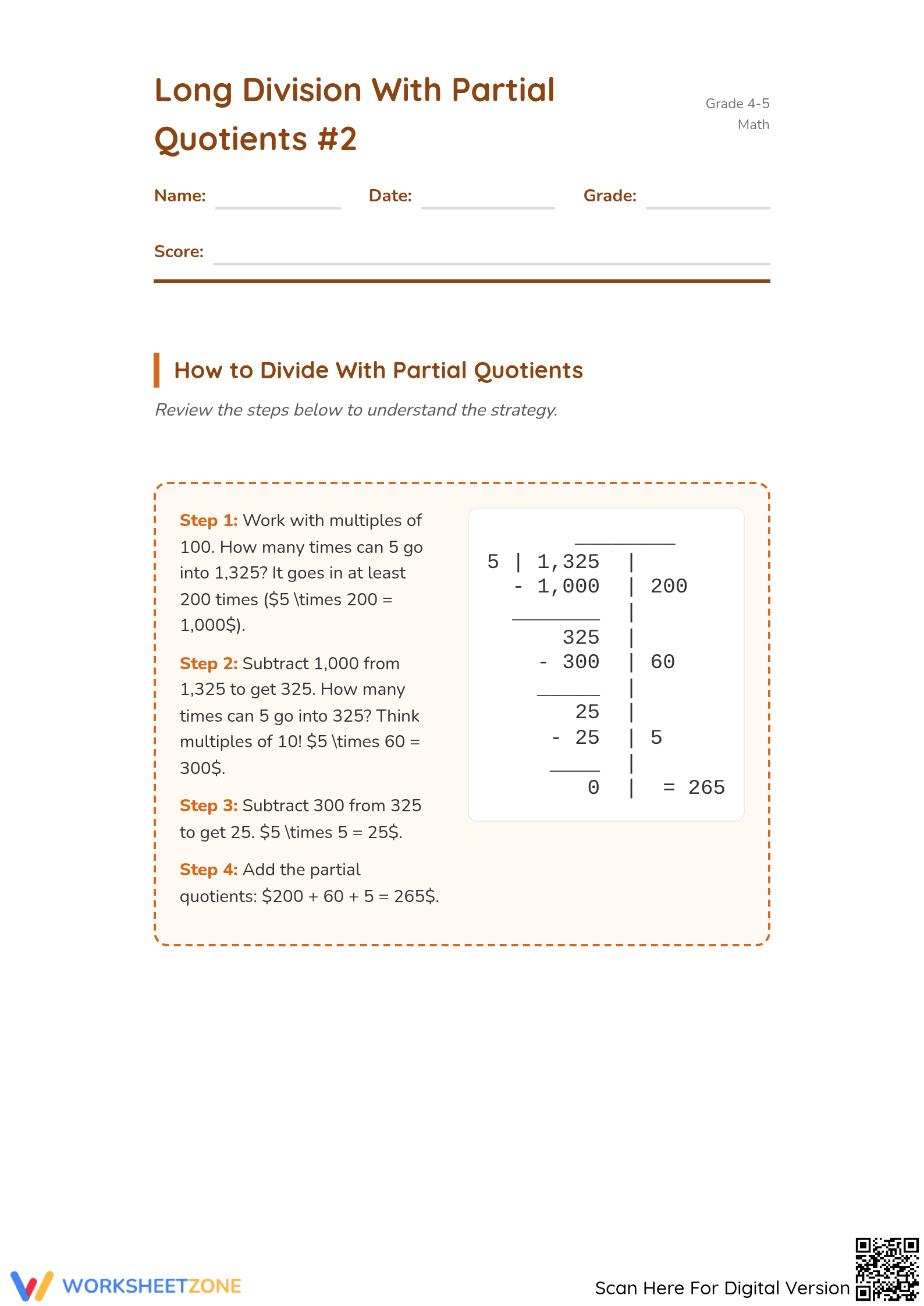
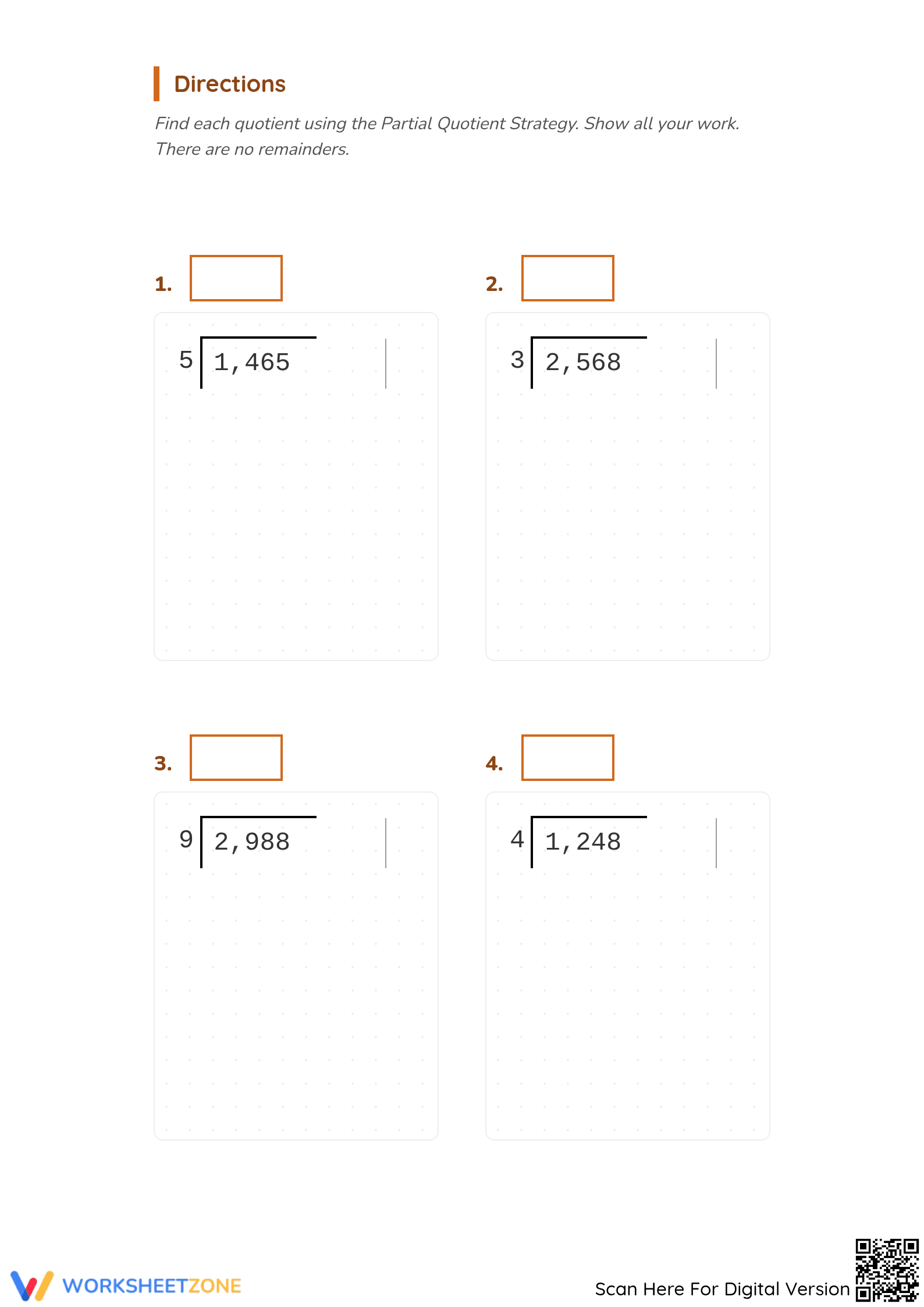
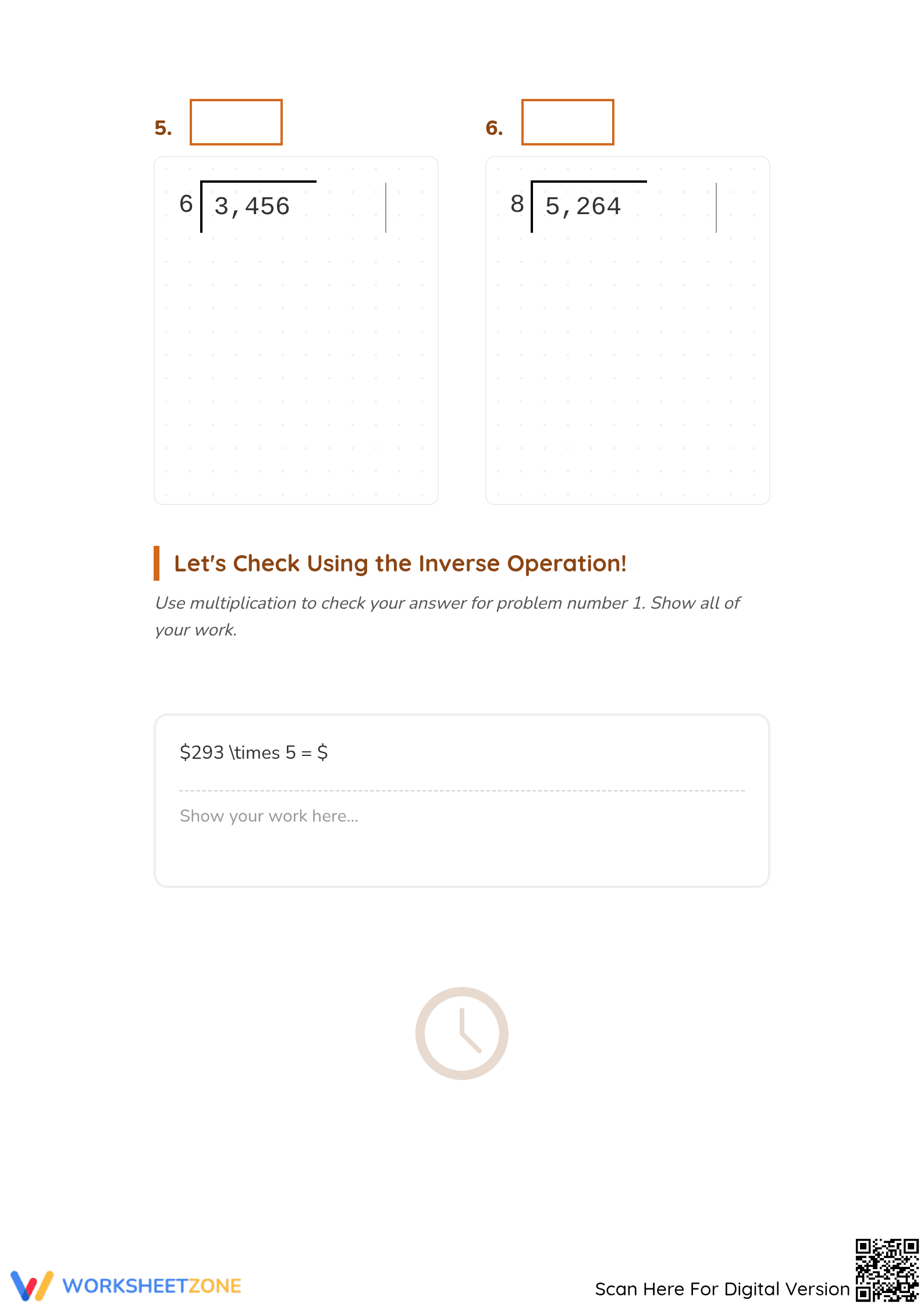
This three-page PDF includes a tutorial modeling the partial quotient method, six division problems without remainders, and a grid workspace for student thinking. It concludes with an inverse operation section to verify quotients using multiplication. A full answer key is included.
- Guided Modeling: A complete worked example demonstrates the 4-step process of identifying multiples, subtracting, and totaling partial quotients.
- Structured Application: Six division problems with 4-digit dividends provide ample space for students to apply the strategy independently within a grid.
- Verification Check: An inverse operation task requires students to multiply their result, ensuring procedural accuracy and deep conceptual understanding.
This approach follows a gradual-release model, moving from observation to independent calculation and metacognitive review.
This resource is directly aligned to `4.NBT.B.6`, which requires students to find whole-number quotients and remainders with up to four-digit dividends and one-digit divisors. It also supports `5.NBT.B.6` by extending division strategies to larger numbers. Both standard codes can be copied directly into lesson plans, IEP goals, or district curriculum mapping tools.
Use this worksheet during the "We Do" phase of a lesson to guide students through their first few independent attempts at partial quotients. It also serves as an excellent formative assessment tool; observe if students choose efficient multiples (like 100s or 10s) to identify where they need support in multiplication facts. Completion usually takes 20-30 minutes.
This resource is designed for Grade 4 and Grade 5 students who are transitioning from basic division facts to multi-digit long division. It is particularly helpful for visual learners who benefit from the grid-aligned workspace. Pair this with a division anchor chart or a short video tutorial on the partial quotients method for maximum instructional impact.
Standard 4.NBT.B.6 emphasizes the importance of using strategies based on place value and the properties of operations, rather than just memorizing a procedural algorithm. According to research by RAND AIRS (2024), students who utilize conceptual strategies like partial quotients demonstrate significantly higher retention of division concepts compared to those taught only the standard algorithm. This worksheet facilitates this conceptual bridge by providing an explicit model of the "chunking" process, allowing students to leverage their mental math strengths while tackling 4-digit dividends. By integrating an inverse operation check, the resource aligns with Fisher & Frey (2014) recommendations for metacognitive verification in mathematics. These evidence-based design choices ensure that students are not merely performing calculations but are actively developing the number sense required for more advanced algebraic thinking. This printable model serves as a reliable tool for classroom teachers and interventionists seeking to build durable mathematical proficiency in upper elementary students.


