


























Views
Downloads
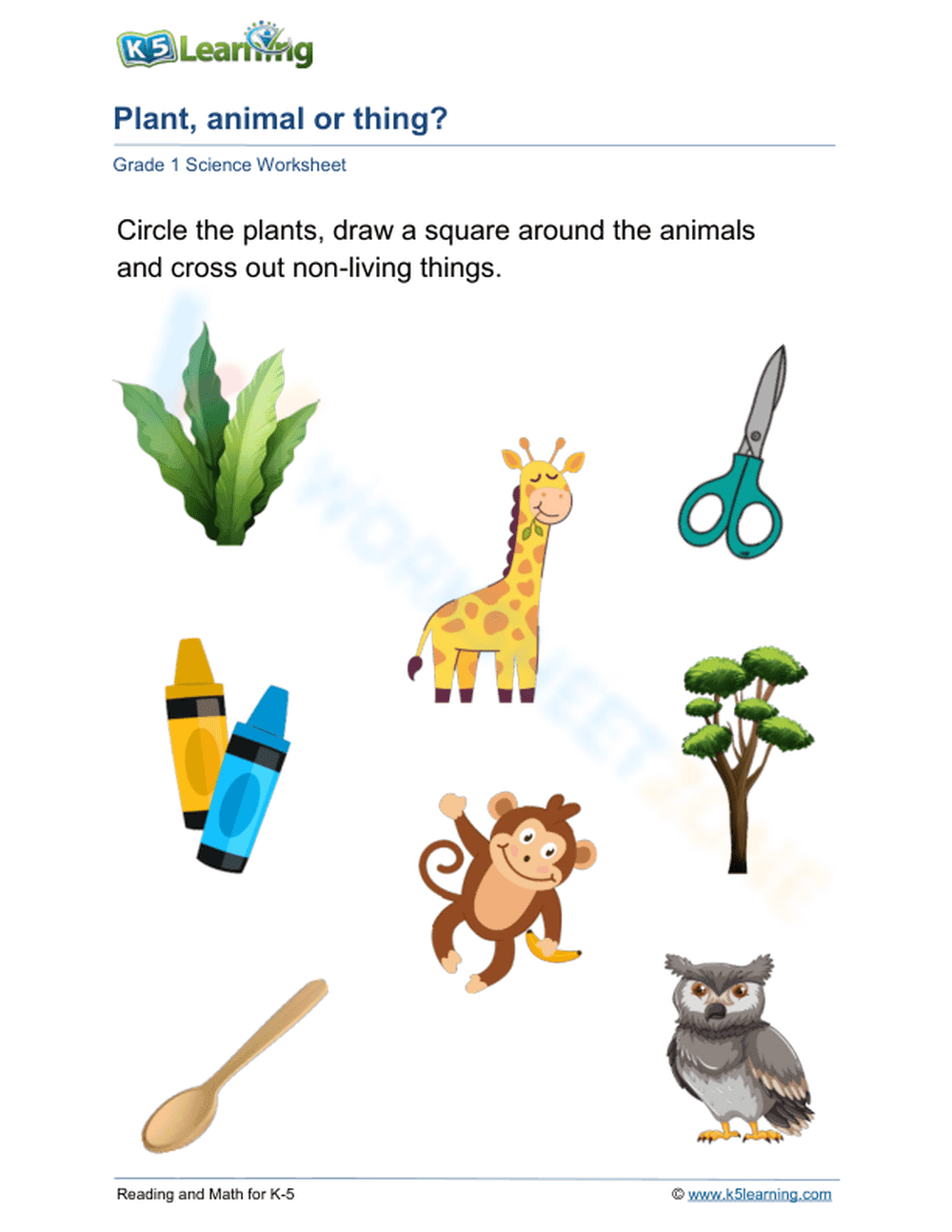

Grade 1 Living Things — Essential No-Prep Worksheet
Paste this activity's link or code into your existing LMS (Google Classroom, Canvas, Teams, Schoology, Moodle, etc.).
Students can open and work on the activity right away, with no student login required.
You'll still be able to track student progress and results from your teacher account.
This worksheet helps students distinguish between plants, animals, and inanimate objects. By categorizing eight familiar items, learners develop foundational biological classification skills. This essential resource ensures Grade 1 students can accurately identify living versus non-living characteristics in their local environment, fostering critical observation habits necessary for future life science mastery and ecological understanding.
At a Glance
- Grade: Grade 1 · Subject: Ecosystems
- Standard:
1-LS1-1— Identify plants and animals as living things that grow and survive- Skill Focus: Living vs Non-Living Classification
- Format: 1 page · 8 problems · Answer key included · PDF
- Best For: First-grade science center or quick review
- Time: 10–15 minutes
What's Inside
Inside this single-page PDF, you will find a clean, visually engaging layout featuring eight distinct illustrations. Students interact with the content through three specific commands: circling plants, drawing squares around animals, and crossing out non-living things. The mix of biological kingdoms and man-made objects like scissors and spoons provides clear contrast. A full answer key is provided for rapid student self-correction or teacher grading.
Zero-Prep Workflow
This resource is designed for immediate classroom deployment with a total prep time of under 60 seconds. Print the master, distribute it, and allow students to work independently. The explicit instructions make it ideal for sub plans or transition activities. Reviewing answers takes just three minutes, providing a high-impact learning moment with zero teacher setup.
Standards Alignment
This worksheet is aligned to 1-LS1-1, which focuses on how plants and animals use their external parts to help them survive, grow, and meet their needs. By identifying these organisms and distinguishing them from non-living "things," students build the prerequisite knowledge required to analyze biological structures. This standard code can be copied directly into lesson plans, IEP goals, or district curriculum mapping tools to ensure vertical alignment across the life science domain.
How to Use It
Use this as a formative assessment after teaching characteristics of living things. It works well in workstations or after a nature walk. Observe whether students distinguish between plants and animals, as this indicates advanced biological classification skills beyond the simple living/non-living binary.
Who It's For
This worksheet is primarily designed for first-grade students, though the visual nature makes it accessible for Kindergarteners or as a review for Grade 2 learners. It provides excellent support for English Language Learners (ELLs) by pairing clear vocabulary with recognizable images. For further exploration, pair this resource with a living things passage or a classroom "specimen sort" where students categorize real-world items found around the school building.
The ability to differentiate between living organisms and non-living objects is a foundational milestone in early childhood science education. Research from the RAND AIRS 2024 report emphasizes that early exposure to classification tasks significantly enhances a student's cognitive ability to organize complex information into hierarchical structures. This worksheet addresses the 1-LS1-1 standard by requiring students to recognize the distinct traits of plants and animals that separate them from inanimate "things." Fisher & Frey (2014) highlights that such visual sorting tasks serve as a critical scaffold for developing scientific observation skills and vocabulary acquisition in the primary grades. By engaging with these eight targeted problems, students move beyond rote memorization of definitions toward active application of biological criteria. This structured approach ensures that Grade 1 learners possess the conceptual clarity needed for more advanced ecological studies, where understanding the interaction between biotic and abiotic factors becomes essential for environmental literacy.


