


























Views
Downloads
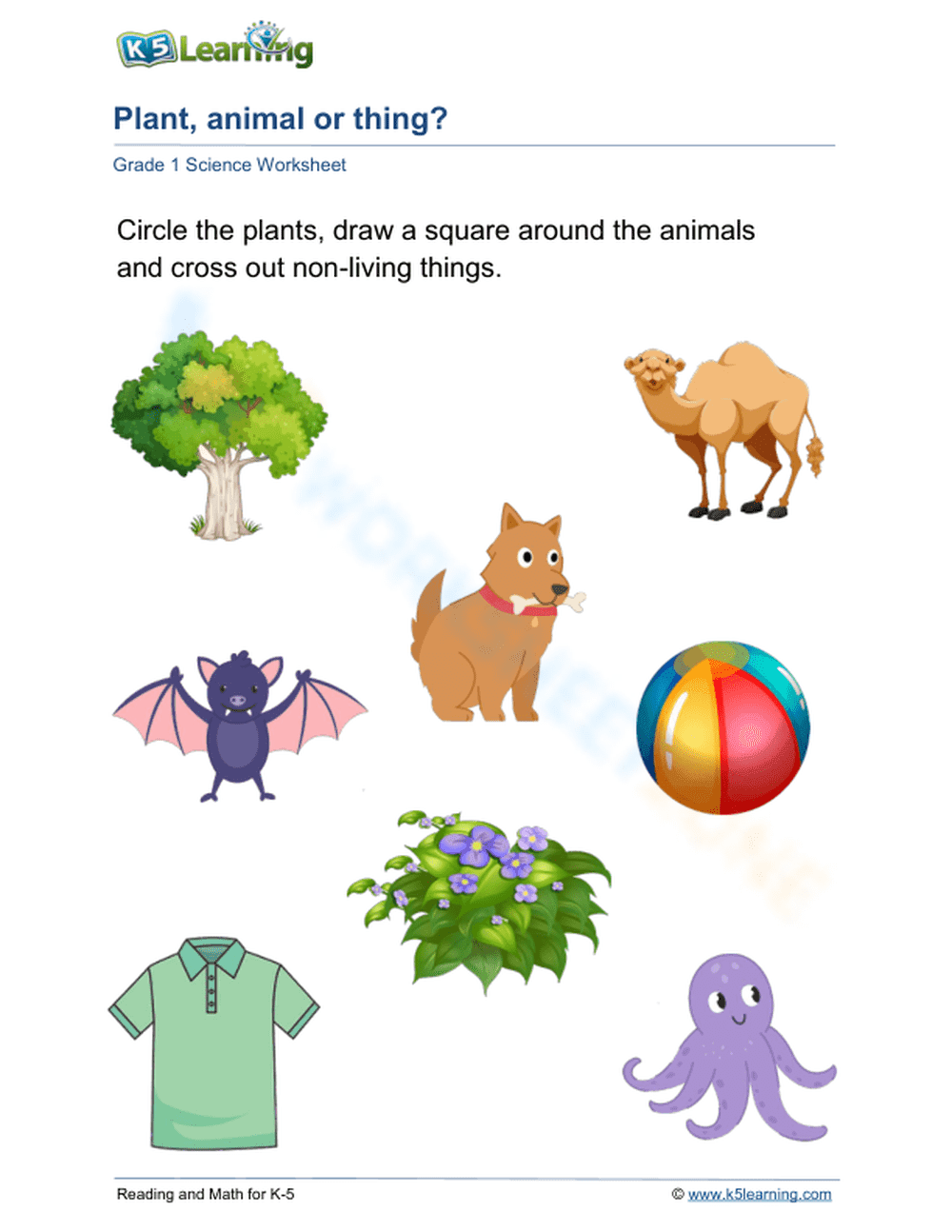

Essential Living and Non-Living Things Worksheet | Grade 1
Paste this activity's link or code into your existing LMS (Google Classroom, Canvas, Teams, Schoology, Moodle, etc.).
Students can open and work on the activity right away, with no student login required.
You'll still be able to track student progress and results from your teacher account.
This Grade 1 science worksheet helps students master the fundamental distinction between living and non-living things through a multi-sensory identification task. By classifying plants, animals, and inanimate objects, learners build a strong foundation for future biology and ecology units. This resource ensures immediate application of life science concepts with minimal teacher oversight.
At a Glance
- Grade: 1 · Subject: Science
- Standard:
1-LS1-1— Identify and classify living and non-living things based on observable external characteristics- Skill Focus: Living vs. Non-Living Classification
- Format: 1 page · 8 problems · Answer key included · PDF
- Best For: Independent practice and quick formative assessment
- Time: 10–15 minutes
What's Inside
This focused 1-page PDF features 8 high-quality illustrations representing diverse categories of living and non-living entities. Students are required to perform three distinct actions: circle plants, square animals, and cross out non-living items like the beach ball or shirt. This triple-action approach requires deeper cognitive engagement than simple binary choice, reinforcing the unique categories within the living world.
Zero-Prep Workflow
- Step 1: Print the single-page document (30 seconds).
- Step 2: Distribute the sheets to your students during the transition to science block (1 minute).
- Step 3: Use the provided answer key to review results as a whole group or during small-group instruction (5 minutes).
Total teacher preparation time is under 2 minutes, making this an ideal sub-plan or morning work activity.
Standards Alignment
The primary alignment for this activity is `1-LS1-1`: "Use materials to design a solution to a human problem by mimicking how plants and/or animals use their external parts to help them survive, grow, and meet their needs." While focused on classification, it supports identifying living structures. This standard code can be copied directly into lesson plans, IEP goals, or district curriculum mapping tools.
How to Use It
Deploy this worksheet during the "elaborate" phase of a 5E lesson. It serves as an excellent formative-assessment tool; observe which students struggle to differentiate the octopus from the shirt to identify misconceptions. Expected completion time is 10 to 15 minutes.
Who It's For
This worksheet is ideal for first-grade students, but also provides review for Kindergarten or second-grade learners. It is particularly effective for English Language Learners due to clear visual cues. Pair this with a nature walk or a reading passage about animal habitats for a complete lesson.
Classification activities like this one are essential for cognitive development in early elementary science, as they require students to move beyond surface-level observation toward structural categorization. According to a ScienceDirect TpT Analysis, structured classification tasks significantly improve long-term retention of biological concepts by creating mental schemas for "living" versus "non-living" properties. This worksheet aligns with `1-LS1-1` by requiring students to identify plants and animals through their external physical traits, a foundational step in understanding how external parts support survival and growth. By requiring three distinct marking actions—circling, squaring, and crossing out—the activity forces students to process each image against three competing criteria, reducing the likelihood of guessing. This pedagogical approach ensures that learners are not just memorizing names but are actively analyzing the functional characteristics of the objects presented, a key requirement for achieving mastery in NGSS-aligned curricula.


