




























Views
Downloads

Living and Non-living Things Worksheet | Grade K-2 Essential

Paste this activity's link or code into your existing LMS (Google Classroom, Canvas, Teams, Schoology, Moodle, etc.).
Students can open and work on the activity right away, with no student login required.
You'll still be able to track student progress and results from your teacher account.
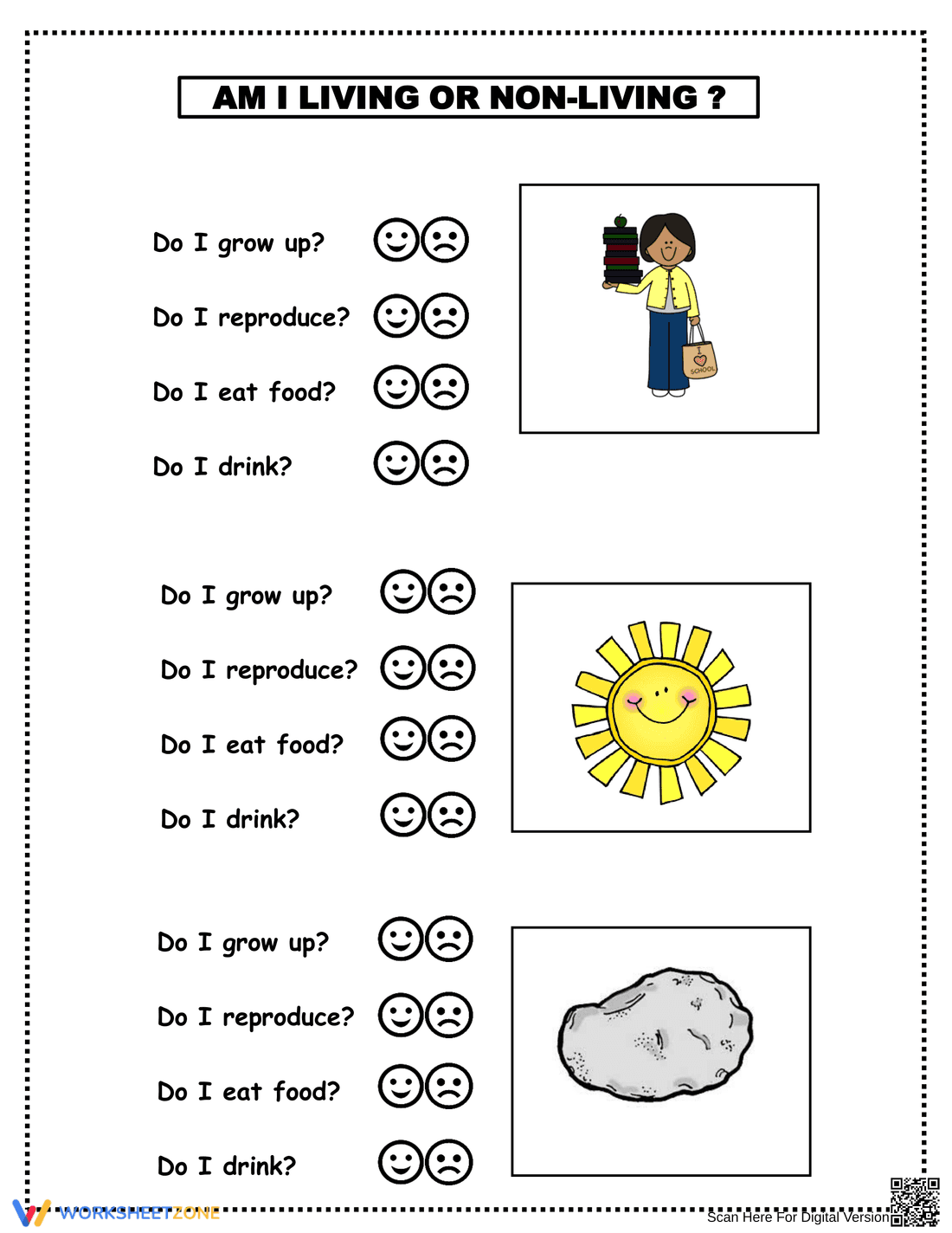
This Grade K-2 science worksheet helps students distinguish between living and non-living entities by evaluating core biological requirements. Students analyze three distinct objects—a person, the sun, and a rock—to determine if they grow, reproduce, eat, and drink. This exercise builds foundational scientific observation skills and categorization logic essential for early life science mastery.
At a Glance
- Grade: K-2 · Subject: Science
- Standard:
K-LS1-1— Use observations to describe patterns of what plants and animals need to survive- Skill Focus: Living vs. Non-living Characteristics
- Format: 1 page · 12 problems · Answer key included · PDF
- Best For: Independent science centers and formative assessment
- Time: 10–15 minutes
This single-page PDF features three visual examples accompanied by a four-point checklist for each. Students engage with icon-based response options (smiley and frowny faces) to answer whether each subject grows, reproduces, consumes food, or requires water. The layout includes a clear answer key for rapid grading and supports students who are still developing their reading fluency through the use of repetitive question structures.
The zero-prep workflow for this activity is designed for efficiency. Teachers can print the single-sheet PDF in seconds, distribute it to students, and review results using the included key in under a minute. Total teacher preparation time is under 2 minutes, making this an ideal resource for emergency sub plans or quick science transitions between core subjects.
This resource is primarily aligned with K-LS1-1, which requires students to use observations to describe patterns of what living things need to survive. By asking students to verify if an object eats or drinks, the worksheet directly addresses the "needs" component of the standard. This standard code can be copied directly into lesson plans, IEP goals, or district curriculum mapping tools.
Use this worksheet as a "quick check" following a direct instruction lesson on the characteristics of life. It works exceptionally well as a formative assessment during a science center rotation; observe if students correctly identify the sun as non-living despite its apparent movement. Completion usually takes 12 minutes, allowing for immediate peer-to-peer discussion of results to reinforce correct scientific reasoning.
Designed for Kindergarten through Grade 2, this resource is highly accessible for English Language Learners due to the heavy reliance on visual icons. It pairs naturally with an introductory picture book about the needs of living things or a classroom nature walk where students observe these same characteristics in real-world environments to solidify their understanding.
Standard biological classification in early childhood education relies on the identification of observable life processes, a method supported by the RAND AIRS 2024 framework for foundational scientific literacy. By evaluating growth, reproduction, and metabolic needs (eating and drinking), students engage in the "patterns" crosscutting concept defined in NGSS K-LS1-1. This Grade K-2 worksheet facilitates these observations through a structured 12-task checklist that bridges the gap between concrete examples (a person or rock) and abstract concepts like solar energy. Research from Fisher & Frey (2014) highlights that such visual scaffolds and repetitive inquiry structures are critical for knowledge retention in young learners. This resource provides the necessary scaffolding to ensure all students can successfully categorize living and non-living things while meeting rigorous national science standards. The clear checklist format allows for easy data collection on student mastery of essential life science concepts during the early elementary years.


