




























Views
Downloads
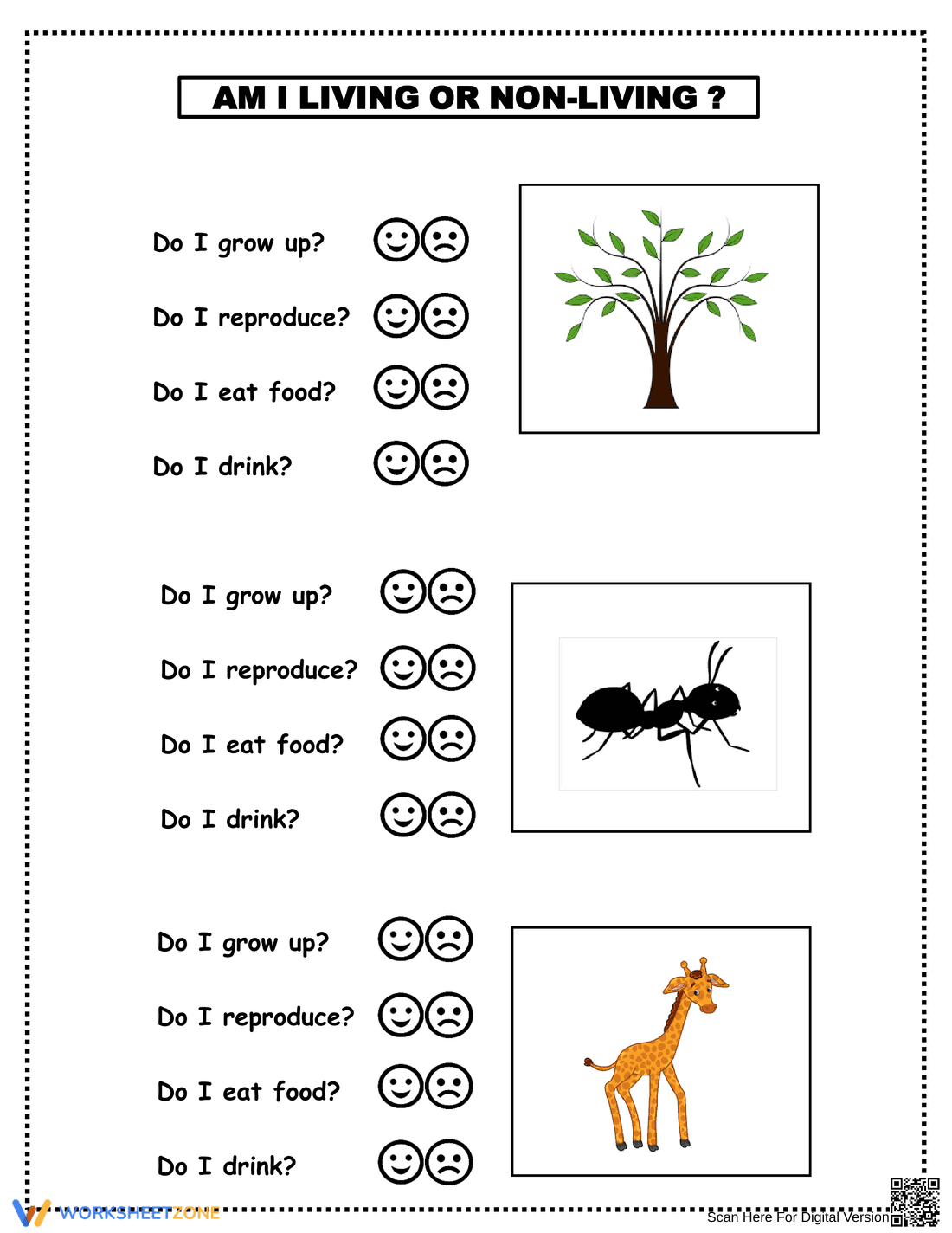

Grade 1 Science: Living vs. Non-Living — Printable Worksheet

Paste this activity's link or code into your existing LMS (Google Classroom, Canvas, Teams, Schoology, Moodle, etc.).
Students can open and work on the activity right away, with no student login required.
You'll still be able to track student progress and results from your teacher account.
This science worksheet helps K-2 students master the characteristics of living things. Through a simple, visual checklist, learners observe three organisms and determine if they grow, reproduce, eat, and drink. It’s a foundational activity for building core biology concepts.
At a Glance
- Grade: K–2 · Subject: Science
- Standard:
K-LS1-1— Describe patterns of what plants and animals need to survive.- Skill Focus: Living vs. Non-living Things
- Format: 1 page · 12 checklist items · Answer key included
- Best For: Science centers, concept introduction, sub plans
- Time: 10–15 minutes
A True Time-Saver
This resource is designed for a zero-prep workflow, making it perfect for busy teachers.
- Print (1 min): The entire activity is on one easy-to-print page.
- Distribute (1 min): The visual instructions are self-explanatory, requiring minimal introduction.
- Review (5 min): Use the included answer key to quickly review responses as a class.
Total prep and review time is under 10 minutes, making it an ideal choice for a sub plan, morning work, or a fast formative check.
This single-page PDF contains a clear, engaging worksheet focused on identifying life. It features three organisms—a tree, an ant, and a giraffe—each paired with a four-point checklist. Students use icons to indicate whether each organism grows, reproduces, eats, and drinks. A full answer key is included.
Standards Alignment and Use
This worksheet directly supports NGSS standard K-LS1-1, where students "Use observations to describe patterns of what plants and animals... need to survive." By checking for needs like growth, food, and water, students build a concrete understanding of life's universal requirements. The standard code is ready to be copied into lesson plans or curriculum maps.
Use this worksheet as a focused activity after introducing the concept of living and non-living things. It works well as an independent task or a science center station. For a quick formative check, listen as students discuss their choices; this reveals their reasoning. Most students will complete the 12 checklist items in about 10-15 minutes.
Built for the K-2 Classroom
Designed for students in Kindergarten through Grade 2, this activity supports visual learners and emerging readers with its simple icons. Its low text demand also makes it accessible for English Language Learners (ELL). Pair this worksheet with a hands-on "living or non-living" scavenger hunt for a more robust lesson.
This worksheet operationalizes standard K-LS1-1 by having students identify essential survival patterns through observation. The use of visual checklists for categorization is an effective instructional strategy, shown by the RAND AIRS 2024 report to reduce cognitive load and improve concept retention in early elementary science. By evaluating multiple examples (plant, insect, mammal), the activity reinforces the universal nature of biological needs. NAEP data consistently indicates that an early, solid grasp of the living/non-living distinction is a critical predictor for future success in complex life science topics. This resource provides a targeted tool for building that foundational knowledge.


