




























Views
Downloads

Printable Living and Non-Living Things Worksheet | Grade 1

Paste this activity's link or code into your existing LMS (Google Classroom, Canvas, Teams, Schoology, Moodle, etc.).
Students can open and work on the activity right away, with no student login required.
You'll still be able to track student progress and results from your teacher account.
Essential Introduction to Biological Classification
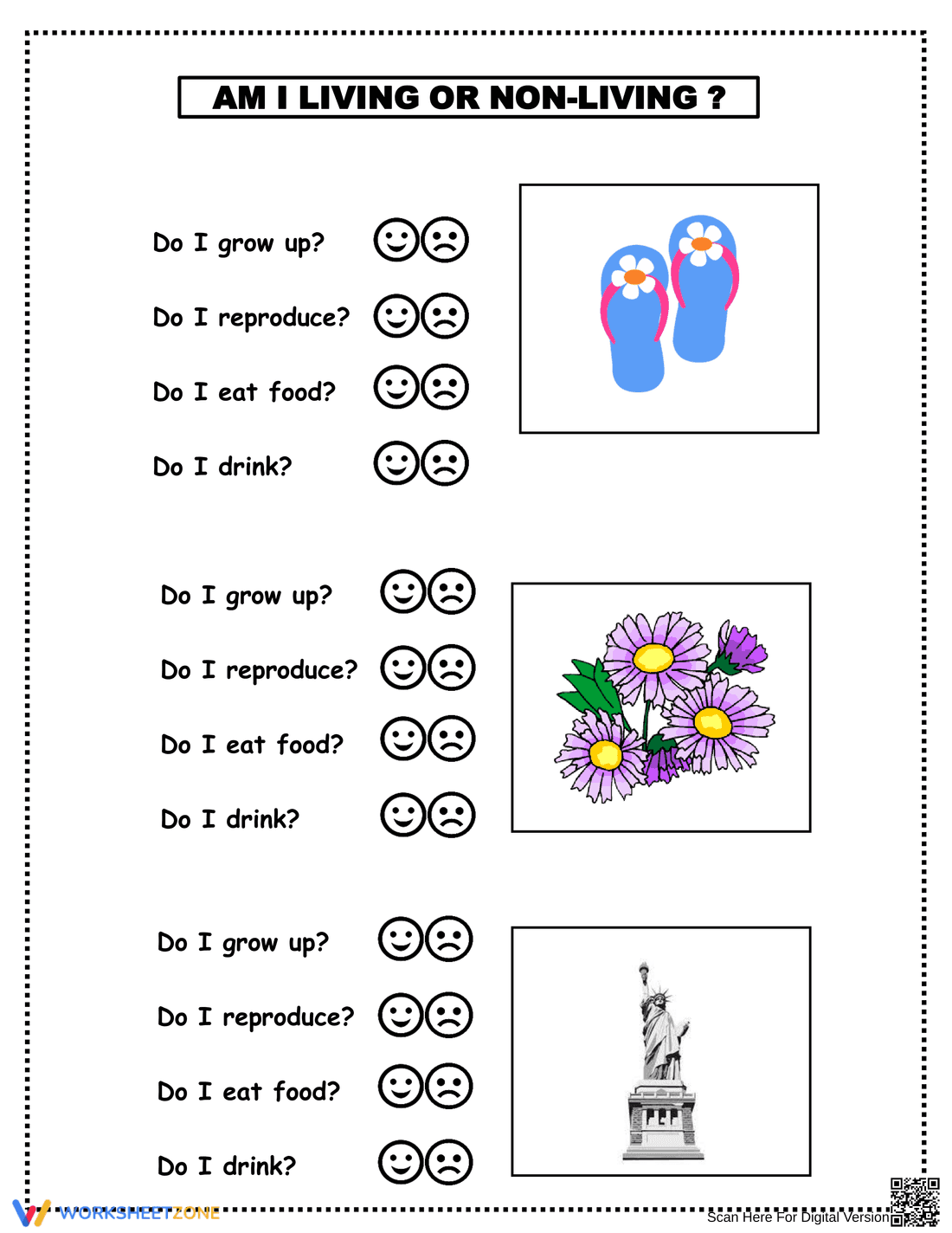
This Grade 1 science worksheet provides a clear framework for classifying objects as living or non-living. By evaluating growth, reproduction, and basic needs, students develop foundational biological observation skills. This activity ensures young learners can accurately distinguish between organisms and inanimate objects through structured inquiry and visual feedback.
At a Glance
- Grade: K–2 · Subject: Science
- Standard:
K-LS1-1— Use observations to describe what plants and animals need to survive.- Skill Focus: Biological Classification
- Format: 1 page · 3 tasks · Answer key included · PDF
- Best For: Introduction to life science or emergency sub plans.
- Time: 15–20 minutes
What's Inside
This one-page PDF features a clean layout containing three distinct objects for analysis: flip-flops, flowers, and the Statue of Liberty. Each object is paired with four diagnostic questions that prompt students to select a happy or sad face icon. This visual response system is ideal for emerging readers and includes an answer key for immediate instructional feedback.
Zero-Prep Workflow
Designed for efficiency, this worksheet eliminates teacher preparation. Simply print the single-page document and distribute it to students as a standalone activity with no extra manipulatives required. Finally, review responses using the included answer key for rapid grading. This workflow is perfect for emergency sub plans or spontaneous science centers where teacher time is limited.
Standards Alignment
This resource is aligned to NGSS K-LS1-1: "Use observations to describe patterns of what plants and animals need to survive." By focusing on growth and consumption, the worksheet directly addresses required observable patterns. The standard code can be copied into lesson plans or curriculum mapping tools to ensure instructional compliance and tracking.
How to Use It
Incorporate this worksheet during the Evaluate phase of a science lesson. Model the diagnostic questioning process before students transition to independent practice. It serves as an effective formative assessment tool; teachers can observe if students struggle with biological growth concepts, allowing for immediate intervention and instructional support.
Who It's For
This activity is tailored for Kindergarten through Grade 2 students exploring life science. Its repetitive sentence structure and visual icons provide excellent scaffolding for English Language Learners. It pairs naturally with a nature walk or an introductory picture book like "Living and Nonliving" to reinforce classroom concepts with real-world examples.
According to the RAND AIRS 2024 report on primary science education, structured classification tasks that utilize visual icons significantly reduce the cognitive load for early elementary learners, allowing them to focus on core conceptual relationships rather than complex literacy demands. This worksheet applies these findings by using a four-point diagnostic system—growth, reproduction, food, and water—to help Grade 1 students master the standard K-LS1-1. By observing these specific biological markers, students build a mental model for life science that aligns with Next Generation Science Standards. The inclusion of an answer key and zero-prep structure supports high-quality instruction in diverse classroom settings. Research indicates that such immediate reinforcement through visual feedback helps solidify the distinction between living organisms and inanimate objects, providing a necessary prerequisite for more advanced topics in ecology and biology.


