


























0
Views
0
Downloads

0.0
0
Save
0 Likes
Share
Identifying Living and Non-Living Things Activity
0 Views
0 Downloads
Paste this activity's link or code into your existing LMS (Google Classroom, Canvas, Teams, Schoology, Moodle, etc.).
Students can open and work on the activity right away, with no student login required.
You'll still be able to track student progress and results from your teacher account.
Information
Description
What It Is:
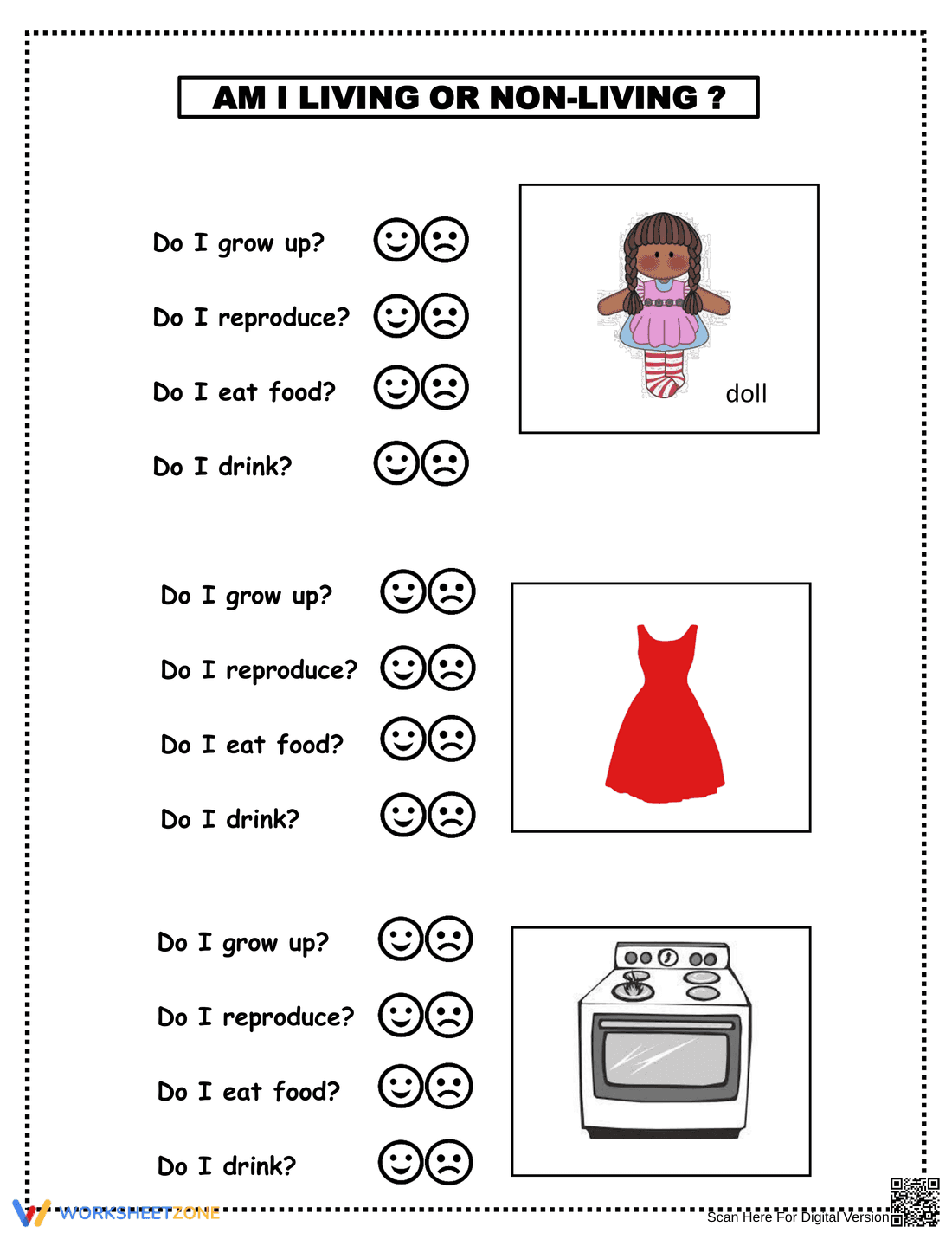
This educational worksheet, titled "AM I LIVING OR NON-LIVING?", features three distinct sections where students evaluate common objects like a doll, a dress, and a stove. For each object, learners answer four essential questions regarding growth, reproduction, nutrition, and hydration using simple smiley and sad face icons.
Why Use It:
It provides a clear, visual framework for children to grasp the fundamental characteristics of life. By applying these criteria to inanimate objects, students develop critical thinking and classification skills while building a foundation for biological science.
How to Use It:
• Identify the object shown in the box on the right side of each section.
• Read each question aloud: "Do I grow up?", "Do I reproduce?", "Do I eat food?", and "Do I drink?"
• Circle the smiley face if the answer is yes or the sad face if the answer is no for that specific object.
• Conclude whether the item is living or non-living based on the pattern of answers.
Grade Suitability:
Best for Early Childhood and Kindergarten.
• Early Childhood kids focus on identifying the objects and understanding simple yes/no concepts.
• Kindergarten students focus on applying scientific criteria to classify items in their environment.
Target Users:
This worksheet is perfect for preschool and kindergarten teachers, homeschooling parents, and early childhood educators looking for an introduction to life science.
This educational worksheet, titled "AM I LIVING OR NON-LIVING?", features three distinct sections where students evaluate common objects like a doll, a dress, and a stove. For each object, learners answer four essential questions regarding growth, reproduction, nutrition, and hydration using simple smiley and sad face icons.
Why Use It:
It provides a clear, visual framework for children to grasp the fundamental characteristics of life. By applying these criteria to inanimate objects, students develop critical thinking and classification skills while building a foundation for biological science.
How to Use It:
• Identify the object shown in the box on the right side of each section.
• Read each question aloud: "Do I grow up?", "Do I reproduce?", "Do I eat food?", and "Do I drink?"
• Circle the smiley face if the answer is yes or the sad face if the answer is no for that specific object.
• Conclude whether the item is living or non-living based on the pattern of answers.
Grade Suitability:
Best for Early Childhood and Kindergarten.
• Early Childhood kids focus on identifying the objects and understanding simple yes/no concepts.
• Kindergarten students focus on applying scientific criteria to classify items in their environment.
Target Users:
This worksheet is perfect for preschool and kindergarten teachers, homeschooling parents, and early childhood educators looking for an introduction to life science.


