




























Views
Downloads
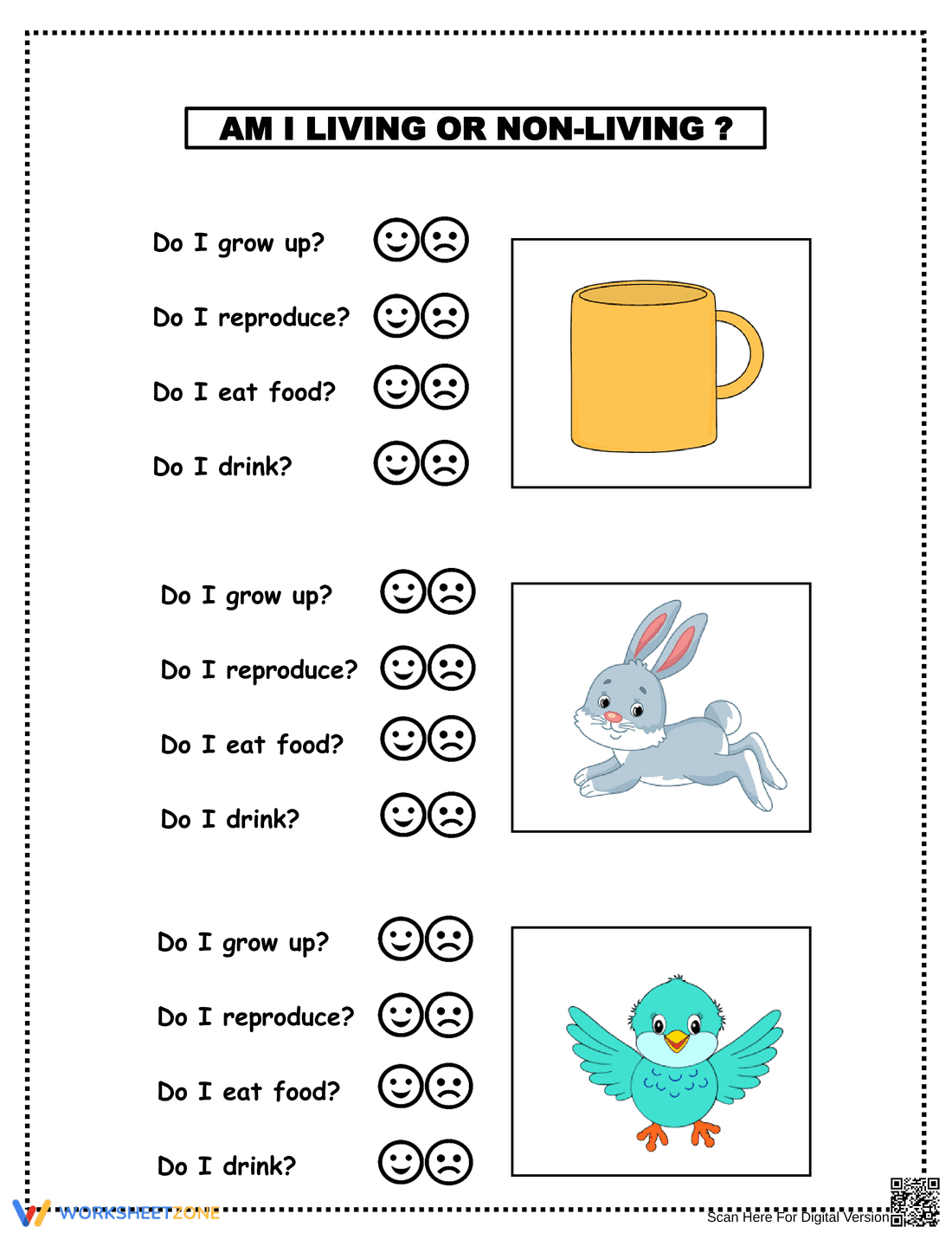

Living and Non-Living Things Worksheet | Grade 1 Essential

Paste this activity's link or code into your existing LMS (Google Classroom, Canvas, Teams, Schoology, Moodle, etc.).
Students can open and work on the activity right away, with no student login required.
You'll still be able to track student progress and results from your teacher account.
Identifying the difference between living and non-living objects is a foundational science skill for early learners. This worksheet guides students through a critical thinking process by asking four key questions about growth, reproduction, and basic needs. By checking these survival patterns, students build a concrete understanding of biological classification in a fun, visual format.
At a Glance
- Grade: 1 · Subject: Science
- Standard:
K-LS1-1— Use observations to describe patterns of what plants and animals need to survive- Skill Focus: Living vs Non-Living Classification
- Format: 1 page · 3 problems · Answer key included · PDF
- Best For: Independent practice or quick formative assessment
- Time: 10–15 minutes
This one-page PDF features three distinct items for analysis: a mug, a rabbit, and a bird. For each item, students respond to four specific prompts using a simple smiley or frowny face system. This layout reduces the writing load for Kindergarten and Grade 1 students while focusing entirely on the conceptual logic of identifying living characteristics and basic survival requirements like food and water.
Zero-Prep Workflow:
- Print (1 minute): Open the PDF and print copies for your entire class or a small group.
- Distribute (1 minute): Hand out the sheets; no additional materials like scissors or glue are required for this activity.
- Review (1 minute): Use the included answer key to quickly grade or conduct a whole-class check. This makes it an ideal choice for emergency sub plans.
This activity is aligned to K-LS1-1: "Use observations to describe patterns of what plants and animals (including humans) need to survive." By evaluating if an object eats, drinks, or grows, students are directly observing and recording biological patterns. Both standard codes can be copied directly into lesson plans, IEP goals, or district curriculum mapping tools.
Assign this worksheet during the elaborate phase of a science lesson to see if students can apply survival concepts to new examples. Alternatively, use it as an exit ticket after a nature walk. Observe how students differentiate between the mug and the animals to assess their grasp of the non-living concept during direct instruction. It provides immediate feedback on student comprehension of life science basics.
Designed for Kindergarten through Grade 2, this resource is perfect for visual learners and students with limited fine-motor skills. It pairs naturally with a living things anchor chart or a short introductory passage about animal needs. Teachers can easily differentiate by reading the questions aloud for emerging readers or English Language Learners who are still building their academic vocabulary.
Research from the RAND AIRS 2024 report emphasizes that early exposure to categorization tasks in science significantly improves a child's ability to recognize patterns in the natural world. This worksheet facilitates that cognitive development by providing structured classification for the K-LS1-1 standard. By focusing on the essential needs of living things—growth, reproduction, food, and water—students move beyond simple identification toward evidence-based reasoning. This approach aligns with the focus on scaffolds that build student independence. The interactive response system ensures high engagement while reducing the cognitive load of handwriting, allowing students to focus on the science concepts. Educators can use this data-driven tool to identify misconceptions early in the curriculum, ensuring that students have a firm foundation before moving into more complex life science topics. It serves as a bridge between observation and scientific documentation in early childhood education.


