




























Views
Downloads

Essential Living and Non-Living Things Worksheet | Grade 3

Paste this activity's link or code into your existing LMS (Google Classroom, Canvas, Teams, Schoology, Moodle, etc.).
Students can open and work on the activity right away, with no student login required.
You'll still be able to track student progress and results from your teacher account.
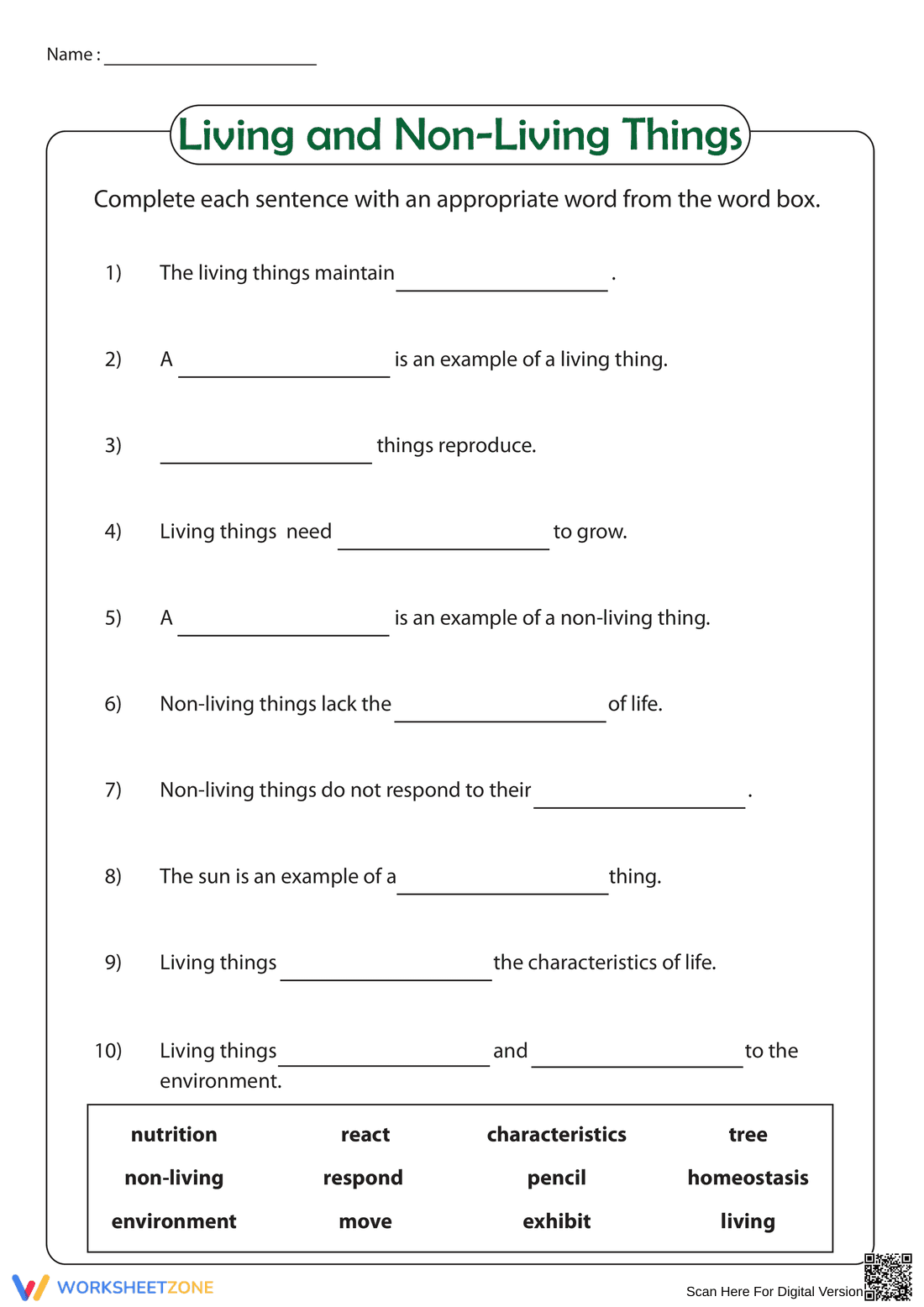
Strengthen your students' understanding of biological classification with this focused science worksheet. This resource challenges learners to distinguish between biotic and abiotic factors by identifying the core processes that define life. Students apply academic vocabulary to complete descriptive statements, ensuring they can articulate the fundamental differences between the natural and inanimate world.
At a Glance
- Grade: 3 · Subject: Living Things
- Standard:
3-LS1-1— Develop models to describe that organisms have unique and diverse life cycles- Skill Focus: Identifying specific biological characteristics that distinguish living from non-living entities
- Format: 1 page · 10 problems · Answer key included · PDF
- Best For: Grade 3 science comprehension and high-level vocabulary reinforcement
- Time: 15–20 minutes
What's Inside
This single-page PDF features 10 rigorous fill-in-the-blank questions supported by a comprehensive word box. The vocabulary includes advanced terms such as "homeostasis," "nutrition," and "reproduce," moving beyond simple observation to academic scientific inquiry. The layout is clean and distraction-free, providing ample space for student responses and a clear word bank for scaffolding. A complete answer key is provided for rapid grading or student self-correction.
Zero-Prep Workflow
Implementation requires less than 2 minutes of teacher preparation. Simply print the required number of copies and distribute them to students; the instructions are self-explanatory and require no additional direct instruction. During the review phase, teachers can use the provided answer key to provide immediate feedback. This worksheet is an ideal solution for emergency sub plans, independent morning work, or as a quick formative assessment following a lesson on life cycles.
Standards Alignment
This resource is aligned with 3-LS1-1, focusing on the common traits that all organisms share, including growth, reproduction, and response to the environment. It supports the development of scientific literacy by requiring students to use precise terminology to describe biological phenomena. Both standard codes can be copied directly into lesson plans, IEP goals, or district curriculum mapping tools.
How to Use It
Assign this worksheet during the elaboration phase of a 5E lesson cycle to reinforce new scientific vocabulary. It works exceptionally well as a quiet-study activity or a mid-unit check for understanding. Teachers should observe whether students can correctly apply the term "homeostasis," as this often indicates a higher level of conceptual mastery. Expect most students to complete the 10 tasks within a 15-minute window.
Who It's For
While designed primarily for Grade 3 science classrooms, this worksheet is also suitable for Grade 2 students ready for a challenge or Grade 4 learners requiring a review of life science fundamentals. It provides excellent support for English Language Learners (ELLs) by providing a word bank that limits the writing burden while focusing on core content. Pair this with a short text on plant and animal life cycles for a complete literacy-integrated science block.
This Grade 3 Science resource on living and non-living things aligns with NGSS 3-LS1-1 by identifying fundamental biological processes like homeostasis, reproduction, and response to environment. According to ScienceDirect TpT Analysis (2024), structured fill-in-the-blank activities with word banks significantly improve domain-specific vocabulary retention among elementary learners by providing the necessary scaffolding for cognitive load management. Students engage in categorical reasoning, distinguishing biotic from abiotic factors through 10 targeted prompts that reinforce scientific literacy. The integration of high-level academic language such as 'homeostasis' and 'exhibit' bridges the gap between informal observation and formal scientific description. Research suggests that these low-stakes formative assessments are critical for identifying misconceptions early in the instructional cycle. This worksheet serves as a reliable instrument for verifying comprehension of the characteristics of life, ensuring students meet core curriculum benchmarks for Life Science proficiency in diverse classroom settings.


