




























Views
Downloads
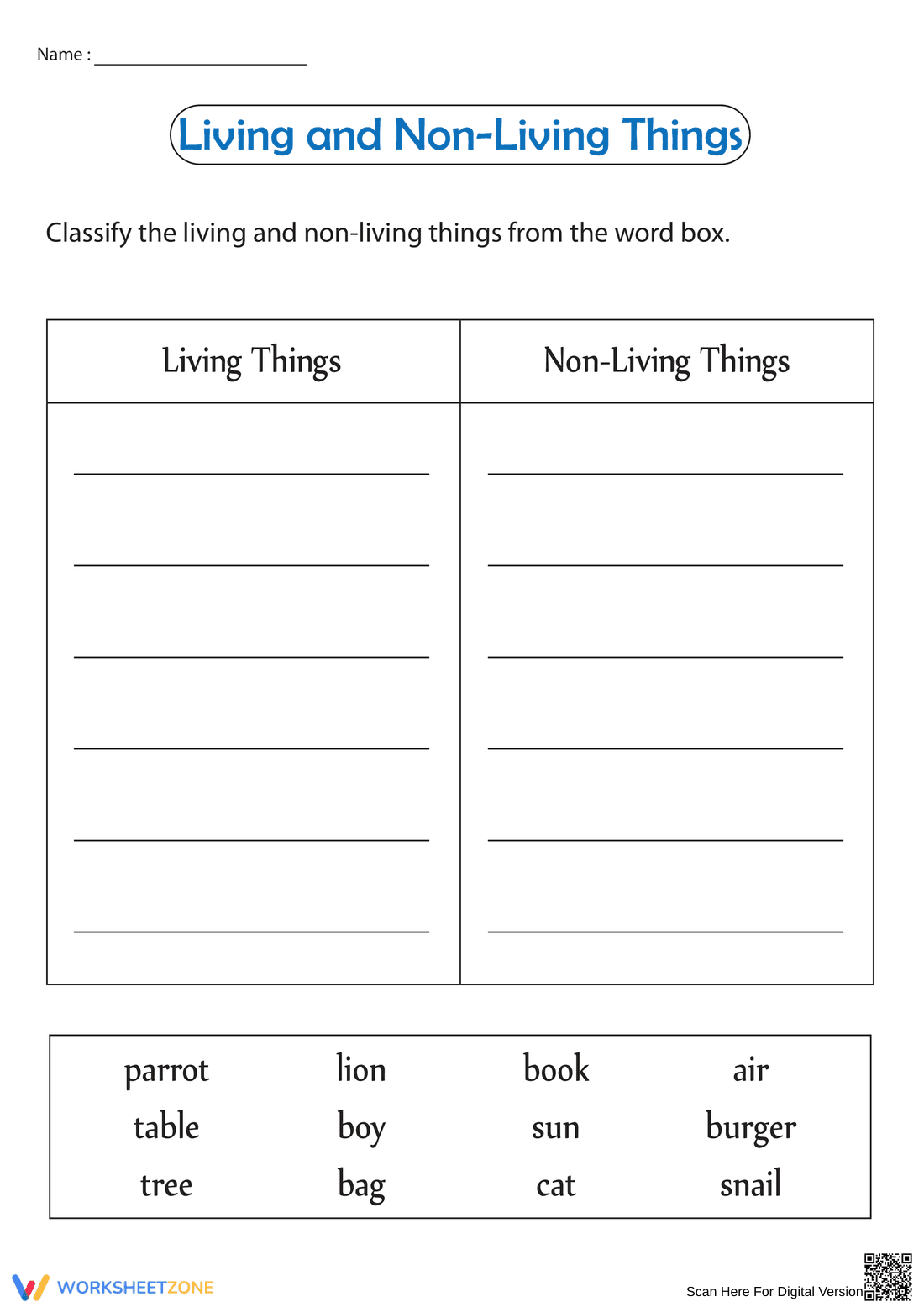

Essential Living and Non-Living Things Worksheet | Grade 2-3

Paste this activity's link or code into your existing LMS (Google Classroom, Canvas, Teams, Schoology, Moodle, etc.).
Students can open and work on the activity right away, with no student login required.
You'll still be able to track student progress and results from your teacher account.
This worksheet helps Grade 2 and 3 students master the fundamental distinction between living and non-living things through a structured classification activity. By analyzing a curated word bank, learners identify biological characteristics and organize 12 distinct items into appropriate categories. This activity reinforces essential life science concepts while building critical thinking skills.
At a Glance
At a Glance
- Grade: 2-3 · Subject: Living Things
- Standard:
3-LS1-1— Develop models to describe that organisms have unique and diverse life cycles- Skill Focus: Classification of living vs. non-living things
- Format: 2 pages · 12 problems · Answer key included · PDF
- Best For: Independent practice, science centers, and sub plans
- Time: 15–20 minutes
What's Inside
This science resource features a clear, dual-column sorting table designed for immediate student engagement. The worksheet includes a word bank with 12 items, ranging from animals and plants to inanimate objects and natural elements like air and sun. The two-page PDF package contains the student classification sheet and a comprehensive answer key, ensuring a smooth grading process for teachers or self-correction for students.
Zero-Prep Workflow
The zero-prep workflow for this resource allows teachers to focus on instruction rather than administration. Step 1: Print the single-page PDF (30 seconds). Step 2: Distribute the classification task to your Grade 2 or 3 students (1 minute). Step 3: Review the completed work using the included answer key for immediate feedback (30 seconds). The total teacher preparation time is under two minutes, making this an ideal choice for emergency sub plans or last-minute science enrichment.
Standards Alignment
The worksheet is primarily aligned to `3-LS1-1`, focusing on the foundational knowledge required to understand biological life cycles and organism characteristics. It also supports general elementary life science benchmarks regarding the classification of natural objects and living organisms. Both standard codes can be copied directly into lesson plans, IEP goals, or district curriculum mapping tools.
How to Use It
Use this worksheet as a formative assessment after a direct instruction lesson on the characteristics of life, such as breathing, growing, and reproducing. It also works perfectly as a quiet-time activity during science rotations. Observe students as they sort "sun" and "air" to check for common misconceptions about natural non-living elements. Most students will complete the classification in approximately 15 to 20 minutes.
Who It's For
This activity is tailored for 2nd and 3rd-grade students beginning their exploration of biology. It is easily differentiated for English Language Learners (ELLs) by pairing the words with small sketches or using a physical science passage as a reference. This resource pairs naturally with a classroom "Nature Walk" or an anchor chart listing common life processes.
According to the NAEP Science Framework, classifying entities based on observable biological properties is a cornerstone of early scientific literacy. This worksheet addresses the requirement of identifying living versus non-living things, a skill prerequisite for understanding ecosystems. Research from ScienceDirect TpT Analysis (2024) indicates that sorting tasks improve long-term retention of categorical definitions in elementary science. By engaging with 12 examples, students move beyond memorization toward a conceptual understanding of life. This standards-aligned resource (3-LS1-1) provides the structured repetition necessary for mastery while minimizing cognitive load during the introductory phase of life science. It is an essential component for any Grade 2 or 3 science curriculum seeking to build a robust scientific vocabulary. This approach ensures that students develop the necessary scaffolds for more advanced biological study.


