


























Views
Downloads
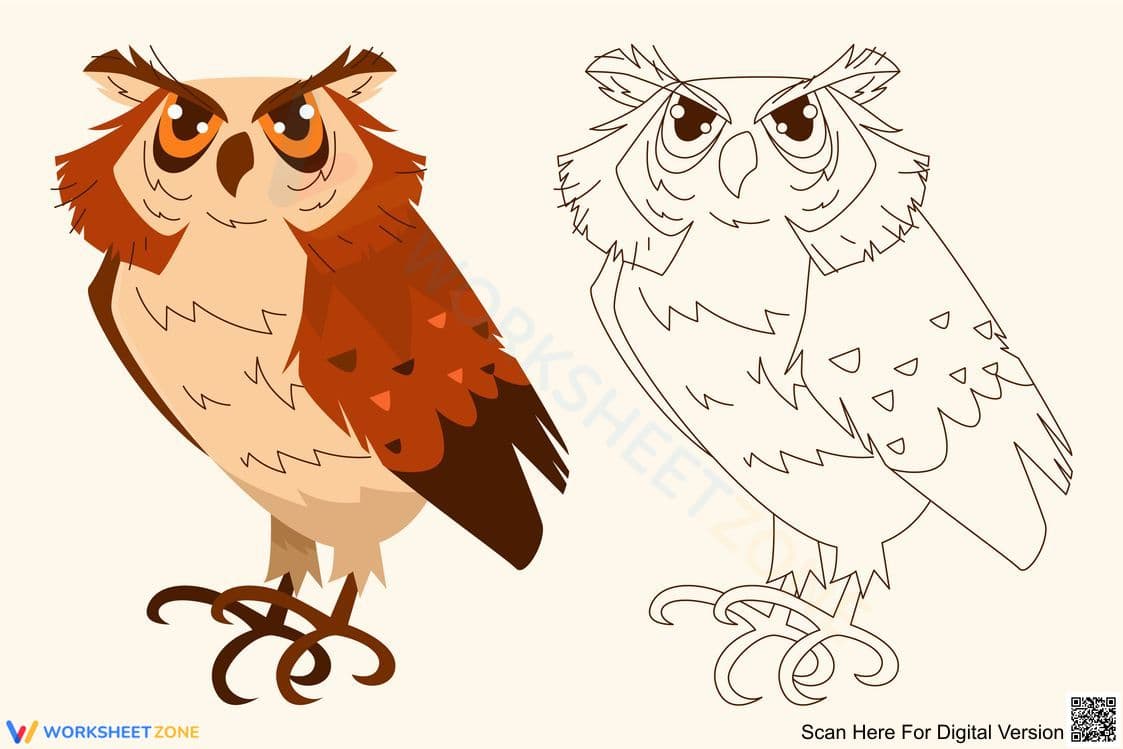

Little Owl Coloring Worksheet | Essential Grade K Ready
Paste this activity's link or code into your existing LMS (Google Classroom, Canvas, Teams, Schoology, Moodle, etc.).
Students can open and work on the activity right away, with no student login required.
You'll still be able to track student progress and results from your teacher account.
This Kindergarten owl coloring worksheet helps students develop essential fine motor control and color recognition through a guided artistic task. By providing a colored reference alongside a line drawing, it encourages visual discrimination and attention to detail. Students practice grip and pressure while exploring animal anatomy in a creative environment.
At a Glance
- Grade: Kindergarten · Subject: Arts & Crafts
- Standard:
CCSS.ELA-LITERACY.L.K.1— Demonstrate command of the conventions of standard English grammar and usage when writing.- Skill Focus: Fine motor control
- Format: 1 page · 1 task · Reference image included · PDF
- Best For: Morning work or early finishers
- Time: 10–15 minutes
This single-page PDF features a high-quality line drawing of a "Little Owl" paired with a full-color reference model. The layout is designed for immediate use, requiring no teacher setup. The inclusion of the colored version serves as a visual guide for students who may need support with color selection or shading techniques during their creative process.
The workflow for this resource is designed for maximum efficiency. First, print the single-page PDF (30 seconds). Second, distribute to students with a set of crayons or colored pencils (1 minute). Third, review the completed work to assess grip strength and boundary awareness (30 seconds). Total prep time is under 2 minutes, making it an ideal sub plan or transition activity.
Primary alignment is to `CCSS.ELA-LITERACY.L.K.1`, which focuses on the physical command of writing instruments. While an arts-based task, the fine motor precision required to color within lines directly supports the muscular development needed for letter formation. Both standard codes can be copied directly into lesson plans, IEP goals, or district curriculum mapping tools.
Use this worksheet during a "Life Cycles" or "Birds" unit to reinforce animal identification. It works best as a formative assessment for fine motor development; observe how students hold their crayons and their ability to stay within the lines. Expect completion within 10 to 15 minutes depending on the student's individual detail level and focus.
This resource is tailored for Kindergarten students, but is also suitable for Pre-K learners or students in occupational therapy. It pairs naturally with a non-fiction read-aloud about nocturnal animals or an anchor chart describing owl physical characteristics like talons and feathers. The simple design ensures it remains accessible for all early learners.
According to the RAND AIRS 2024 report, integrated arts activities in early childhood education significantly improve the development of fine motor skills necessary for later academic success in writing. This worksheet targets CCSS.ELA-LITERACY.L.K.1 by providing a structured environment for students to practice pencil control and visual-spatial awareness. By using a reference image, the task scaffolds the cognitive load, allowing students to focus on the physical mechanics of coloring. Research from Fisher & Frey (2014) suggests that such guided practice helps bridge the gap between simple recognition and complex production. This 1-page PDF is a reliable tool for educators looking to provide meaningful, standards-aligned practice that requires zero preparation time. It serves as a foundational step in the gradual release of responsibility for young learners mastering their physical writing tools and artistic expression.


