




























Views
Downloads
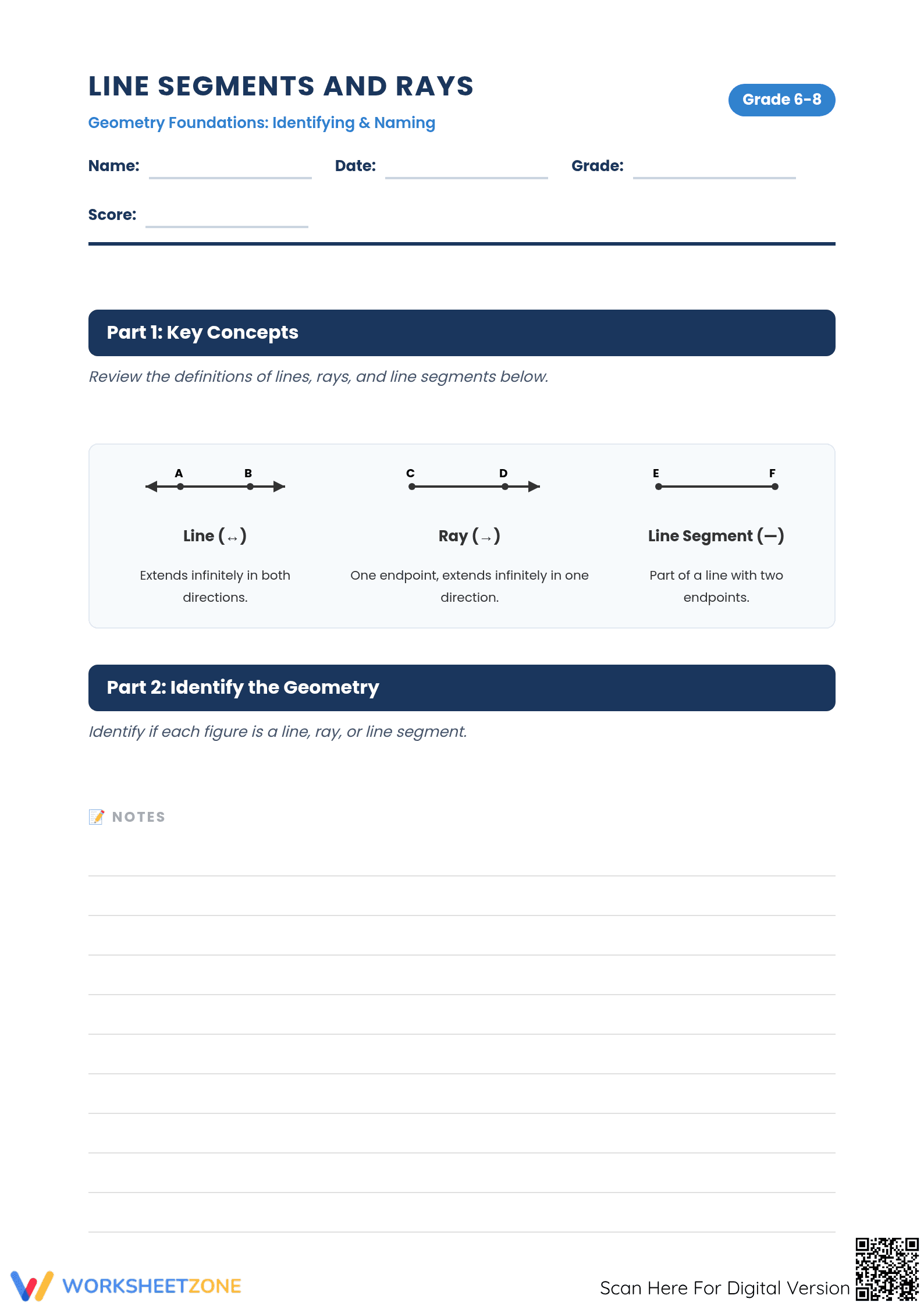


Essential Line Segments and Rays Worksheet | Grade 6-8

Paste this activity's link or code into your existing LMS (Google Classroom, Canvas, Teams, Schoology, Moodle, etc.).
Students can open and work on the activity right away, with no student login required.
You'll still be able to track student progress and results from your teacher account.
Build a rock-solid foundation in geometry with this comprehensive 4-page practice packet. Students will master the critical skills of identifying, distinguishing, and naming lines, rays, and line segments using precise mathematical notation. This resource ensures that learners can recognize geometric figures in isolation and within complex diagrams, preparing them for advanced coordinate geometry and proofs.
At a Glance
- Grade: 6–8 · Subject: Math
- Standard:
CCSS.MATH.CONTENT.4.G.A.1— Identify and name points, lines, line segments, and rays in two-dimensional figures- Skill Focus: Geometric notation and identification
- Format: 4 pages · 28 problems · Answer key included · PDF
- Best For: Geometry foundation review and notation mastery
- Time: 30–45 minutes
This 4-page PDF contains a comprehensive conceptual review and 28 practice problems. It features a clear visual anchor chart defining key concepts, 16 identification tasks, a detailed diagram analysis section, and a mixed review of conceptual questions. The layout provides ample space for student notes and includes a full answer key for immediate feedback and self-grading.
- Guided practice: Students begin by identifying 8 distinct geometric figures as lines, rays, or line segments based on visual cues and endpoint characteristics.
- Supported practice: The next 8 tasks require students to translate visual figures into formal geometric notation using lettered endpoints and the correct symbolic overbars.
- Independent practice: Students analyze a complex multi-point diagram to extract and name specific geometric objects based on given constraints and relationship properties.
This sequence follows a gradual-release model, moving from basic visual recognition to technical mathematical application.
Standards Alignment
The primary focus is CCSS.MATH.CONTENT.4.G.A.1, which covers drawing and identifying these foundational objects. While introduced in Grade 4, mastery is essential for the Grade 6-8 geometry progression, particularly for CCSS.MATH.CONTENT.HSG.CO.A.1 which demands precise definitions. Both standard codes can be copied directly into lesson plans, IEP goals, or district curriculum mapping tools.
How to Use It
Use this resource as a diagnostic tool before beginning a unit on coordinate geometry to verify student understanding of notation. It also serves as an excellent formative assessment halfway through a lesson on geometric construction. Have students compare their notation symbols in pairs to observe whether they correctly placed arrows or bars over their endpoint letters. Expect completion within a single class period.
Who It's For
This worksheet is designed for middle school students in Grades 6-8 who need to solidify their geometric foundations. It provides necessary scaffolding for English Language Learners through visual representations and clear definitions. It pairs perfectly with an introductory lecture on Euclidean geometry or a digital interactive lesson on line properties and ray directionality.
The CCSS.MATH.CONTENT.4.G.A.1 standard requires students to draw and identify points, lines, line segments, and rays. This worksheet facilitates this mastery by bridging the gap between visual identification and formal geometric notation. According to the RAND AIRS 2024 report, high-quality supplemental materials that emphasize precise mathematical language are critical for middle school students as they transition to more complex coordinate geometry and transformational reasoning. By requiring students to name figures using specific symbols—such as the double-headed arrow for lines and the single-headed arrow for rays—this resource reinforces the structural components of geometric logic. Students engage in 28 distinct tasks that progress from conceptual definitions to complex diagram analysis, ensuring they can isolate individual components within larger geometric systems. This rigorous approach to foundational naming conventions provides the necessary scaffolding for future success in high school geometry proofs and trigonometric applications, where notation accuracy is non-negotiable for problem-solving success.


