


























1 / 2
0
Views
0
Downloads

0.0
0
Save
0 Likes
Light and the Electromagnetic Spectrum
0 Views
0 Downloads
Paste this activity's link or code into your existing LMS (Google Classroom, Canvas, Teams, Schoology, Moodle, etc.).
Students can open and work on the activity right away, with no student login required.
You'll still be able to track student progress and results from your teacher account.
Information
Description
What It Is:
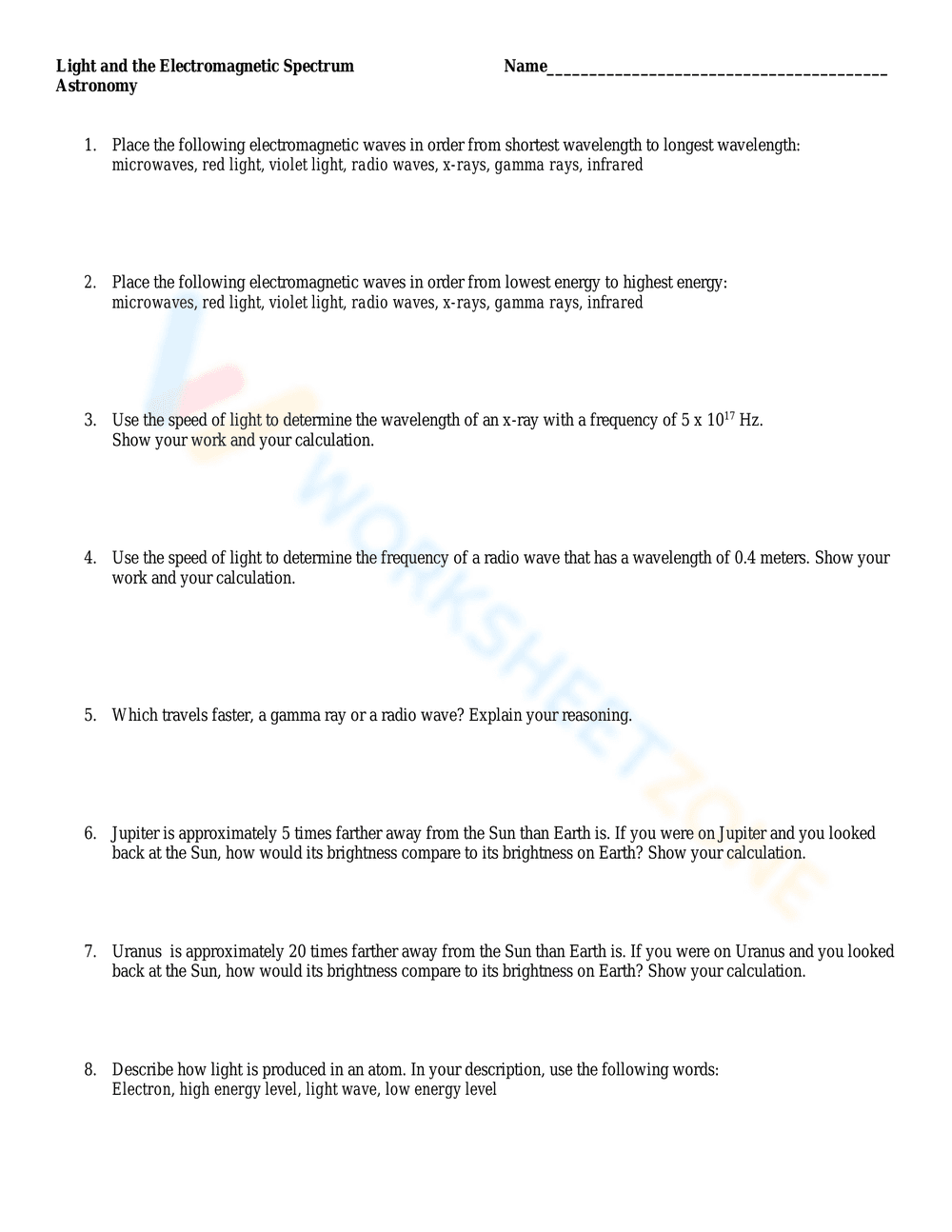
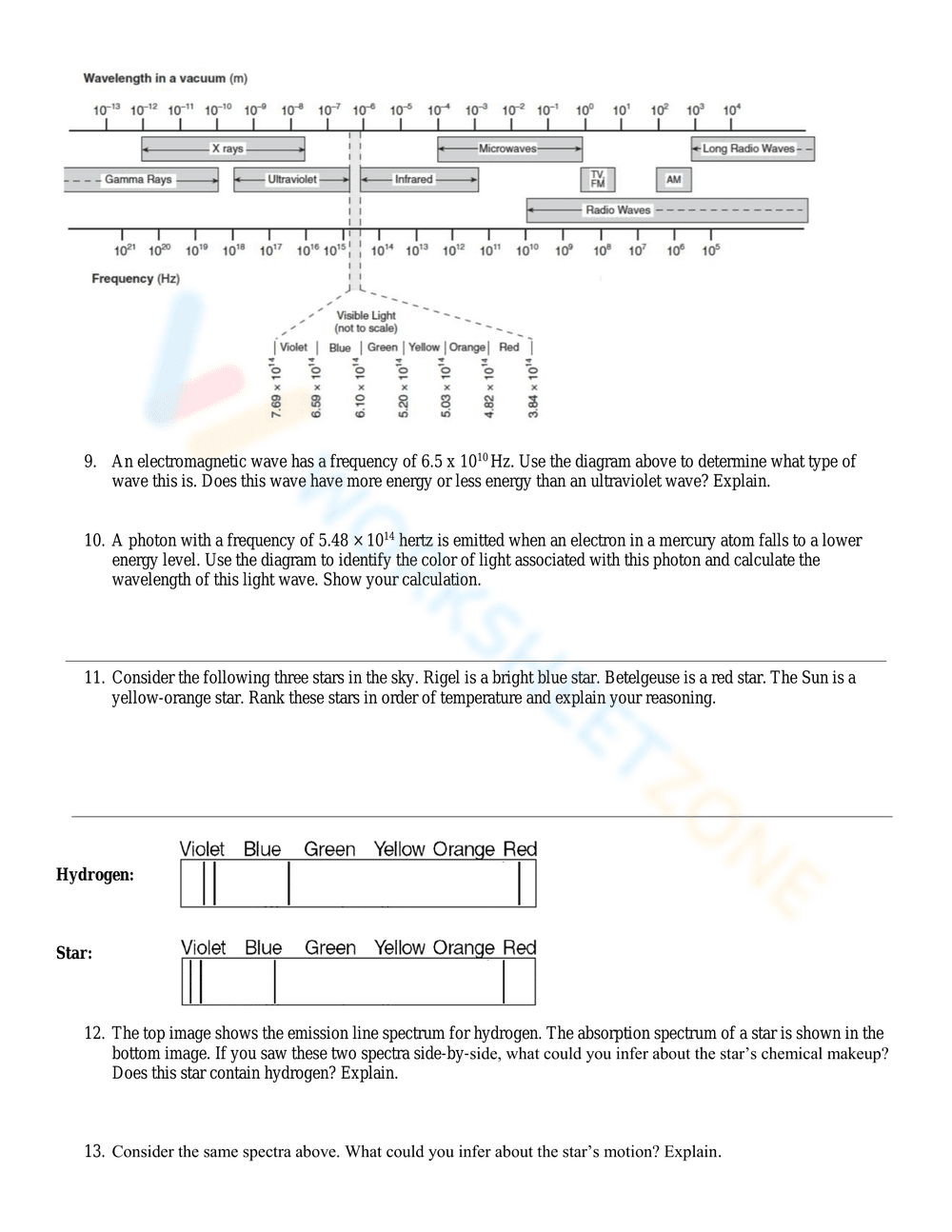
This is an astronomy worksheet focusing on light and the electromagnetic spectrum. It includes exercises such as ordering electromagnetic waves by wavelength and energy (microwaves, red light, violet light, radio waves, x-rays, gamma rays, infrared), calculating wavelength and frequency using the speed of light, comparing the speed of gamma rays and radio waves, calculating brightness based on distance from the sun, and describing how light is produced in an atom using specific vocabulary.
Grade Level Suitability:
Suitable for grades 9-12 (high school) physics or astronomy. The concepts require a foundational understanding of physics principles, algebraic manipulation, and the electromagnetic spectrum. The brightness calculations and the atom description require a more advanced understanding.
Why Use It:
This worksheet reinforces understanding of the electromagnetic spectrum, the relationship between wavelength, frequency, and energy of light, and the application of these concepts to astronomical observations. It encourages problem-solving skills through calculations and conceptual understanding through explanations.
How to Use It:
Students should first review the electromagnetic spectrum and related formulas. They should then complete the exercises, showing their work for the calculations. Encourage students to explain their reasoning for the conceptual questions. Review the completed worksheet and provide feedback on their understanding of the concepts.
Target Users:
High school students studying physics, astronomy, or related science courses. It is also suitable for students preparing for science competitions or exams that cover these topics.
This is an astronomy worksheet focusing on light and the electromagnetic spectrum. It includes exercises such as ordering electromagnetic waves by wavelength and energy (microwaves, red light, violet light, radio waves, x-rays, gamma rays, infrared), calculating wavelength and frequency using the speed of light, comparing the speed of gamma rays and radio waves, calculating brightness based on distance from the sun, and describing how light is produced in an atom using specific vocabulary.
Grade Level Suitability:
Suitable for grades 9-12 (high school) physics or astronomy. The concepts require a foundational understanding of physics principles, algebraic manipulation, and the electromagnetic spectrum. The brightness calculations and the atom description require a more advanced understanding.
Why Use It:
This worksheet reinforces understanding of the electromagnetic spectrum, the relationship between wavelength, frequency, and energy of light, and the application of these concepts to astronomical observations. It encourages problem-solving skills through calculations and conceptual understanding through explanations.
How to Use It:
Students should first review the electromagnetic spectrum and related formulas. They should then complete the exercises, showing their work for the calculations. Encourage students to explain their reasoning for the conceptual questions. Review the completed worksheet and provide feedback on their understanding of the concepts.
Target Users:
High school students studying physics, astronomy, or related science courses. It is also suitable for students preparing for science competitions or exams that cover these topics.


