




























0
Views
0
Downloads

0.0
0
Save
0 Likes
Share
Understanding Light and Dark
0 Views
0 Downloads

Paste this activity's link or code into your existing LMS (Google Classroom, Canvas, Teams, Schoology, Moodle, etc.).
Students can open and work on the activity right away, with no student login required.
You'll still be able to track student progress and results from your teacher account.
Information
Description
What It Is:
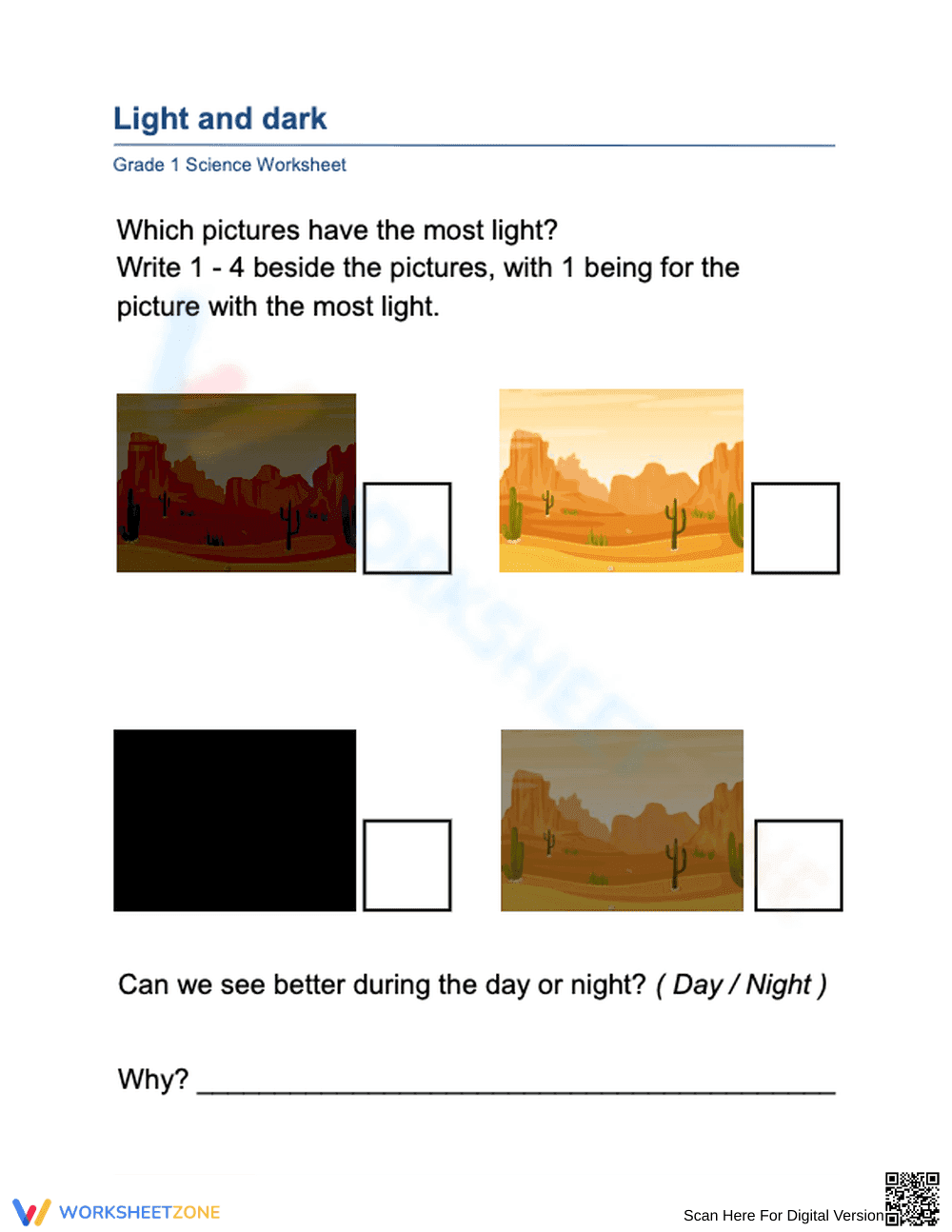
This is a Grade 1 science worksheet focused on the concept of light and dark. It features four pictures of desert landscapes with varying degrees of light. Students are instructed to rank the pictures from 1 to 4 based on the amount of light present, with 1 representing the picture with the most light. The worksheet also includes a question asking whether we see better during the day or night and a space to explain why.
Grade Level Suitability:
This worksheet is suitable for Grade 1 students. The concepts of light and dark are fundamental science topics for this age group. The activity of ranking pictures based on light levels is simple and engaging for young learners. The final question encourages critical thinking and explanation, appropriate for their cognitive development.
Why Use It:
This worksheet helps students understand the basic concepts of light and dark and how they affect our ability to see. It develops observation skills by requiring students to compare and contrast different levels of light in the pictures. It also encourages critical thinking as students explain why we see better during the day or night.
How to Use It:
Begin by explaining the concepts of light and dark to the students. Then, have them examine the four pictures carefully. Instruct them to write the numbers 1 through 4 in the boxes next to the pictures, ranking them from the most light (1) to the least light (4). Finally, have them answer the question about day and night and explain their reasoning in the space provided.
Target Users:
This worksheet is designed for Grade 1 students learning about light and dark in a science context. It can also be used for homeschooling or as a supplemental activity to reinforce classroom learning. It is beneficial for students who are developing their observation and critical thinking skills.
This is a Grade 1 science worksheet focused on the concept of light and dark. It features four pictures of desert landscapes with varying degrees of light. Students are instructed to rank the pictures from 1 to 4 based on the amount of light present, with 1 representing the picture with the most light. The worksheet also includes a question asking whether we see better during the day or night and a space to explain why.
Grade Level Suitability:
This worksheet is suitable for Grade 1 students. The concepts of light and dark are fundamental science topics for this age group. The activity of ranking pictures based on light levels is simple and engaging for young learners. The final question encourages critical thinking and explanation, appropriate for their cognitive development.
Why Use It:
This worksheet helps students understand the basic concepts of light and dark and how they affect our ability to see. It develops observation skills by requiring students to compare and contrast different levels of light in the pictures. It also encourages critical thinking as students explain why we see better during the day or night.
How to Use It:
Begin by explaining the concepts of light and dark to the students. Then, have them examine the four pictures carefully. Instruct them to write the numbers 1 through 4 in the boxes next to the pictures, ranking them from the most light (1) to the least light (4). Finally, have them answer the question about day and night and explain their reasoning in the space provided.
Target Users:
This worksheet is designed for Grade 1 students learning about light and dark in a science context. It can also be used for homeschooling or as a supplemental activity to reinforce classroom learning. It is beneficial for students who are developing their observation and critical thinking skills.


