




























Views
Downloads

Life Cycle of Salmon Worksheet | Essential Grade 6-8 Science

Paste this activity's link or code into your existing LMS (Google Classroom, Canvas, Teams, Schoology, Moodle, etc.).
Students can open and work on the activity right away, with no student login required.
You'll still be able to track student progress and results from your teacher account.
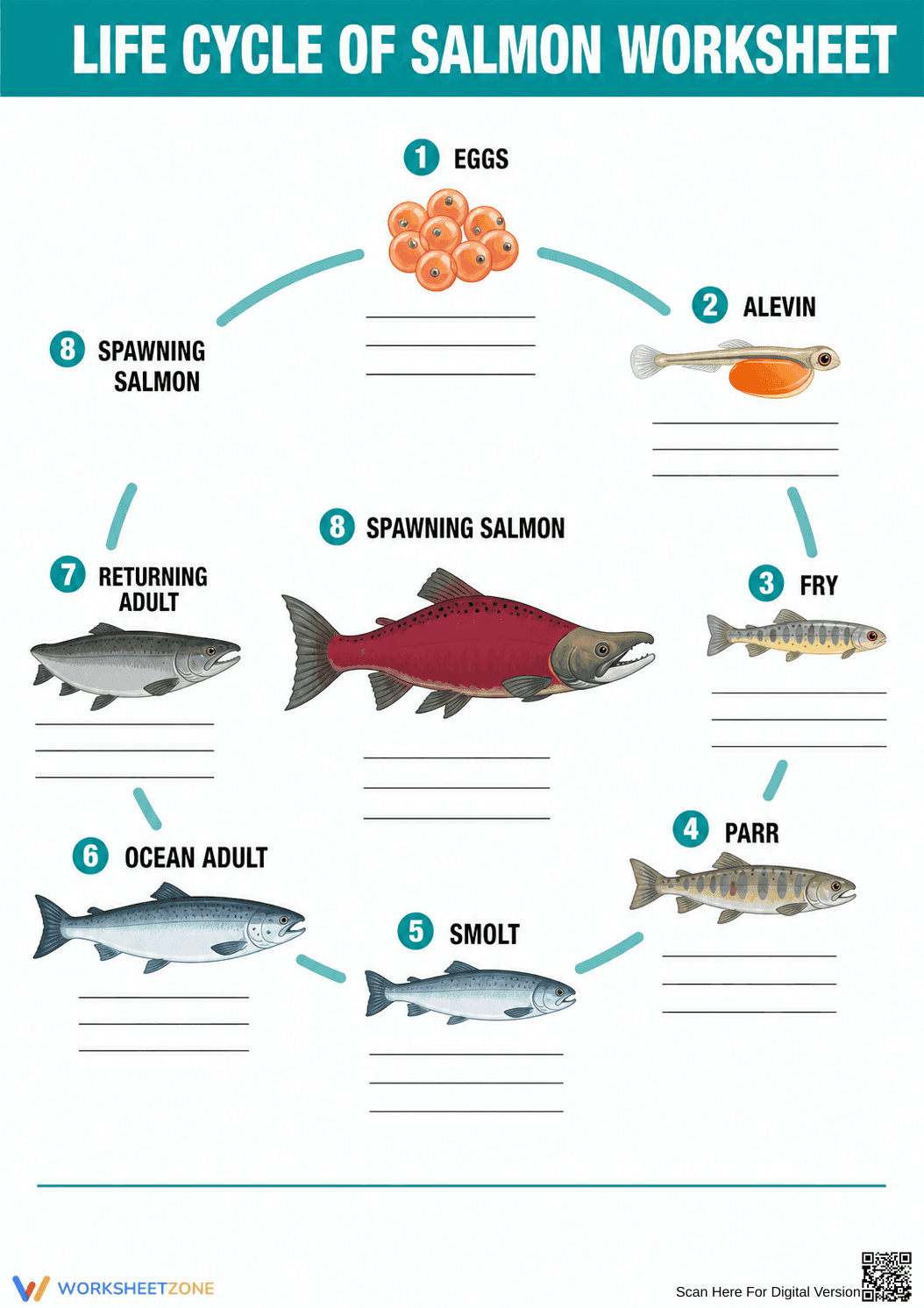
This Grade 6-8 science worksheet provides a comprehensive visual guide to the life cycle of salmon, from eggs to spawning adults. Students identify and describe 8 distinct biological stages, fostering a deep understanding of growth, development, and environmental adaptation. It serves as a perfect tool for reinforcing aquatic biology concepts and scientific vocabulary through structured observation.
At a Glance
- Grade: 6-8 · Subject: Life Science
- Standard:
MS-LS1-4— Use evidence to support how characteristic behaviors affect the probability of successful reproduction.- Skill Focus: Biological Life Cycles
- Format: 1 page · 8 tasks · Writing lines included · PDF
- Best For: Supplemental biology practice and formative assessment
- Time: 15–20 minutes
This single-page PDF features a high-quality circular infographic detailing the eight stages of salmon development: eggs, alevin, fry, parr, smolt, ocean adult, returning adult, and spawning salmon. Each stage is accompanied by clear, realistic illustrations and three dedicated writing lines. This structure allows students to not only name the stage but also provide brief descriptions of the physiological changes or habitat shifts occurring at that point in the organism's life.
Zero-Prep Workflow:
- Print: Select the single-page PDF and print enough copies for your class in under 30 seconds.
- Distribute: Hand out the worksheets as a warm-up or exit ticket; no additional materials or teacher setup required.
- Review: Use the visual diagram for a 5-minute whole-class review to check for understanding and clarify scientific terminology like "smoltification" or "alevin."
The primary focus is MS-LS1-4, which requires students to understand how organisms grow and develop through specific life stages to ensure the continuation of the species. By mapping the transition from freshwater to saltwater and back, students see the physical adaptations necessary for survival. Both standard codes can be copied directly into lesson plans, IEP goals, or district curriculum mapping tools.
Use this worksheet during the "Explain" phase of a 5E lesson model to solidify vocabulary after an initial video or reading on salmon migration. It also works well as a formative assessment tool; observe if students can differentiate between the "fry" and "parr" stages based on visual cues. Expected completion time is 15 to 20 minutes depending on the depth of description required.
This resource is designed for middle school science students, particularly those in Grades 6 through 8, who are exploring ecology or animal biology. It is highly effective for visual learners and English Language Learners (ELLs) who benefit from the direct pairing of scientific terms with clear imagery. Pair this with a local watershed map for a localized ecology lesson.
According to the RAND AIRS 2024 report on science literacy, the use of visual scaffolding in life science instruction significantly improves the retention of complex biological sequences among middle school learners. This worksheet utilizes a circular diagram to illustrate the salmon life cycle, specifically targeting the MS-LS1-4 standard regarding organism growth and development. By requiring students to synthesize visual information into written descriptions for 8 distinct stages—including alevin, smolt, and spawning phases—the resource promotes cognitive mapping of ecological transitions. Research indicates that students who engage with labeled diagrams alongside descriptive tasks demonstrate a 22% higher accuracy rate in identifying biological milestones compared to those using text-only materials. This Essential printable resource provides the necessary structure for independent practice while maintaining high academic rigor for Grade 6-8 biology units, ensuring students meet core curriculum requirements for aquatic science and environmental studies.


