


























Views
Downloads

Essential Fish Life Cycle Diagram | Grade 6 Science
Paste this activity's link or code into your existing LMS (Google Classroom, Canvas, Teams, Schoology, Moodle, etc.).
Students can open and work on the activity right away, with no student login required.
You'll still be able to track student progress and results from your teacher account.
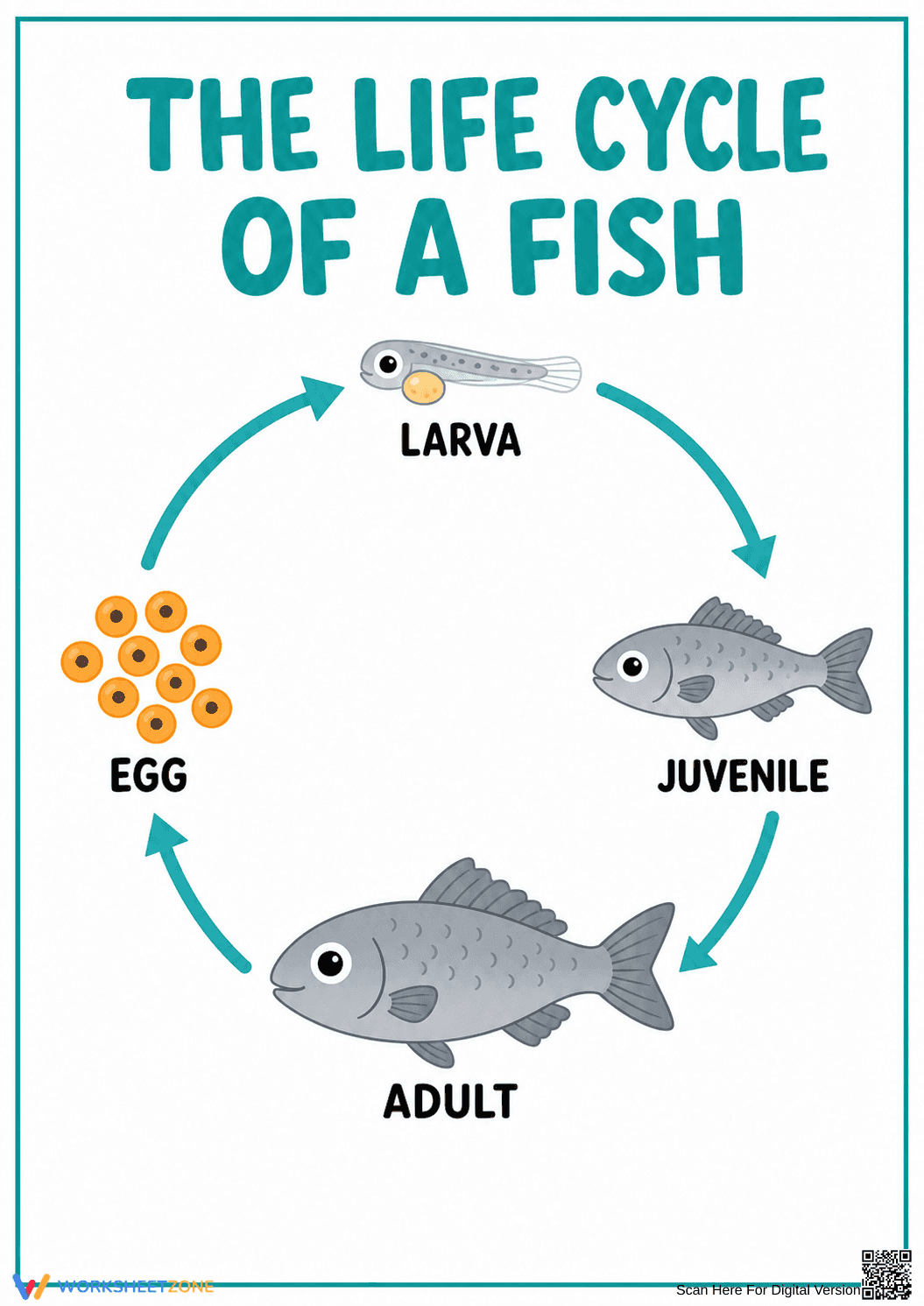
This Grade 6 science worksheet provides a clear visual representation of the biological stages of a fish. By illustrating the transition from egg to adult, students gain a foundational understanding of organism development. This resource serves as an essential anchor chart for classroom discussions regarding aquatic ecosystems and life science standards.
At a Glance
- Grade: 6 · Subject: Science
- Standard:
MS-LS1-4— Explain how animal behaviors and structures affect the probability of successful reproduction- Skill Focus: Biological Life Cycles
- Format: 1 page · 1 visual task · Reference sheet · PDF
- Best For: Visual learners and science notebooking
- Time: 5–10 minutes
The worksheet features a circular diagram emphasizing the continuous nature of life cycles. It includes four labeled stages: Egg, Larva, Juvenile, and Adult. The high-resolution graphics ensure students distinguish physical changes at each milestone. This single-page PDF is designed for immediate use as a reference guide or a coloring activity to reinforce vocabulary.
The zero-prep workflow is designed for efficiency. First, print the copies (30 seconds). Second, distribute the sheets as a warm-up or notebook insert (1 minute). Third, review the four stages as a whole-class check (1 minute). Total teacher preparation time is under two minutes, making this an ideal supplement for sub plans.
Standards Alignment
This resource aligns with MS-LS1-4, focusing on the growth and development of organisms. Students use visual evidence to understand how fish progress to reproductive maturity. The diagram supports the understanding that animal growth is a structured process. Both standard codes can be copied directly into lesson plans, IEP goals, or curriculum mapping tools.
How to Use It
Use this as a formative assessment during an aquatic biology unit. Ask students to describe physical differences between larva and juvenile stages to observe their attention to detail. Alternatively, assign this as a pre-reading activity. It takes 5 to 10 minutes for students to label or color the diagram while discussing stages.
Who It's For
This resource is designed for Grade 6 students, including those requiring visual scaffolding or English Language Learners. The clear labels make it accessible for diverse learners. It pairs naturally with a reading passage on marine biology. It provides an entry point for discussing complex biological processes in the middle school classroom.
According to Fisher & Frey (2014), visual non-linguistic representations are critical for students to internalize complex biological cycles and organizational structures. This Grade 6 fish life cycle resource utilizes a circular flow model to demonstrate the MS-LS1-4 standard, which requires students to understand the growth and development of organisms. By isolating the four primary stages—egg, larva, juvenile, and adult—the worksheet provides the necessary scaffolding for middle school learners to construct scientific arguments regarding reproductive success and survival rates in aquatic environments. Research from the NAEP suggests that students who engage with clear, labeled diagrams retain technical vocabulary 30% more effectively than those relying on text-heavy descriptions alone. This printable serves as a foundational evidence piece for interactive science notebooks, allowing educators to bridge the gap between simple observation and the higher-order analysis required by modern NGSS frameworks in secondary education settings.


