


























Views
Downloads

Essential Lewis Latimer Biography Worksheet | Grade 7 ELA
Paste this activity's link or code into your existing LMS (Google Classroom, Canvas, Teams, Schoology, Moodle, etc.).
Students can open and work on the activity right away, with no student login required.
You'll still be able to track student progress and results from your teacher account.
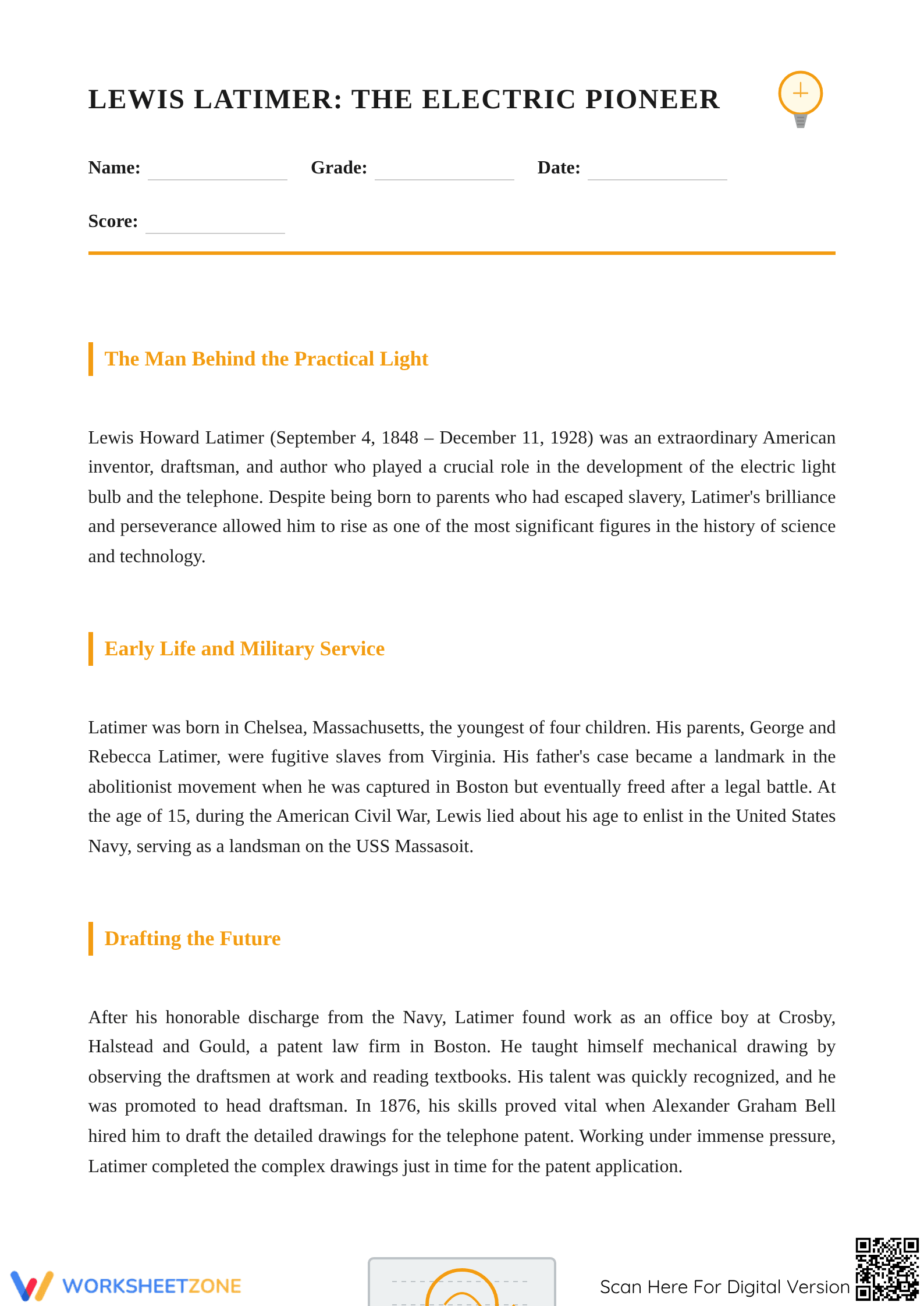
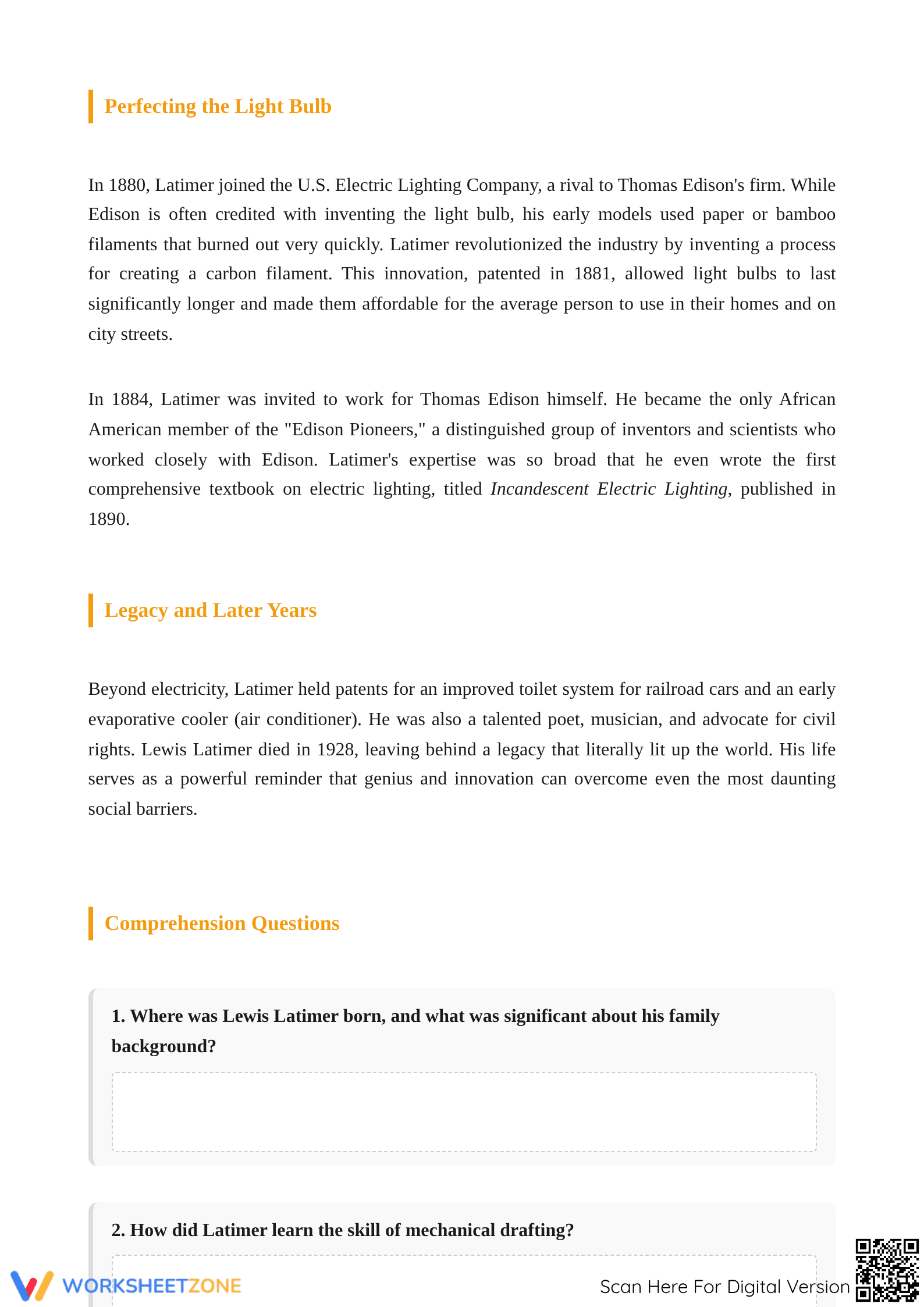
Students explore the remarkable life of Lewis Latimer, a pivotal figure in the history of electricity and invention. This reading comprehension worksheet provides a detailed biography of the "Electric Pioneer," challenging learners to analyze his perseverance and technical brilliance. By engaging with this text, students gain a deeper understanding of Black History and the evolution of modern technology.
At a Glance
- Grade: 7 · Subject: English Language Arts
- Standard:
CCSS.ELA-LITERACY.RI.7.1— Cite several pieces of textual evidence to support analysis of informational texts- Skill Focus: Biographical Reading & Evidence Citation
- Format: 3 pages · 7 problems · Answer key included · PDF
- Best For: Black History Month or Informational Text Units
- Time: 30–45 minutes
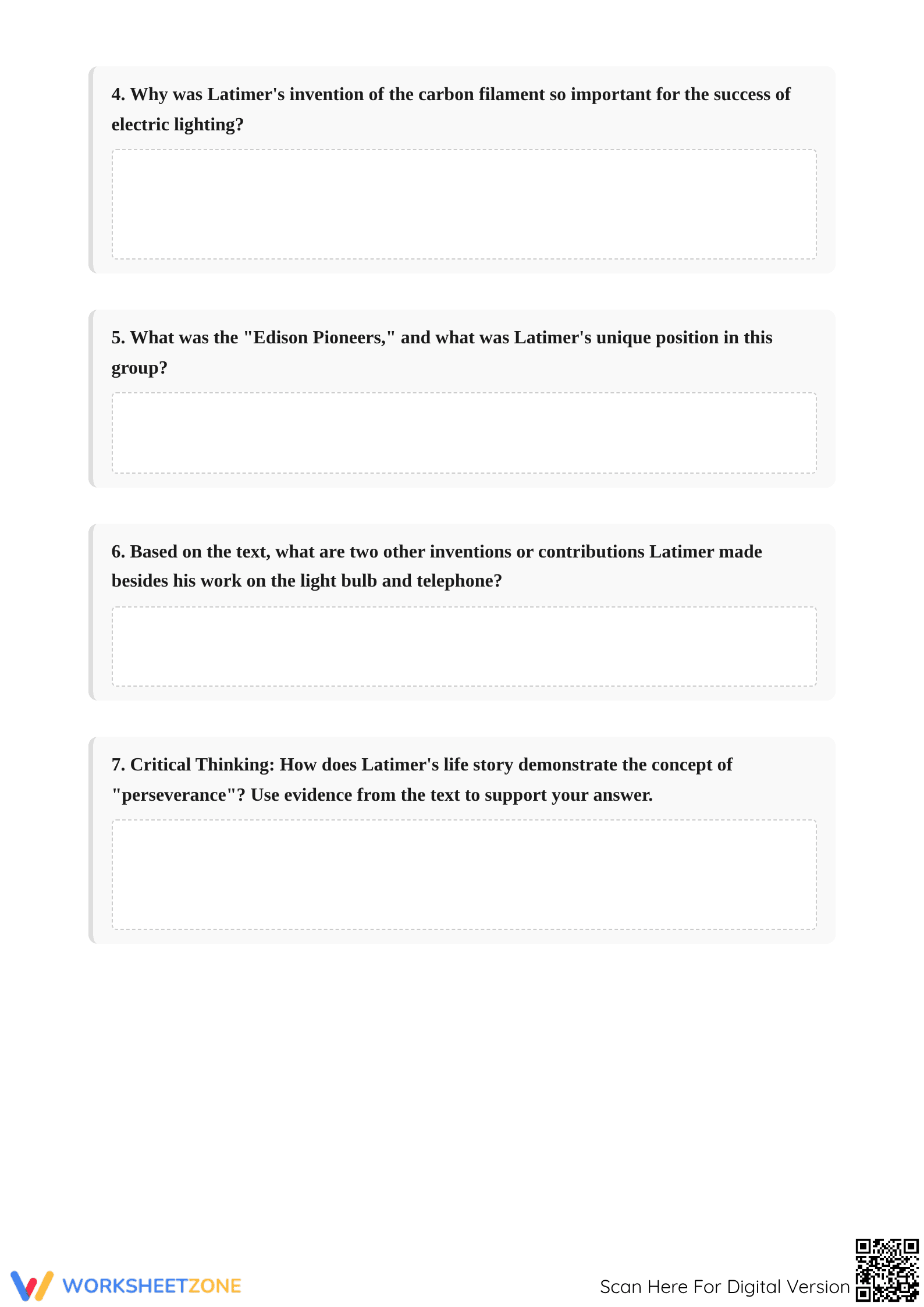
The resource includes a comprehensive two-page biographical passage covering Latimer’s early life, his service in the U.S. Navy, and his significant contributions to the light bulb and telephone patents. Following the text, students encounter 7 structured comprehension questions, including short-answer prompts and a critical thinking exercise. A full answer key is provided for efficient grading.
The task progression follows a gradual-release model to build student confidence. First, guided practice questions prompt learners to locate explicit details about Latimer’s birth and military background. Next, supported practice tasks require identifying specific skills he developed, such as mechanical drafting. Finally, independent practice concludes with a critical thinking prompt where students must synthesize evidence to define the concept of perseverance.
This worksheet is primarily aligned with `CCSS.ELA-LITERACY.RI.7.1`, focusing on citing several pieces of textual evidence to support analysis. It also supports RI.7.2 through the summarization of key events in a historical figure's life. Both standard codes can be copied directly into lesson plans, IEP goals, or district curriculum mapping tools.
Integrate this worksheet during a direct instruction lesson on Black inventors or as a standalone activity during Black History Month. For a formative assessment, observe whether students are pulling direct quotes or paraphrasing from the text to answer question 7. Expect most students to complete the reading and the 7-question set within a single 45-minute class period.
This resource is designed for Grade 7 students, though it is suitable for Grade 6–9 learners requiring informational text practice. It serves as an excellent pairing with a primary source document or an anchor chart on the light bulb's invention. The clear headings and manageable chunks of text provide natural support for diverse learners.
Educational research highlighted by the ScienceDirect TpT Analysis (2024) emphasizes that biographical texts serve as a critical bridge for middle school students to develop informational reading stamina. By focusing on Lewis Latimer, an African American inventor who overcame significant social barriers, this resource aligns with the pedagogical shift toward culturally responsive literacy instruction. The structured comprehension questions target CCSS.ELA-LITERACY.RI.7.1 by requiring students to extract specific textual evidence regarding Latimer’s military service, his collaboration with Alexander Graham Bell, and his invention of the carbon filament. Such evidence-based practice is essential for moving learners beyond surface-level recall into deep analysis and inference. Studies indicate that integrating historical figures into the English Language Arts curriculum improves engagement and retention of structural text features. This worksheet provides a rigorous yet accessible pathway for Grade 7 students to master the skill of citing several pieces of evidence to support their claims about complex historical narratives.


