


























Views
Downloads

Letter W Tracing Worksheet | Grade K Printable
Paste this activity's link or code into your existing LMS (Google Classroom, Canvas, Teams, Schoology, Moodle, etc.).
Students can open and work on the activity right away, with no student login required.
You'll still be able to track student progress and results from your teacher account.
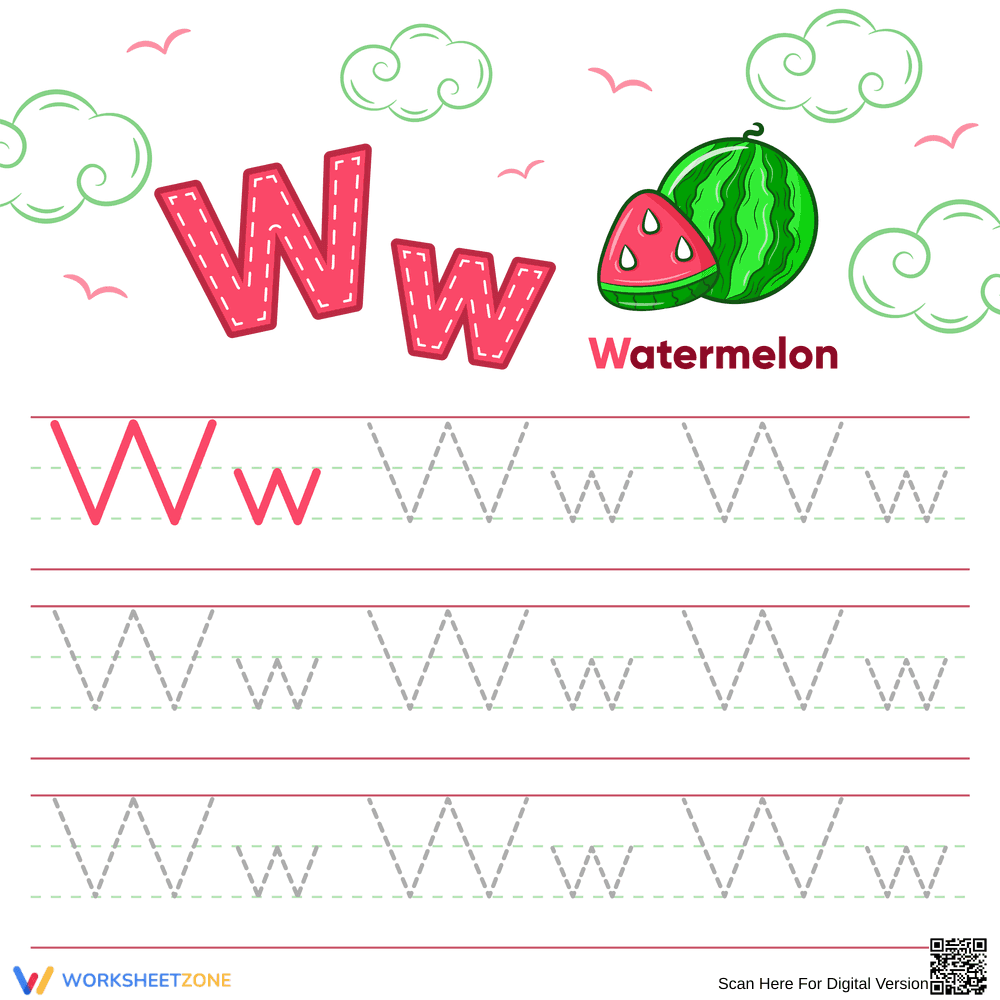
This printable Kindergarten handwriting worksheet provides focused practice for tracing the letter W. Students develop fine motor control and letter recognition by tracing both uppercase and lowercase forms alongside a fun watermelon theme. This resource builds foundational literacy skills essential for early reading and writing success.
At a Glance
- Grade: Kindergarten · Subject: English
- Standard:
CCSS.ELA-LITERACY.L.K.1.A— Print many upper- and lowercase letters- Skill Focus: Letter W Tracing
- Format: 1 page · 14 problems · No answer key needed · PDF
- Best For: Morning work or literacy centers
- Time: 5–10 minutes
Inside this single-page resource, educators will find three structured rows of handwriting practice. The page features a large, colorful watermelon illustration to anchor the phonetic sound of the letter W. Students begin with a solid example of the uppercase and lowercase letter pair, followed by 14 dashed tracing models that guide proper stroke order and proportion on standard primary lines.
Zero-Prep Workflow
This resource is designed for immediate classroom implementation with minimal teacher setup:
- Print (1 minute): Simply download the PDF and print the required number of copies. The clear black-and-white dashed lines print perfectly for student use.
- Distribute (1 minute): Hand out the worksheets during morning routines or place them in literacy center folders.
- Review (1 minute): Quickly check student work for proper letter formation and line adherence.
With a total prep time of under two minutes, this worksheet is an excellent addition to any emergency sub plan or quick transition activity.
Standards Alignment
This worksheet aligns directly with CCSS.ELA-LITERACY.L.K.1.A, requiring students to print many upper- and lowercase letters. By repeatedly tracing the letter W on guided primary lines, early learners build the muscle memory necessary for independent writing. This standard code can be copied directly into lesson plans, IEP goals, or district curriculum mapping tools.
How to Use It
This tracing sheet is highly versatile for early childhood classrooms. Use it as a morning bell-ringer activity to settle students into the day, or incorporate it into a dedicated alphabet station during literacy centers. As a formative assessment tip, observe students while they trace to ensure they are starting their strokes from the top line rather than the bottom. Expected completion time ranges from 5 to 10 minutes depending on the student's fine motor proficiency.
Who It's For
This resource is primarily designed for Kindergarten students mastering their alphabet and basic handwriting skills. It also serves as an effective intervention tool for first graders needing extra fine motor support or occupational therapy practice. For a complete lesson, pair this worksheet with a read-aloud book featuring words that start with W or a classroom anchor chart displaying summer fruits.
Developing automaticity in letter formation is a critical stepping stone for early literacy. According to Fisher & Frey (2014), providing students with targeted, repetitive practice on specific letters reduces cognitive load during later writing tasks, allowing young learners to focus on idea generation rather than mechanics. This worksheet directly supports CCSS.ELA-LITERACY.L.K.1.A by helping students print many upper- and lowercase letters with accuracy. The guided dashed lines offer the exact scaffolding needed to build confident writers. By isolating the letter W and pairing it with a recognizable phonetic anchor like a watermelon, educators can effectively bridge the gap between visual recognition and physical reproduction. Consistent use of structured tracing materials ensures that foundational handwriting skills are firmly established before students progress to complex word construction.


