


























Views
Downloads

Printable Letter M Beginning Sound Worksheet | Grade K
Paste this activity's link or code into your existing LMS (Google Classroom, Canvas, Teams, Schoology, Moodle, etc.).
Students can open and work on the activity right away, with no student login required.
You'll still be able to track student progress and results from your teacher account.
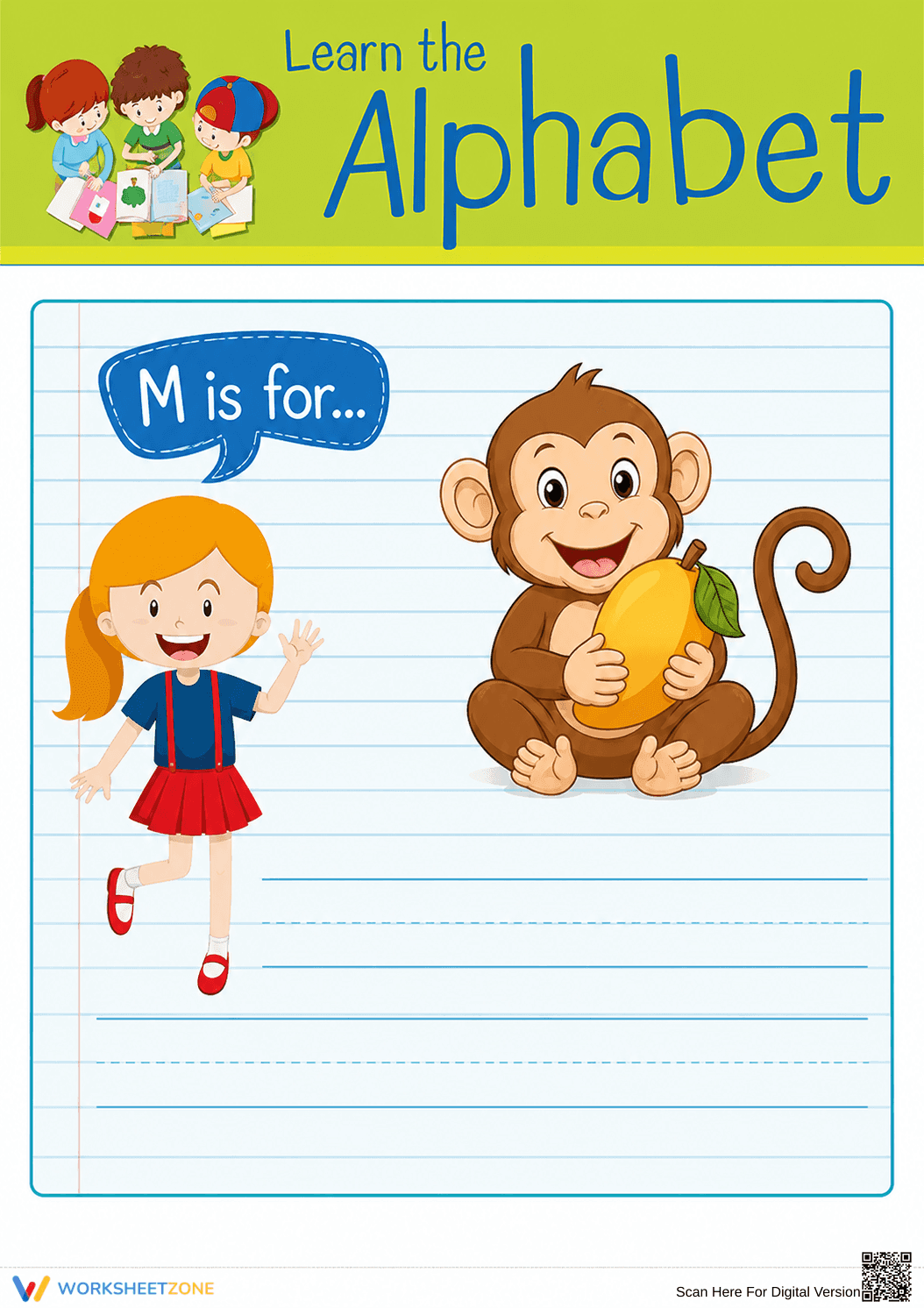
This printable Kindergarten phonics worksheet helps early readers master the beginning sound of the letter M while practicing proper handwriting formation. By connecting visual cues like a monkey and a mango to the target letter, students build essential phonemic awareness and strengthen their foundational literacy skills.
At a Glance
- Grade: K · Subject: ELA
- Standard:
CCSS.ELA-LITERACY.RF.K.3.A— Produce primary sounds for consonants- Skill Focus: Letter M Beginning Sound
- Format: 1 page · 3 handwriting lines · No answer key needed · PDF
- Best For: Independent phonics practice
- Time: 10–15 minutes
Inside this single-page resource, educators will find a highly visual layout designed for early learners. The top section features engaging illustrations of a monkey and a mango to reinforce the "M" sound contextually. Below the visual prompts, three primary-ruled handwriting lines provide ample space for students to practice writing the uppercase and lowercase letter M, or the featured vocabulary words.
This resource offers a streamlined zero-prep workflow.
- Print (30 seconds): Generate enough copies for your reading groups or whole class directly from the PDF file.
- Distribute (30 seconds): Hand out the sheets along with pencils or crayons. The visual instructions mean students understand the task instantly.
- Review (1 minute): Quickly check student letter formation and ask them to verbally identify the pictures to confirm sound recognition.
Total teacher prep time is under two minutes, making this an excellent option for morning work, literacy centers, or an emergency substitute teacher plan.
This worksheet is directly aligned to CCSS.ELA-LITERACY.RF.K.3.A: Demonstrate basic knowledge of one-to-one letter-sound correspondences by producing the primary sound or many of the most frequent sounds for each consonant. It also supports early writing standards by providing structured space for letter formation. Both standard codes can be copied directly into lesson plans, IEP goals, or district curriculum mapping tools.
Teachers can utilize this resource during morning arrival as a focused warm-up activity, or place it in a literacy center for independent reinforcement after direct instruction on the letter M. As a formative assessment observation tip, watch how students form their letters on the guided lines and listen to hear if they emphasize the /m/ sound when naming the monkey and mango. Expected completion time ranges from ten to fifteen minutes, depending on the student's fine motor development.
This material is ideal for Kindergarten students developing basic phonemic awareness and fine motor writing skills. For differentiation, teachers can challenge advanced learners to write the full words "monkey" or "mango" on the lines, while students needing extra support can focus solely on tracing or writing the single letter M. It pairs perfectly with an alphabet anchor chart or a read-aloud book featuring heavy alliteration of the target letter.
Developing strong phonemic awareness, specifically the ability to produce primary sounds for consonants, is a critical predictor of future reading success. According to an EdReports 2024 analysis, explicit instruction in letter-sound correspondence combined with immediate handwriting practice significantly improves retention in early learners. This resource targets the CCSS.ELA-LITERACY.RF.K.3.A standard by requiring students to connect the visual representation of the letter M with its phonetic sound. By integrating visual vocabulary cues with structured writing lines, the worksheet provides a multimodal approach to literacy. This ensures students recognize the letter, articulate its sound, and physically reproduce it, laying the groundwork for fluent decoding.


