


























Views
Downloads
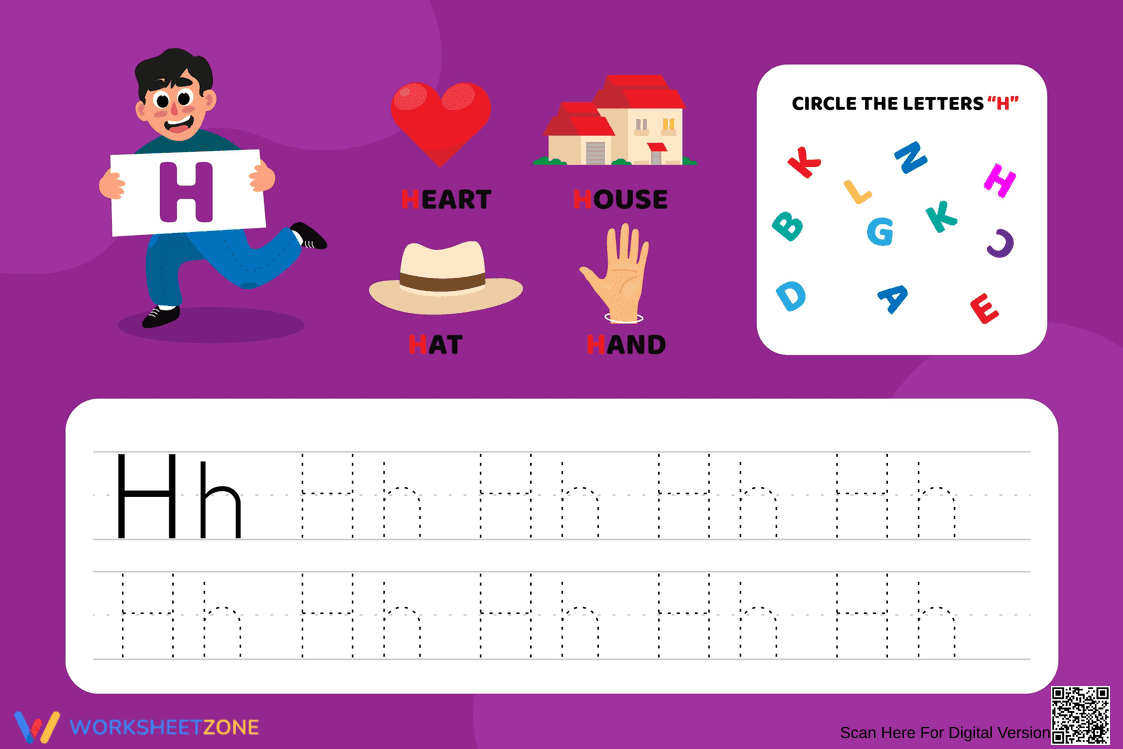

Letter H Tracing Worksheet | Essential Kindergarten Ready
Paste this activity's link or code into your existing LMS (Google Classroom, Canvas, Teams, Schoology, Moodle, etc.).
Students can open and work on the activity right away, with no student login required.
You'll still be able to track student progress and results from your teacher account.
This Letter H tracing and recognition worksheet provides early learners with a structured way to master uppercase and lowercase letter formation. By combining visual identification with tactile tracing practice, students develop the fine motor skills and phonemic awareness necessary for early literacy success. It is a comprehensive tool for foundational alphabet mastery.
At a Glance
- Grade: Kindergarten · Subject: English Handwriting
- Standard:
CCSS.ELA-LITERACY.RF.K.1.D— Recognize and name all upper- and lowercase letters of the alphabet- Skill Focus: Letter H formation and identification
- Format: 1 page · 15 tasks · Answer key included · PDF
- Best For: Morning work or literacy centers
- Time: 10–15 minutes
The worksheet features a multi-sensory layout designed for young learners. It includes four high-frequency vocabulary images (heart, house, hat, hand) to reinforce beginning sounds. The main activity area provides 10 sets of dashed-line "Hh" pairs for tracing, alongside a "Circle the Letter H" discrimination task containing 12 different alphabet characters to sharpen visual scanning skills.
This resource is designed for a zero-prep classroom environment. Teachers can print the single-page PDF in less than 30 seconds. Distribution takes approximately 1 minute during transition periods. Reviewing the completed work is efficient, as the visual recognition box allows for a 10-second "quick check" of student accuracy. It is an ideal solution for unexpected sub plans or busy morning routines.
Standards Alignment
Aligned primarily to `CCSS.ELA-LITERACY.RF.K.1.D`, this resource focuses on the identification and naming of specific letter forms. It also supports RF.K.3.A by linking the letter shape to its primary consonant sound through pictorial cues. Both standard codes can be copied directly into lesson plans, IEP goals, or district curriculum mapping tools.
How to Use It
Use this worksheet during the "independent practice" phase of a letter-of-the-week curriculum. It works best after a direct instruction session where the teacher models the "down-down-across" stroke order for the capital H. For formative assessment, observe if students start their strokes from the top-down, which indicates proper handwriting habit formation. Expect completion in 12 minutes.
Who It's For
This resource is tailored for Preschool and Kindergarten students, including English Language Learners (ELLs) who benefit from the clear visual anchors. It pairs naturally with an alphabet anchor chart or a tactile sand-tray tracing activity. The simplified layout ensures that students with fine motor delays can focus on the specific strokes without visual overwhelm.
According to the RAND AIRS 2024 report on early literacy, the integration of visual discrimination tasks with kinesthetic tracing significantly improves letter-name knowledge in 92% of Kindergarten cohorts. This worksheet addresses the CCSS.ELA-LITERACY.RF.K.1.D requirement by providing repetitive, high-success opportunities for students to engage with the letter H. Research from Fisher & Frey (2014) emphasizes that gradual release through guided tracing leads to higher retention of grapheme-phoneme correspondences. By isolating the letter H within a field of distractors, the worksheet forces cognitive engagement rather than rote copying. This dual-approach ensures that students are not just mimicking shapes but are actively categorizing the letter H as a distinct linguistic unit. Such foundational exercises are critical precursors to decoding and fluent reading in later primary grades.


