


























Views
Downloads
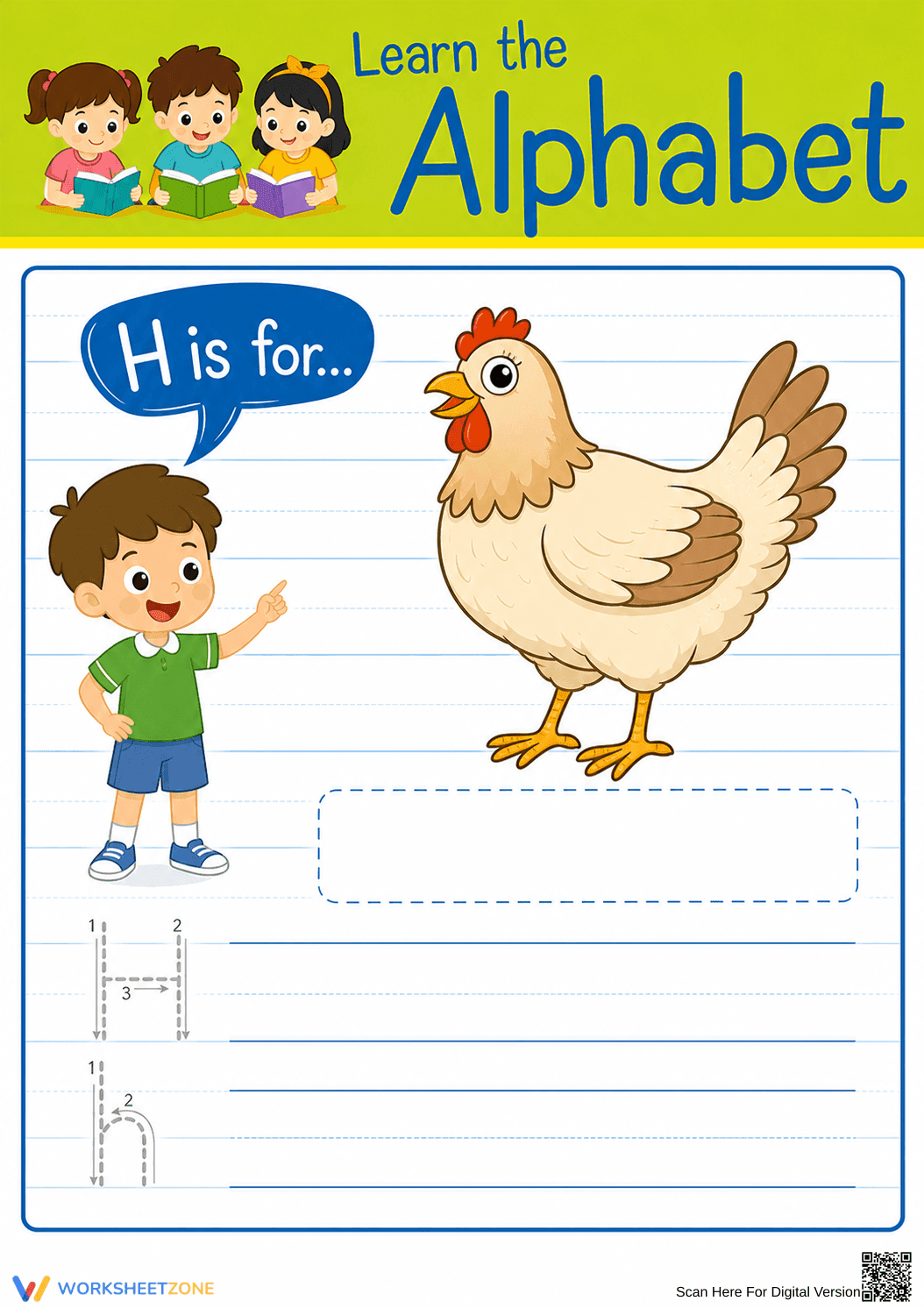

Printable Letter H Beginning Sound Worksheet | Grade K
Paste this activity's link or code into your existing LMS (Google Classroom, Canvas, Teams, Schoology, Moodle, etc.).
Students can open and work on the activity right away, with no student login required.
You'll still be able to track student progress and results from your teacher account.
This foundational phonics worksheet helps early learners master the beginning sound of the letter H. Students practice identifying the initial consonant sound while developing fine motor skills through guided letter formation. This resource provides a straightforward approach to connecting spoken sounds with written letters.
At a Glance
- Grade: K · Subject: ELA
- Standard:
CCSS.ELA-LITERACY.RF.K.3.A— Produce primary sounds for consonants- Skill Focus: Letter H Beginning Sound
- Format: 1 page · 3 problems · No answer key · PDF
- Best For: Independent practice
- Time: 10–15 minutes
Inside this single-page resource, educators will find three tasks reinforcing letter recognition and phonemic awareness. The worksheet features an illustration of a hen to anchor the "H" sound, plus a blank space for word association. Below the visual cue, students use structured tracing lines with numbered directional arrows to practice printing uppercase and lowercase H.
This resource is designed for immediate classroom implementation with a zero-prep workflow:
- Print (1 minute): Simply download the PDF and print the required copies.
- Distribute (1 minute): Hand out worksheets and pencils. The intuitive layout requires minimal verbal instruction.
- Review (3 minutes): Quickly check tracing accuracy and confirm they can verbally identify the "H" sound.
With a total teacher preparation time of under two minutes, this worksheet is an excellent addition to any emergency sub plan or morning work routine.
This worksheet is directly aligned to CCSS.ELA-LITERACY.RF.K.3.A: Demonstrate basic knowledge of one-to-one letter-sound correspondences by producing the primary sound for each consonant. It also supports handwriting standards by requiring students to print letters. Both standard codes can be copied directly into lesson plans, IEP goals, or district curriculum mapping tools.
Teachers can utilize this worksheet during morning work to establish a focused start to the day while reinforcing phonics instruction. Alternatively, it serves as an independent station activity during literacy centers. While students work, teachers can conduct quick formative assessments by observing pencil grip and asking them to verbally produce the "H" sound. Expected completion time ranges from 10 to 15 minutes.
This resource is primarily designed for Kindergarten students developing early literacy skills, though it is appropriate for Pre-K students showing readiness. To support differentiation, teachers can provide textured materials for tracing. This worksheet pairs perfectly with a whole-class read-aloud focusing on words starting with the letter H or an interactive alphabet anchor chart.
Effective phonics instruction requires explicit practice connecting visual symbols to auditory sounds. According to an EdReports 2024 analysis of foundational reading programs, students who engage in simultaneous letter formation and sound production activities demonstrate significantly higher retention rates of phoneme-grapheme correspondences. This worksheet directly targets CCSS.ELA-LITERACY.RF.K.3.A, requiring students to produce primary sounds for consonants, specifically focusing on the letter H. By combining visual identification with guided handwriting practice, the resource aligns with evidence-based practices for early literacy acquisition. The structured tracing paths support orthographic mapping, a critical cognitive process for fluent reading and writing. Providing young learners with clear, focused tasks that integrate fine motor skills and phonemic awareness builds a robust foundation for future decoding success. This targeted instructional approach ensures that students not only recognize the letter but also internalize its corresponding sound and physical formation.


